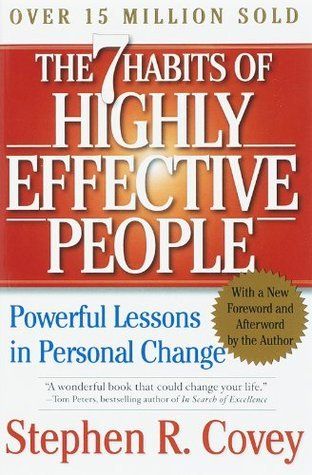
7 Habits of Highly Effective People Book Summary
Powerful Lessons in Personal Change
Book by Stephen Covey
Summary
The 7 Habits of Highly Effective People is a powerful framework for personal and interpersonal growth, teaching principles of character, vision, integrity, collaboration, communication, and renewal. By adopting these habits, readers learn to take proactive charge of their lives and continually invest in their greatest asset - themselves.
1. Paradigms and Principles
The Key To Success Lies Within
In the opening section, Covey explains that achieving lasting success and happiness requires looking inward rather than seeking quick-fix solutions. He argues that real change and growth come from examining and adjusting our own character, paradigms and motives. This "inside-out" approach is more difficult than just treating symptoms, but leads to deeper, more meaningful improvement.
Section: 1, Chapter: 1
Paradigms: The Lenses We See The World Through
Covey defines a paradigm as the lens or map through which we interpret the world. Our paradigms are often unconscious but profoundly shape how we perceive and interact with reality.
- We can have paradigms about ourselves, others, and life in general
- Paradigms can be accurate or inaccurate representations of reality
- Faulty paradigms lead us to misinterpret situations and interact ineffectively
- Shifting to more accurate paradigms allows us to see the world more objectively and make better choices
Section: 1, Chapter: 2
Which Glasses Are You Wearing?
Covey shares an impactful example of how paradigms shape perception. He presents the famous optical illusion showing both a young woman and an old woman.
Depending on their initial paradigm, people only see one woman or the other at first. Even when guided to look for the other woman, many struggle to shift their perception. It's only when they persist in changing their mental frame of reference that they can finally see the other image.
This demonstrates how powerfully our paradigms filter reality and how difficult it can be to see things from a different perspective, even when that perspective is clearly pointed out to us.
Section: 1, Chapter: 2
Personality vs Character Ethics
Covey argues that there are two contrasting approaches to success - the "personality ethic" and the "character ethic."
The personality ethic focuses on:
- Developing superficial skills and techniques
- Public image and seeking to influence others' perceptions
- Short-term thinking and treating symptoms rather than root causes
In contrast, the character ethic prioritizes:
- Inner growth and aligning actions with universal principles
- Authenticity and staying true to one's deepest values
- Long-term development and addressing underlying drivers of effectiveness
While aspects of the personality ethic can be beneficial, Covey asserts that neglecting character in favor of personality ultimately leads to unsustainable, unsatisfying "success."
Section: 1, Chapter: 2
2. Private Victory
Habit 1: Being Proactive Is The Foundation Of Effectiveness
Covey describes proactivity as the first and most basic habit of highly effective people. Being proactive means:
- Taking responsibility for your life and choices, rather than blaming circumstances or others
- Focusing your time and energy on what you can control (your Circle of Influence) rather than worrying about things you can't (your Circle of Concern)
- Taking the initiative to make things happen instead of waiting to react to external events
- Listening to your inner values and making value-based choices rather than getting caught up in moods or impulses
Proactive people shape their own lives; reactive people are shaped by external forces. Developing proactivity is essential because the other habits depend on the ability to act based on principle rather than reacting to circumstance.
Section: 2, Chapter: 3
"The Most Important Investment We Can Make Is In Ourselves"
"The most important investment we can ever make in life - investment in ourselves, in the only instrument we have with which to deal with life and to contribute."
Section: 2, Chapter: 3
Writing A Personal Mission Statement
Habit 2: Being with the End in Mind.
To begin implementing Habit 2, set aside time to work on crafting your personal mission statement. This process allows you to define success for yourself and outline your unique principles and priorities. Covey recommends including:
- Character traits you want to embody and values you want to exemplify
- Contributions and achievements you want to focus on in various roles (family, work, community, etc.)
- A statement of purpose - what you want to accomplish and the impact you want to have
A good mission statement serves as your personal constitution - a stable inner compass to guide your decisions and actions. It's essential to invest in developing your mission statement since it becomes the foundation for the other habits.
Section: 2, Chapter: 4
All Things Are Created Twice
A core concept from Habit 2 is that all things are created twice - first mentally, then physically. For example:
- A building is constructed twice - first through architecture plans, then through actual materials
- A company is built twice - first in a business plan, then in actual operations
The same concept applies to our personal lives and goals. Taking time to mentally create your life is key to achieving the outcomes you desire. If you don't make a conscious effort to visualize who you are and what you want, you risk letting others and circumstances determine your life by default.
By developing a mission statement and envisioning success as described in Habit 2, you take charge of your own first creation. Managing from this blueprint allows you to more effectively handle the second creation - the actual experience.
Section: 2, Chapter: 4
3. Public Victory
4. Renewal
Related Content
Atomic Habits Book Summary
James Clear
Atomic Habits reveals the surprising power of small habits, demonstrating how tiny changes can compound into remarkable results over time. By focusing on systems over goals and building identity-based habits, you can create lasting change and unlock your full potential.
Atomic Habits reveals the surprising power of small habits, demonstrating how tiny changes can compound into remarkable results over time. By focusing on systems over goals and building identity-based habits, you can create lasting change and unlock your full potential.
Productivity
Personal Development
Psychology