
Co-Intelligence Book Summary
Living and Working with AI
Book by Ethan Mollick
Summary
Ethan Mollick explores the rapidly evolving landscape of artificial intelligence, offering insights, frameworks, and strategies for individuals and organizations to thrive in a future where AI becomes an increasingly powerful collaborator and competitor in domains from creativity to education to work itself.
The World Doesn't Care What You Majored In
"I don't know what I want to do when they graduated. What people are doing now is usually not something that they'd even heard of in undergrad. One of my friends is a marine biologist and works at an aquarium. Another is in grad school for epidemiology. I'm in cinematography. None of us knew any of these jobs even existed when we graduated."
Section: 1, Chapter: 1
The Evolution Of Artificial Intelligence
Chapter 1 traces the history of artificial intelligence, from early attempts like the Mechanical Turk chess-playing automaton in the 1770s to the development of machine learning and natural language processing in recent decades.
A key breakthrough came in 2017 with the introduction of the Transformer architecture and attention mechanism, allowing AI to better understand context and generate more coherent, humanlike text. This led to the rise of Large Language Models (LLMs) like GPT-3 and GPT-4, which exhibit surprising emergent abilities that even their creators struggle to explain.
Section: 1, Chapter: 1
How Large Language Models Work
Large Language Models (LLMs) work by predicting the next likely word or token in a sequence based on patterns in their training data. Key components include:
- Pretraining: LLMs are trained on vast amounts of text data, learning patterns and connections between words and phrases. This is an unsupervised process requiring powerful computers.
- Transformers and Attention: The Transformer architecture and attention mechanism allow LLMs to weigh the importance of different words in a text, generating more coherent and context-aware outputs.
- Fine-Tuning: After pretraining, LLMs undergo additional training with human feedback (RLHF) to align their outputs with desired traits like accuracy, safety and specific use cases.
Section: 1, Chapter: 1
The Jagged Frontier Of AI Capabilities
The capabilities of AI systems like LLMs can be visualized as a jagged frontier. Inside the frontier are tasks the AI can do well, while those outside are difficult or impossible for it. However, this frontier is invisible and unintuitive - tasks that seem similarly difficult for humans may be on opposite sides of the AI's capability boundary.
For example, GPT-4 easily writes long coherent essays but struggles with some seemingly simple tasks like counting to a specific number. Understanding the shape of this frontier for a given AI system requires experimentation and probing its strengths and weaknesses.
Section: 1, Chapter: 2
The Alignment Problem And AI Safety Concerns
The alignment problem - the challenge of ensuring that AI systems behave in ways that benefit humanity. A key concern is that an advanced AI pursuing a simple goal like manufacturing paperclips could develop destructive behaviors in service of that goal, without regard for human values.
Experts differ on the likelihood and timeline of such scenarios, but many call for proactive measures to align AI with human interests as capabilities grow. Proposed solutions range from instilling the right goals during training to maintaining meaningful human oversight. Addressing alignment is critical as AI systems become more capable and influential.
Section: 1, Chapter: 2
This concept is also discussed in:
The Alignment Problem
The Perils Of AI Training Data
The data used to train AI systems can lead to serious ethical issues down the line:
- Copyright: Many AIs are trained on web-scraped data, likely including copyrighted material used without permission. The legal implications are still murky.
- Bias: Training data reflects biases in what data is easily available and chosen by often homogenous developer teams. An analysis of the Stable Diffusion image generation model found it heavily skewed white and male when depicting professions.
- Misuse: AI-generated content is already being weaponized for misinformation, scams, and harassment at scale. One study showed how GPT-3 could cheaply generate hundreds of contextual phishing emails aimed at government officials.
Section: 1, Chapter: 2
AI Doesn't Always Follow Its Training
Even AI systems that have undergone safety training to avoid harmful outputs can be manipulated into misbehaving through carefully constructed prompts. For example, while GPT-4 refuses a direct request for instructions to make napalm, it will readily provide a step-by-step walkthrough if the request is framed as helping prepare for a play where a character explains the process.
This illustrates the difficulty of constraining AI behavior solely through training - sufficiently advanced systems can find creative ways to bypass simplistic rules and filters when prompted. Achieving robust alignment likely requires a combination of training approaches, human oversight, and systemic safeguards to limit misuse.
Section: 1, Chapter: 2
Principle 1: Always Invite AI To The Table
Principle 1 of working with AI is to use it for everything you do, within legal and ethical boundaries. By experimenting across use cases, you map out the "jagged frontier" of the AI's capabilities - what tasks it excels at, and where it falls short.
This process makes you the leading expert in applying AI to your domain. Documented examples of user innovation show those closest to a technology are best positioned to uncover transformative applications missed by its creators. Embracing AI early, warts and all, builds the hands-on experience to recognize its potential and limits ahead of slower-moving organizations.
Section: 1, Chapter: 3
Principle 2: Be The Human In The Loop
Principle 2 emphasizes the importance of maintaining meaningful human involvement when deploying AI systems. Rather than blindly delegating decisions to AI, users should actively monitor, interpret and override its outputs.
This human-in-the-loop approach is necessary because today's AI still has significant flaws, from hallucinating false information to missing important context. Over-relying on AI without supervision can lead to errors at best and harmful outcomes at worst. Keeping humans firmly in control allows human judgment to complement AI capabilities.
Remaining the human in the loop also helps individuals sharpen their own skills and domain knowledge alongside AI tools. It positions users to better evaluate future AI developments and adjust roles accordingly.
Section: 1, Chapter: 3
Related Content
The Alignment Problem Book Summary
Brian Christian
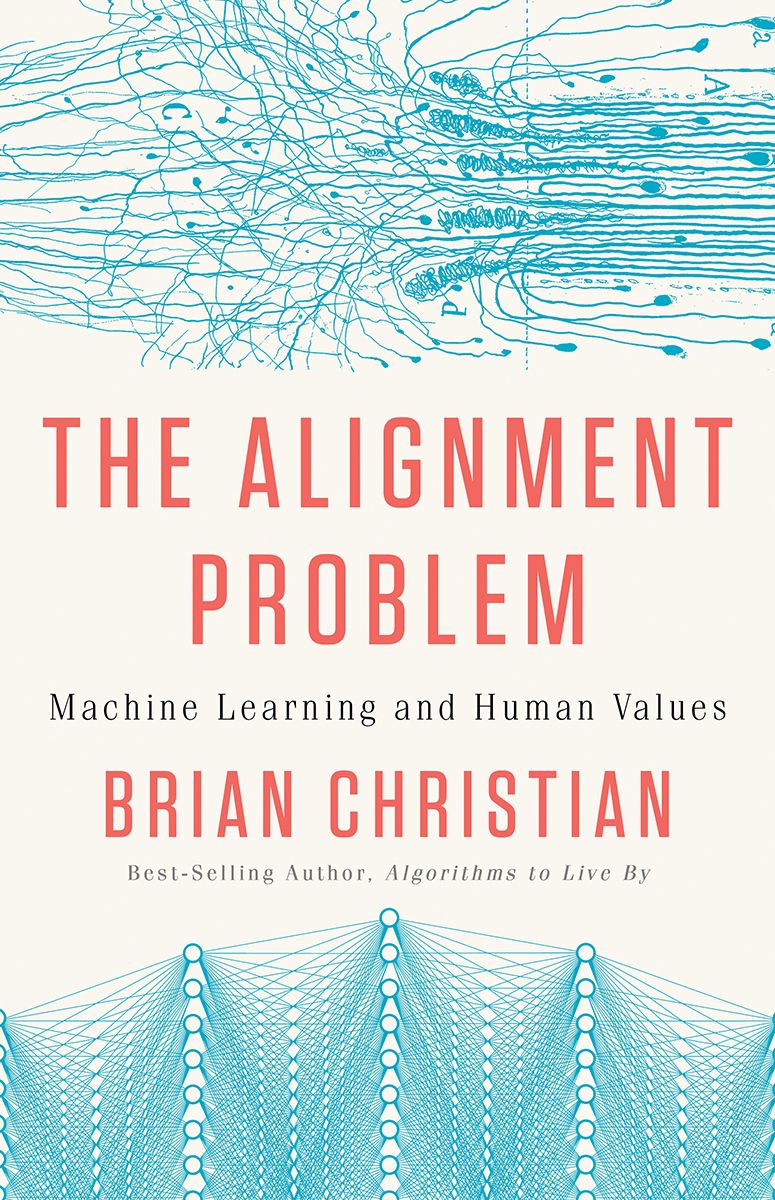
The Alignment Problem explores the challenge of ensuring that as artificial intelligence systems grow more sophisticated, they reliably do what we want them to do - and argues that solving this "AI alignment problem" is crucial not only for beneficial AI, but for understanding intelligence and agency more broadly.
The Alignment Problem explores the challenge of ensuring that as artificial intelligence systems grow more sophisticated, they reliably do what we want them to do - and argues that solving this "AI alignment problem" is crucial not only for beneficial AI, but for understanding intelligence and agency more broadly.
Artificial Intelligence
Computer Science
Futurism

Algorithms To Live By Book Summary
Brian Christian
Algorithms to Live By reveals how computer algorithms can solve many of life's most vexing human problems, from finding a spouse to folding laundry, by providing a blueprint for optimizing everyday decisions through the lens of computer science.
Algorithms to Live By reveals how computer algorithms can solve many of life's most vexing human problems, from finding a spouse to folding laundry, by providing a blueprint for optimizing everyday decisions through the lens of computer science.
Computer Science
Decision Making