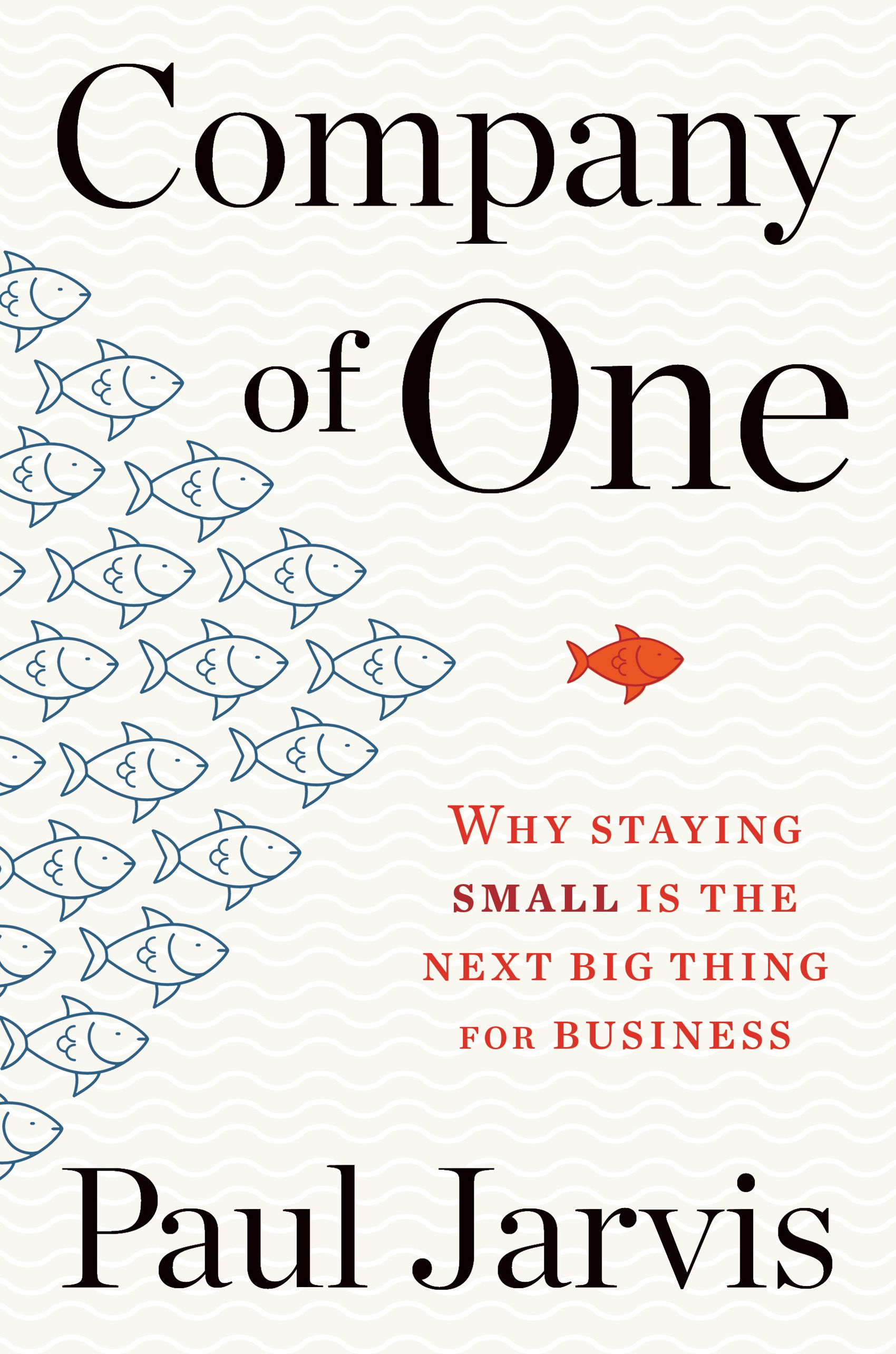
Company Of One Book Summary
Why Staying Small Is the Next Big Thing for Business
Book by Paul Jarvis
Feeling Lazy?Read 1 Minute Summary
Summary
In "Company of One," Paul Jarvis makes a compelling case for staying small and questioning growth in business, arguing that by staying lean, agile, and customer-focused, you can build a sustainable and fulfilling business on your own terms.
1. Begin
Companies of One Question Growth
A company of one is a business that questions the assumption that growth is always good. Instead, it focuses on being better rather than just bigger. Key traits include resilience, autonomy, speed, and simplicity. Companies of one can be solo entrepreneurs, small businesses, or even self-directed teams within larger organizations.
The focus is on making considered decisions about growth based on specific goals and values, not pursuit of growth for its own sake. Prioritizing profits over scalability. Retaining freedom to adapt and change course quickly. Keeping things as simple as possible by avoiding unnecessary complexity. A company of one aims to do great work and serve customers excellently, even if it means staying small.
Section: 1, Chapter: 1
The Four Key Traits of Companies of One
The central argument of "Company of One" is that staying small is a viable alternative to the standard "go big or go home" approach to entrepreneurship. Technology has made it easier than ever to automate and outsource aspects of running a business, so a small team or even a solo founder can have huge impact and reach. Some key advantages:
- Resilience - The ability to recover from difficulties and adapt to change. Having multiple skills and not relying on a single customer.
- Autonomy - The freedom and control to make your own choices. Mastering a valuable skill set to work independently.
- Speed - The agility to change course quickly if needed. Using constraints creatively. Avoiding bureaucracy.
- Simplicity - Focusing on core essentials, avoiding unnecessary complexity. Iterating to make things simpler over time.
Section: 1, Chapter: 1
The Dark Side of Entrepreneurship
The common advice that entrepreneurs need to be constantly "hustling" and sacrificing everything for their business is misguided. Studies show workaholics are no more productive, just more stressed. Leaders should avoid this "hustlin'" mentality and the implication that overwork equals success. Instead, focus on working smarter in condensed periods of high productivity. Build in time for rest and recovery. Your business should fit your desired lifestyle, not consume your entire life.
Section: 1, Chapter: 1
Chasing Growth At All Costs is the Main Reason Startups Fail
Multiple studies, including by the Startup Genome Project and the Kauffman Foundation, found that premature scaling and growth was the primary reason over 70% of startups failed. For example, startups would spend money and resources based on hoped-for future revenue, rather than actual profit. When the projected growth didn't materialize, the companies would implode, resulting in layoffs and bankruptcy. Growth can't be an end in itself - it must be based on real profit and sustainability.
Section: 1, Chapter: 2
Envy - The Hidden Driver of Business Growth
Much of the obsession with growing businesses as big as possible stems from ego and envy, not smart strategy. We see other large, successful companies and assume growth is the only way to respect and clout. But comparisons are misleading - you don't see behind the scenes, only the shiny exterior.
Instead, use envy as a tool to identify what truly matters to you. If you envy a company's profits or impact, focus on improving those things sustainably, not just getting bigger overall. Don't let ego drive irrational growth. Stay true to your own definition of "enough."
Section: 1, Chapter: 2
Growth Should Have an Upper Limit
In the 1990s, as most airlines struggled, over 100 cities begged Southwest Airlines to expand to their airports. Southwest turned down 95% of the offers and started serving only 4 new locations. They wanted sustainable growth with an upper limit, not growth at any cost.
Setting upper bounds works because there's a point of diminishing returns, where more growth doesn't improve quality of life. Identify "enough" profits and customers for your business. Don't assume more is always better. Grow slowly and intentionally like Southwest, not in an unsustainable rush.
Section: 1, Chapter: 2
Introverts Can Be Highly Effective Leaders
The stereotypical brash, dominant, extroverted leader is not the only model. Studies show introverted leaders can be very successful, especially with proactive teams. Introverts tend to listen carefully, focus deeply, and provide autonomy.
For example, Mark Zuckerberg leverages his introversion to build genuine relationships with key team members and acquihires. He empowers them with trust and autonomy rather than constant oversight. Introverts should lean into their natural strengths and collaborate with extroverted colleagues to balance things out.
Section: 1, Chapter: 3
Companies of One Need Well-Rounded Generalists
Unlike specialist corporate workers utilizing a single skill, leaders of companies of one need a generalist skill set across multiple domains:
- Psychology - Understanding customer and team motivations and decision making
- Communication - Writing clear emails, documents and presentations
- Resilience - Bouncing back from adversity and maintaining optimism
- Focus - Saying no and avoiding distractions to focus on priorities
- Decisiveness - Making smart choices quickly without getting overwhelmed
Section: 1, Chapter: 3
Most Businesses Grow For the Wrong Reasons
There are four main reasons most businesses pursue growth from the start:
- Inflation - Rising costs over time
- Investors - Pressure from VCs/funders for 10X returns
- Churn - Need to replace leaving customers with new ones
- Ego - Craving respect and status of a big company
But early stage companies can avoid these pressures. Don't take investor money if possible. Build loyalty so churn isn't an issue. Fight ego-driven urges. Have a realistic strategy focusing on sustainable profits, not just growth itself.
Section: 1, Chapter: 4
Find the Smallest Way to Solve a Real Problem
When starting out, don't get caught up in building complex infrastructure, hiring staff, getting offices, etc. Instead, identify the core problem you want to solve. What solution could you provide to a single customer right now, with the bare minimum of resources?
For example, designer Paul Jarvis started getting clients by simply emailing his network, offering his skills. Crew started by manually matching clients and freelancers, then automated only after proving out demand. Start tiny, prove your concept, then slowly expand only as needed to better serve customers. Premature scaling is the enemy.
Section: 1, Chapter: 4
Redefining Goals: Aim For "Minimum Viable Profit"
For a company of one, the key financial goal in the early days should be reaching "minimum viable profit" as quickly as possible. This means generating enough profit to:
- Cover your basic living expenses
- Reinvest in the business's growth
- Build up some savings as a cushion
Minimum viable profit will look different for everyone depending on lifestyle and business model. But generally the lower it is, the faster you can reach it and start building on that base. Some tips for getting to profitability quickly:
- Keep expenses as low as possible by only spending on essentials
- Maintain a separate job or consulting income as long as needed
- Secure advance payments or retainers from clients to improve cash flow
- Focus on selling one product/service at healthy margins to a clear niche
- Resist urge to scale up staff, office space, inventory until absolutely necessary
Section: 1, Chapter: 4
"Profit Is Sanity, Revenue Is Vanity"
"Profit, not revenue, is what matters. Revenue is often thought of as the top line, the "gross sales" a company has made in a year, yet what really matters is how much of that money is left after all the bills are paid—that's profit... Focusing on profit from day one sets you up for long-term stability."
Section: 1, Chapter: 4
Rethinking Career Growth For Companies Of One
In a traditional corporate career path, "success" means managing more and more people over time. Your scope of responsibility grows, but you often get further away from the craft you love. Companies of one need an alternate model for advancement that doesn't require endless team expansion.
Buffer has pioneered a clever framework for progression without direct reports:
- Scope of Influence - Master your core skill at increasing levels of impact, from individual work to team-wide to company-wide to industry-wide contribution.
- Ownership - Take on more responsibility and strategic importance over your domain. Progress from executing tasks to owning projects to shaping entire functions.
The takeaway is to redefine advancement in terms of mastery, impact and ownership - not raw headcount. You can evolve in your role and compensation without the added overhead.
Section: 1, Chapter: 4