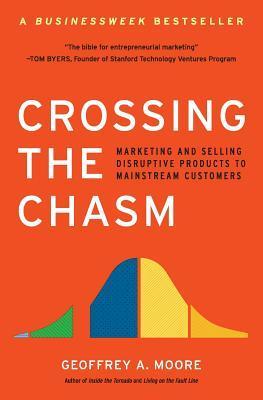
Crossing the Chasm Book Summary
Marketing and Selling High-Tech Products to Mainstream Customers
Book by Geoffrey Moore
Summary
"Crossing the Chasm" unveils the hidden challenges of launching disruptive technologies and provides a proven roadmap for navigating the treacherous gap between early adopters and mainstream markets, enabling companies to achieve market leadership and sustainable growth.
Discovering the Chasm
Part 1 of "Crossing the Chasm" introduces the challenges and pitfalls associated with bringing disruptive, high-tech products to mainstream markets. It exposes the limitations of the traditional technology adoption lifecycle model, which assumes a smooth, continuous progression from early adopters to the majority. Instead, Moore identifies a critical gap, the "chasm," that separates visionary early adopters from the pragmatic early majority. This chasm arises due to the fundamental differences in their expectations, risk tolerance, and decision-making criteria. Early adopters embrace disruptive innovation for its potential, while the early majority seeks proven, practical solutions with established references and support.
Part 1 delves into the psychographics of each customer segment within the technology adoption lifecycle, providing insights into their motivations and behaviors. By understanding these distinctions, companies can develop targeted marketing strategies to bridge the chasm and achieve mainstream market success.
The High-Tech Marketing Model: A Flawed Assumption
Chapter 1 delves into the Technology Adoption Life Cycle, a model that describes the different stages of technology adoption based on the psychological and social profiles of consumer groups:
Innovators: Technology enthusiasts who pursue new technology products aggressively and are willing to experiment with early-stage products.
Early Adopters: Visionaries who see the potential of new technology and are willing to take risks to gain a competitive advantage.
Early Majority: Pragmatists who wait for technology to become more established and proven before adopting it.
Late Majority: Conservatives who are more risk-averse and adopt technology only when it has become a mature and widely accepted standard.
Laggards: Skeptics who are resistant to new technology and adopt it only when necessary.
The High-Tech Marketing Model, derived from this life cycle, suggests a smooth progression through these stages, leading to market dominance and profitability. However, the book argues that this model is flawed due to the presence of gaps between these stages, particularly the significant “chasm” between Early Adopters (visionaries) and the Early Majority (pragmatists). This chasm arises due to the inherent differences in their expectations and priorities, making it difficult for companies to leverage early success with visionaries to win over the pragmatic majority.
Section: 1, Chapter: 1
The Chasm: A Graveyard of High-Tech Ventures
Take the examples of products that have failed to cross the chasm, such as Segways and Iridium satellite phones. These products initially gained traction with early adopters due to their innovative technology but failed to resonate with the pragmatic majority due to limitations and lack of infrastructure. Segways, for example, faced the challenge of stairs, limiting their practicality for everyday use. Iridium, with its bulky handsets and high subscription costs, struggled to compete with the convenience and affordability of cellular phones.
Section: 1, Chapter: 1
Early Market: Where Enthusiasm Meets Vision
Chapter 2 focuses on understanding the dynamics of early and mainstream markets. The early market is characterized by the presence of technology enthusiasts and visionaries. Technology enthusiasts are driven by the technology itself and are willing to overlook flaws and limitations in exchange for being at the forefront of innovation. Visionaries, on the other hand, seek a strategic leap forward and are willing to take risks with unproven technology to achieve breakthrough results. The early market is often fueled by project-based sales, where companies customize their offerings to meet the specific needs of visionary customers.
Section: 1, Chapter: 2
Why do companies Fail to Cross the Chasm?
"The real news, however, is not the two cracks in the bell curve, the one between the innovators and the early adopters, the other between the early and late majority. No, the real news is the deep and dividing chasm that separates the early adopters from the early majority. This is by far the most formidable and unforgiving transition in the Technology Adoption Life Cycle, and it is all the more dangerous because it typically goes unrecognized."
- Geoffrey Moore
Section: 1, Chapter: 1
Mainstream Market: The Realm of the Pragmatists
Mainstream markets, in contrast, are dominated by the pragmatic majority and conservatives. Pragmatists seek incremental improvements, prioritize practicality and reliability, and rely heavily on references and established standards. They are more price-sensitive and prefer complete solutions that require minimal effort to adopt and integrate. Conservatives are even more risk-averse and tend to adopt technology only when it has become a mature and widely accepted standard.
Section: 1, Chapter: 2
Why Visionaries are a Poor Fit for the Mainstream Market
Visionaries lack respect for the value of colleagues' experiences: They see themselves as pioneers and are less concerned with established practices and references, which are crucial for pragmatists.
Visionaries take a greater interest in technology than in their industry: They are more focused on the potential of the technology itself, while pragmatists prioritize solutions that address specific industry needs and challenges.
Visionaries fail to acknowledge the importance of existing product infrastructure: They are willing to build systems from scratch, while pragmatists prefer solutions that integrate seamlessly with their existing infrastructure.
Visionaries have little self-awareness about the impact of their disruptiveness: Their willingness to challenge the status quo can be disruptive to organizations, which pragmatists seek to avoid.
Section: 1, Chapter: 2
Bridging the Gap: Understanding the Chasm
The chasm between the early market and the mainstream market presents a critical challenge for high-tech companies. To successfully navigate this chasm, companies need to shift their focus from the technology-centric approach of the early market to a market-centric approach that resonates with the pragmatic majority. This involves:
Understanding the specific needs and priorities of pragmatists: Focusing on practicality, reliability, and compatibility with existing systems.
Developing complete solutions that address their concerns: Providing a whole product that includes not just the technology itself but also the necessary services, support, and integrations.
Building credibility through references and partnerships: Establishing a track record of success with similar customers and partnering with established players in the industry.
Section: 1, Chapter: 2
Crossing the Chasm
Part 2 of "Crossing the Chasm" presents a strategic framework and actionable tactics for successfully navigating the chasm and achieving mainstream market adoption for disruptive technologies. Central to this approach is the concept of targeting a specific niche market as a beachhead, focusing all resources on dominating that segment, and then using it as a base for broader expansion.
Moore emphasizes the importance of developing a "whole product," which extends beyond the core technology to include the necessary services, partnerships, and support infrastructure required to meet the comprehensive needs of the target customer. Additionally, Part 2 delves into the critical aspects of competitive positioning, creating a clear and differentiated value proposition, and securing the right distribution channels and pricing models to motivate both customers and partners.
The Chasm: A Perilous Crossing
The D-Day strategy, inspired by the Allied invasion of Normandy, provides a framework for crossing the chasm:
Target a Specific Niche Market: Focus all resources on achieving a dominant position in a small, well-defined segment of the mainstream market.
Assemble an Invasion Force: Build a complete solution (whole product) that addresses the specific needs of the target market and establish partnerships to enhance the offering.
Define the Battle: Identify the competition, understand their strengths and weaknesses, and position your product as the superior choice.
Launch the Invasion: Establish a distribution channel and pricing strategy that aligns with the target market and motivates the channel partners.
By concentrating resources on a narrow target, companies can gain a foothold in the mainstream market and establish a reference base for further expansion.
Section: 2, Chapter: 3
Why a Sales-Driven Approach Fails
The book cautions against a sales-driven approach during the chasm period. While it may seem tempting to pursue every possible sale, this strategy can lead to:
Whole Product Gaps: Spreading resources too thin can result in incomplete solutions and unfulfilled promises, damaging customer relationships and hindering future sales.
Ineffective Word-of-Mouth: Winning a few customers in multiple segments does not create the critical mass needed for effective word-of-mouth marketing.
Lack of Market Leadership: Pragmatic customers prefer to buy from market leaders, and a scattered approach makes it difficult to achieve a dominant position in any one segment.
Section: 3, Chapter: 2
Related Content
The Innovator's Dilemma Book Summary
Clayton M. Christensen
"The Innovator's Dilemma" unveils a paradoxical truth: successful companies are often perfectly positioned to fail. Established firms can become blindsided by disruptive technologies that reshape industries. This book offers a framework for navigating these disruptive threats, urging companies to embrace new market opportunities and transform themselves to thrive in the face of inevitable change.
"The Innovator's Dilemma" unveils a paradoxical truth: successful companies are often perfectly positioned to fail. Established firms can become blindsided by disruptive technologies that reshape industries. This book offers a framework for navigating these disruptive threats, urging companies to embrace new market opportunities and transform themselves to thrive in the face of inevitable change.
Business
Innovation
Management