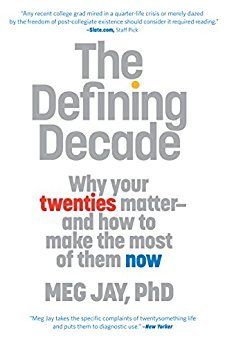
The Defining Decade Book Summary
Why Your Twenties Matter—And How to Make the Most of Them Now
Book by Meg Jay
Feeling Lazy?Read 1 Minute Summary
Summary
The Defining Decade is a insightful guide to making the most of your twenties, the most crucial years for building the personal and professional foundations that will shape the rest of your adult life.
1. Work
You Don't Need A Decade To Find Yourself
Contrary to popular belief, your twenties are not the time to put off building your identity capital - the collection of personal assets like your experiences, skills, relationships and personality that make up who you are. You don't need to wander aimlessly hoping to "find yourself." Instead, use your twenties to intentionally start building your identity capital by gaining experiences, skills and relationships that will serve you later. It's okay if you don't have everything figured out, but don't put off getting started.
Section: 1, Chapter: 1
"Forget Purpose, Find A Problem"
A key way to build identity capital is to orient yourself toward finding and solving problems you care about, rather than following some abstract notion of passion or purpose.
Look for challenges that motivate you and opportunities where you can contribute. Start working on these problems, even if in small ways at first, and your sense of purpose will emerge from engaging with them over time. Have the courage to commit to something rather than wandering aimlessly.
Section: 1, Chapter: 1
The Erikson Case Study: Crisis + Capital Go Together
The famous psychoanalyst Erik Erikson coined the term "identity crisis", but he himself went through one in his own twenties. Raised by his mother and step-father, he traveled Europe after high school, sleeping under bridges and taking art classes.
However, he wasn't just having an extended adolescence. By age 25 he was teaching art, studying education and psychoanalysis, meeting influential people in his field. By 30 he had a psychoanalytic degree and was launching his career as a teacher, analyst and theorist.
His identity capital came from productively using his twenties, not postponing adulthood indefinitely.
Section: 1, Chapter: 1
Your Closest Friends Aren't Your Most Valuable Network
In your twenties, spending all your time with the same group of friends, your "urban tribe", may feel comforting but it can hold you back. The people you know the least well, your "weak ties" are actually the most likely to provide new opportunities and experiences to help you grow.
Weak ties have novel information and connections that your close friend group doesn't. To build a diverse network, you have to be intentional about connecting with people outside your regular social circle.
Section: 1, Chapter: 2
The Strength of Weak Ties Comes From Interacting Differently
According to sociologist Mark Granovetter, weak ties provide value in two key ways:
- Weak ties expose you to new information and opportunities. They have connections and knowledge that overlap less with what you already know.
- Interacting with weak ties forces you to communicate from a place of difference. You can't rely on the unspoken assumptions and "restricted speech" you use with your core friend group. You have to engage in "elaborated speech", explaining yourself more fully. This helps you grow.
Section: 1, Chapter: 2
"Ask For A Favor And They'll Like You More"
The Ben Franklin effect shows that asking weak ties for a favor makes them more likely to help you again in the future. When Franklin wanted to win over a rival legislator, rather than doing a favor for the man, Franklin asked to borrow a rare book from him. The rival was flattered and afterwards, was much more friendly and willing to help Franklin.
So don't just do favors for weak ties, ask them for favors too. People like to feel helpful, as long as the request isn't a burden. Make it specific, concrete and relevant to their interests.
Section: 1, Chapter: 2
"Almost Good Enough Is Not Good Enough"
Many twentysomethings get tripped up by "the tyranny of the should" or "the search for glory" - perfectionist beliefs that keep them from committing to good-enough jobs or relationships. They imagine their purpose is some limitless achievement or special destiny, when in reality, their potential lies in a set of reasonable, realistic options in front of them. But choosing feels like settling, so they put it off.
The twenties are a time to start making choices based on what is possible and what YOU truly want, not some vague "should."
Section: 1, Chapter: 3
"Compare And Despair"
Many twentysomethings feel like they are falling behind based on the curated versions of their peers' lives they see on social media. They imagine everyone else is more successful and fulfilled.
But people tend to post only the positive highlight reel of their lives, not the behind-the-scenes struggles. Measuring yourself against this distorted mirror inevitably leads to frustration. Focus on your own path and resist drawing false comparisons. Everyone's life is full of ups and downs.
Section: 1, Chapter: 4
The "Tyranny of the Should"
Many twentysomethings get trapped by "the tyranny of the should" - narrow, prescribed visions of who they ought to be, based on family expectations or cultural scripts. Signs you are stuck in the "tyranny of the should":
- Your goals come from what others expect of you (parents, friends, society) not your own desires
- You have a rigid, idealized vision of what success looks like, and no flexibility for other good options
- You are putting off making choices because you worry they won't measure up to how things "should" be
- You feel you have to have it all now - the dream job, the soulmate, the perfect life - and can't move forward until everything lines up
- The solution is to shift focus from the outward "should" to your inner wants and needs.
Section: 1, Chapter: 4
"Create Yourself A Custom Life, With Common Parts"
Just like building a custom bicycle, you can craft a life that uniquely fits you by assembling common "parts" - jobs, relationships, interests, cities - according to your own specifications. The key is to actually choose some parts and start putting them together, even if they aren't all ideal or specialized.
Don't get paralyzed because you can't immediately build the "perfect" ride. You can swap out parts as you go. But you have to start with something basic that works in order to get anywhere.
Section: 1, Chapter: 5
"Good Stories Propel Good Lives"
The stories you tell about your life - your personal narrative - are a crucial form of identity capital. Twentysomethings who can craft a compelling story about who they are, what they've learned from their experiences, and where they are headed tend to get further than those who can't.
In interviews, dates, applications - people respond to a coherent, honest, growth-oriented story, not just a list of facts. Spend time reflecting on how to integrate what you've done so far into a meaningful arc. Revise and retell your story as you gain new experiences.
Section: 1, Chapter: 5
2. Love
3. The Brain and the Body
Related Content
Why Has Nobody Told Me This Before Book Summary
Julie Smith
In "Why Has Nobody Told Me This Before?", Dr. Julie Smith shares practical insights and tools from therapy to help you navigate life's challenges, build resilience, and create a meaningful life aligned with your values.
In "Why Has Nobody Told Me This Before?", Dr. Julie Smith shares practical insights and tools from therapy to help you navigate life's challenges, build resilience, and create a meaningful life aligned with your values.
Psychology
Therapy
Self-Help
Personal Development