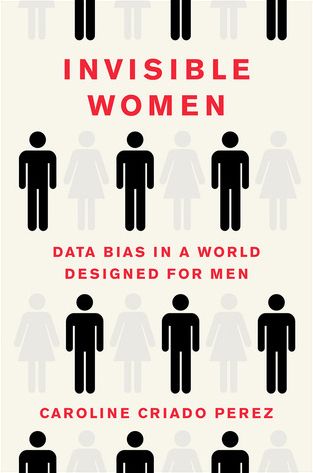
Invisible Women Book Summary
Data Bias in a World Designed for Men
Book by Caroline Criado Perez
Feeling Lazy?Read 1 Minute Summary
Summary
Invisible Women exposes the gender data gap that underlies our male-default world, revealing the hidden ways in which the failure to collect data on women's lives leads to bias, discrimination, and disadvantage in everything from healthcare to the workplace to public policy - and offers a roadmap for closing this gap to build a more equitable future for all.
1. Daily Life
The Default Male in Urban Planning
Urban planning has historically catered to the default male - that is, plans are made around the travel and mobility patterns of men. This stems from a gender data gap, where the people (mainly men) designing transit systems don't think about women's differing needs. Women tend to make more frequent, shorter trips, often accompanying children or elderly relatives. Their mobility is constrained by their greater share of care-taking responsibilities.
However, city transit networks are often designed for commuters going to and from work, without accounting for women's trip-chaining to multiple destinations. Sánchez de Madariaga, an urban planning professor, notes that not collecting gender-disaggregated data leads to a male bias in infrastructure planning.
Section: 1, Chapter: 1
Gender-Sensitive Urban Planning Saves Lives and Money
Urban planners need to adopt a gender-sensitive approach that accounts for women's travel patterns and needs. Some ways to do this:
- Collect sex-disaggregated data on transit usage to identify differing patterns
- Prioritize pedestrian infrastructure like well-lit, obstacle-free sidewalks that make walking easier and safer
- Invest in buses and intermediate public transit that are more flexible than rail
- Develop mixed-use zoning that locates essential services, employment and childcare in proximity to shorten women's trips
Not only is this more equitable, but it has economic benefits in enabling women's workforce participation and reducing medical costs from injuries. It's a win-win to plan cities around women's lives.
Section: 1, Chapter: 1
The Pervasive Problem of Potty Parity
The lack of adequate public toilet facilities for women is a global issue. Women often have to wait in long lines because there are insufficient female toilets, while men rarely queue. This is due to several flawed assumptions in restroom design:
- Providing equal floor space for male and female restrooms, even though urinals allow more men to use the facility at once
- Not accounting for women's need to use the toilet more frequently and for longer durations, due to biological factors like menstruation, pregnancy, and higher risk of UTIs
- Ignoring that women are more likely to be accompanied by children or elderly/disabled people they are caring for
Section: 1, Chapter: 2
The Economic Cost of Ignoring Women's Sanitation Needs
A Yale study applied a mathematical model to calculate the cost-benefit of installing public toilets for women to reduce sexual assault in Khayelitsha, a South African township. They found that increasing the number of toilets would result in a net savings, even after accounting for installation and maintenance:
- Currently there are 5,600 toilets for 2.4 million people, and 635 sexual assaults happen per year, at a cost of $40 million
- Doubling the number of toilets would decrease sexual assaults by 30%, saving $5 million per year in medical, legal and other costs
- This is a conservative estimate that doesn't even include the many additional health benefits and increased economic participation of women when they have access to safe sanitation
Section: 1, Chapter: 2
2. The Workplace
The "Invisible" Labor of Women's Unpaid Work
In 1975, 90% of Iceland's women went on strike for a day, refusing to do any work - paid labor or housework and childcare. Chaos ensued as a result:
- Offices and schools shut down, unable to operate
- Fathers scrambled to find food and care for their children
- Sausages, a common ready meal, sold out as men struggled to cook
This "Women's Day Off" demonstrated how much society depends on women's behind-the-scenes labor to function. Despite unpaid domestic and care work being essential, it is not recognized as "real" work because it is not included in economic measures like GDP. This renders women's contributions invisible.
Section: 2, Chapter: 3
The Uneven Division of Unpaid Labor
Globally, women do significantly more unpaid work than men, and this disparity persists even as more women enter the paid workforce. On average, women do 4.5 hours of unpaid work per day compared to men's 1.5 hours.
- In India, women spend 6 hours a day on housework compared to men's 13 minutes
- American women do 4 hours of unpaid work per day vs 2.5 hours for men
- Even in Norway, with a relatively gender-equal culture, women do more unpaid work
Time use data shows that when women reduce their unpaid work, it is usually because they are doing more paid work - not because men are contributing more. Men consistently fail to match women's unpaid contributions, regardless of employment status or income.
Section: 2, Chapter: 3
"A woman's work is never done - or counted"
"Globally women do three times the amount of unpaid care work men do; according to the IMF, this can be further subdivided into twice as much childcare and four times as much housework."
Section: 2, Chapter: 3
The False Promise of Meritocracy
Meritocracy is a myth. Despite companies increasingly using supposedly objective measures like performance reviews and scores to evaluate merit, gender bias still creeps in:
- Women face gendered double standards, with qualities like assertiveness being penalized in women but rewarded in men
- Women receive more subjective negative feedback about their personalities, while men receive more constructive feedback about their work
- Women's performance ratings are more likely to be attributed to luck rather than skill
- White men are judged as more competent than equally performing women and people of color
The reliance on merit metrics and "objective" algorithms can actually deepen inequality, by laundering human biases through a veneer of neutrality. True meritocracy requires an honest reckoning with bias.
Section: 2, Chapter: 4