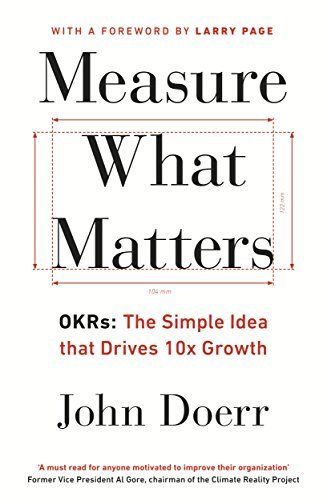
Measure What Matters Book Summary
OKRs: The Simple Idea that Drives 10x Growth
Book by John Doerr
Summary
Measure What Matters is the essential guide for using Objectives and Key Results (OKRs) to drive focus, alignment, and extraordinary performance at every level of your organization.
1. Part 1
How Google Embraced OKRs
In 1999, Google was still a fledgling startup. That's when venture capitalist John Doerr introduced founders Larry Page and Sergey Brin to Objectives and Key Results (OKRs).
OKRs provided the scaffolding to help Google scale from 40 employees to over 60,000 and achieve 10x growth and success across products like Search, Chrome, Android, YouTube and more. As Doerr states, "OKRs were a vaccine against fuzzy thinking and fuzzy execution." Google's leadership institutionalized OKRs as a core operating principle and management tool to provide focus, alignment, commitment, tracking and stretching to amazing.
Section: 1, Chapter: 1
The Four OKR Superpowers
OKRs, when implemented well, bestow organizations with four powerful benefits:
- Focus and commit to priorities
- Align and connect for teamwork
- Track for accountability
- Stretch for amazing
These "superpowers" enable organizations to operate with focus, alignment, accountability, ambition and transparency - all critical ingredients for executing on what matters most.
Section: 1, Chapter: 2
Andy Grove - The Architect Behind OKRs
Andy Grove, Intel's pioneering CEO, was the main architect behind OKRs. Grove wanted to create an environment at Intel that valued and emphasized output rather than activities.
He sought to create a system where managers didn't have to tell people what to do through command-and-control. Rather, he aimed to create a culture of discipline and self-management where there was clarity on objectives and people could determine the best approach themselves.
Grove eschewed traditional, private goal-setting in favor of transparent OKRs where everyone's goals, from the CEO down, were openly shared. Objectives were significant, concrete and action-oriented. Key results were measurable and verifiable milestones for achieving the objective.
Section: 1, Chapter: 2
"It Almost Doesn't Matter What You Know"
When explaining the impetus behind OKRs at Intel, Andy Grove stated:
"It almost doesn't matter what you know. It's what you can do with whatever you know or can acquire and actually accomplish [that] tends to be valued here. The key phrases . . . are objectives and the key result. And they match the two purposes. The objective is the direction: 'We want to dominate the mid-range microcomputer component business.' That's an objective. That's where we're going to go. Key results for this quarter: 'Win ten new designs for the 8085' is one key result. It's a milestone. The two are not the same."
Section: 1, Chapter: 2
Operation Crush: An Intel Story
In 1979, Intel was losing the battle for the 16-bit microprocessor market to Motorola. That's when Andy Grove and other Intel leaders used OKRs to mobilize the entire company behind "Operation Crush" - an effort to reclaim market leadership. The top-line objective was clear and time-bound: "Establish the 8086 as the highest performance 16-bit microprocessor family, as measured by having more than 2,000 design wins by the end of the year."
Every department and person at Intel, from engineering to sales to marketing, set aligned OKRs to support the Operation Crush objective. This connectivity enabled coordination, accountability and focus across all teams. By the end of the year, Intel had exceeded the goal with 2,300 design wins, regained market dominance, and set itself up for industry leadership for decades to come.
Section: 1, Chapter: 3
Hallmarks of effective OKRs
- Urgency: When a crisis arose, Intel's leadership responded within weeks to set and communicate a clear, focused objective to the entire company.
- Clarity: From the CEO down, everyone knew exactly what the objective was and how their work connected to it. No ambiguity.
- Alignment: Every team, from engineering to marketing to sales, set their own OKRs in service of Operation Crush. While the key results differed, the overarching objective unified everyone.
- Tracking: Regular check-ins and grading enabled leaders to monitor progress, identify obstacles, and make adjustments as needed.
- Stretching: The 2,000 design win goal was hugely ambitious. But it motivated people to rethink old approaches and deliver amazing results.
Section: 1, Chapter: 3
The Importance Of Focusing On What Matters Most
As Grove wrote, "The art of management lies in the capacity to select from the many activities of seemingly comparable significance the one or two or three that provide leverage well beyond the others and concentrate on them."
- Limit to 3-5 objectives per cycle. More dilutes focus.
- Choose objectives with the most leverage for outstanding performance.
- Be willing to say no and make hard choices about what not to do.
- Communicate choices clearly to the entire org to reduce ambiguity and create alignment.
Section: 1, Chapter: 4
What, How, When - The Anatomy of Effective OKRs
Effective OKRs clearly define the what, how and when:
- What are you trying to achieve? This is the objective - significant, action-oriented, and ideally inspiring.
- How will you get there? These are the key results - measurable, time-bound milestones.
- When do you need to achieve them by? OKRs should have a clear deadline, typically quarterly.
Section: 1, Chapter: 4
2. Part Two
3. Part Three
Related Content
Algorithms To Live By Book Summary
Brian Christian
Algorithms to Live By reveals how computer algorithms can solve many of life's most vexing human problems, from finding a spouse to folding laundry, by providing a blueprint for optimizing everyday decisions through the lens of computer science.
Algorithms to Live By reveals how computer algorithms can solve many of life's most vexing human problems, from finding a spouse to folding laundry, by providing a blueprint for optimizing everyday decisions through the lens of computer science.
Computer Science
Decision Making