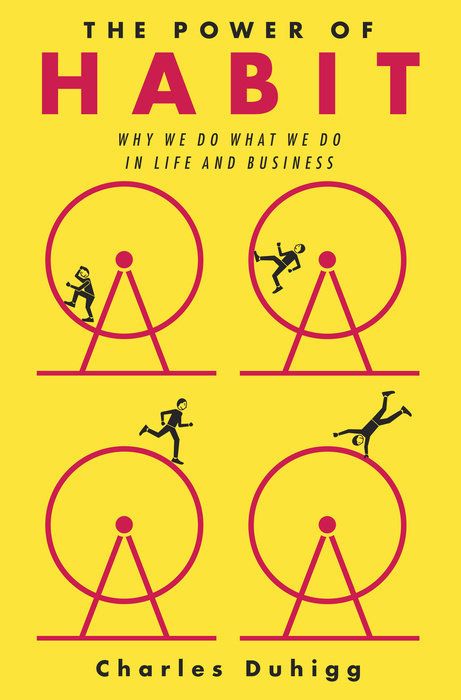
The Power of Habit Book Summary
Why We Do What We Do in Life and Business
Book by Charles Duhigg
Summary
The Power of Habit illuminates the science behind habit formation and provides practical strategies for transforming habits in our personal lives, organizations, and society.
1. The Habits of Individuals
The 3-Step Habit Loop
Habits are formed through a 3-step process called the "habit loop":
- Cue: An environmental trigger that tells your brain to go into automatic mode and prompts a habit
- Routine: The actual behavior or action you take, which can be physical, mental or emotional
- Reward: The benefit or pleasure you gain from doing the behavior, which helps your brain determine if the loop is worth remembering for the future
Over time, this loop becomes more and more automatic as the cue and reward become neurologically intertwined. Eventually a powerful sense of anticipation and craving emerges, and the habit becomes ingrained.
Section: 1, Chapter: 1
MIT Researchers Discover the Habit Loop
In the 1990s, MIT researchers began studying the neurological patterns of rats running through mazes to understand how habits are formed in the brain. They discovered:
- As the rats learned to navigate the maze, their mental activity decreased. The behavior became more and more automatic, with minimal thought required.
- Habits are stored in a part of the brain called the basal ganglia. When a cue is encountered, the brain essentially "chunks" the routine behavior together into an automatic unthinking response.
- This evolutionarily ancient part of the brain plays a key role in recalling patterns and acting on them, while the rest of the brain goes into a sleep-like state when a habit is occurring.
Section: 1, Chapter: 1
The Craving Brain
Once a habit is formed, the brain stops fully participating in decision making. It stops working so hard, or diverts focus to other tasks. So unless you deliberately fight a habit—unless you find new routines—the pattern will unfold automatically.
Habits never really disappear. They're encoded into the structures of our brain, which is a huge advantage for us, because it would be awful if we had to relearn how to drive after every vacation. The problem is that your brain can't tell the difference between bad and good habits, so if you have a bad one, it's always lurking there, waiting for the right cues and rewards.
The brain's dependence on automatic routines can be dangerous. Habits are often as much a curse as a benefit. The key is to learn how to observe the cues and rewards that drive our behaviors, so we can change the routine that occurs in between.
Section: 1, Chapter: 1
Claude Hopkins - The Father of Modern Advertising
Claude Hopkins, one of the most famous advertisers of the early 20th century, created a national toothbrushing habit through his ads for Pepsodent toothpaste. His key insights:
- Find simple and obvious cues (like the tooth film that continually forms on teeth)
- Clearly define the rewards (like beautiful teeth)
- And claim that using your product is the best way to achieve those rewards
Through constant advertising, people began expecting the reward of a tingling clean feeling in their mouths whenever they encountered the cue of tooth film. As the cue and reward became linked in people's minds, brushing with Pepsodent became a daily habit.
Hopkins showed how new habits can be cultivated by focusing advertising on the cues and rewards that drive behaviors. But there was another component he didn't realize - the power of cravings.
Section: 1, Chapter: 2
The Power of Craving
Simply knowing the cue (like tooth film) and the reward (beautiful teeth) wasn't enough to make the Pepsodent habit stick long-term. Hopkins had also inadvertently tapped into the third component of the habit loop - craving.
Pepsodent contained citric acid, mint oil and other chemicals that created a cool tingling sensation in the mouth. This provided a subtle neurological pleasure, that over time became linked with the other cues and rewards of using Pepsodent. People began craving that slight irritation, the tingling sensation that signaled their mouths were clean. If it wasn't there, their mouths didn't feel right.
Cravings are the key that make cues and rewards work. Cravings power the habit loop. The routine occurs because the craving emerges, in anticipation of getting the reward to satisfy it. Countless studies have shown how powerful cravings can be in driving behavior. If we can identify the cravings that drive habits, we gain a huge advantage in changing behavior.
Section: 1, Chapter: 2
How to Create a Craving Where None Existed Before
When Febreze first launched, sales were abysmal. The product eliminated odors, but it had no scent of its own. People with smelly houses couldn't detect the bad smells that should have cued them to use Febreze. There was no existing craving driving the habit.
Then P&G marketers made a key insight - they needed to create a craving to use Febreze, even when smells weren't noticeable. They did this by:
- Adding a subtle new perfume to the product
- Showing commercials with women spraying Febreze at the end of a cleaning routine, as a final touch
- Portraying Febreze as a mini-celebration - a pleasant moment that brought joy and satisfaction after household chores
Section: 1, Chapter: 2
The Golden Rule of Habit Change
According to studies, it's very difficult to simply extinguish bad habits. Habits are so powerful because they create neurological cravings - the cues and rewards become hardwired in our brains. But you can change habits by applying the Golden Rule of habit change:
Keep the same cue. Provide the same reward. Change the routine in the middle.
If you use the same cue, and provide the same reward, you can shift the routine and change the habit. Almost any behavior can be transformed if you keep the cue and reward but insert a new routine. The cravings drive the habit loop, but as long as the loop provides the same cues and rewards, the routine in the middle can be altered.
Section: 1, Chapter: 3
2. The Habits of Successful Organizations
3. The Habits of Societies
Related Content
Atomic Habits Book Summary
James Clear
Atomic Habits reveals the surprising power of small habits, demonstrating how tiny changes can compound into remarkable results over time. By focusing on systems over goals and building identity-based habits, you can create lasting change and unlock your full potential.
Atomic Habits reveals the surprising power of small habits, demonstrating how tiny changes can compound into remarkable results over time. By focusing on systems over goals and building identity-based habits, you can create lasting change and unlock your full potential.
Productivity
Personal Development
Psychology