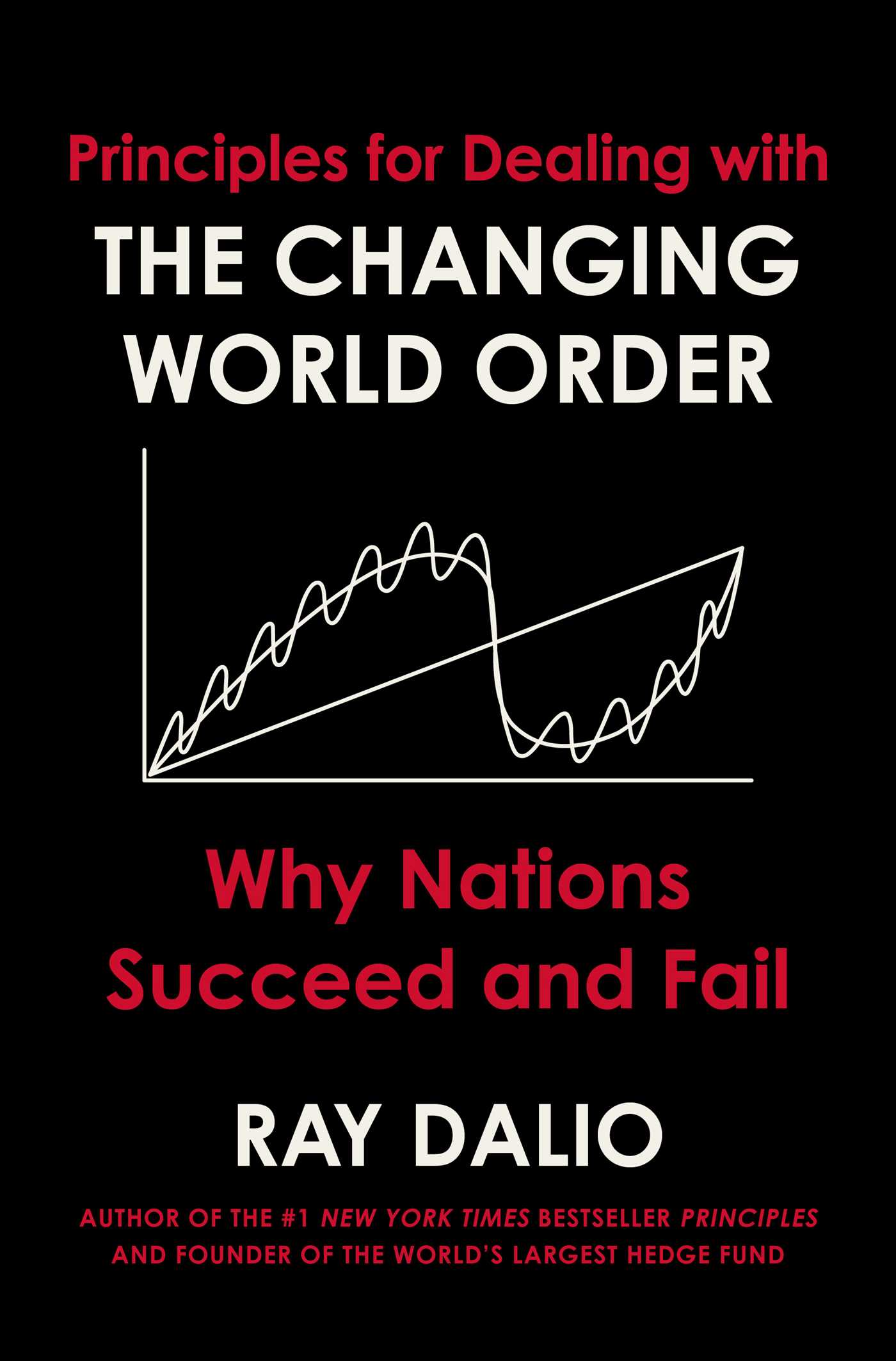
Principles For Dealing With the Changing World Order Book Summary
Why Nations Succeed and Fail
Book by Ray Dalio
Summary
Ray Dalio draws on historical patterns to provide a thought-provoking framework for understanding the cycles of rise and decline of nations, currencies, and markets, offering invaluable insights for investors and leaders navigating the complex dynamics shaping our future.
1. How The World Works
The Times Ahead Will Be Radically Different
Dalio believes the times ahead will be very different from what we've experienced in our lifetimes, though similar to many times in history. To handle his responsibilities well over the past 50 years, he needed to understand the factors that make countries succeed and fail. This led him to study historical cases to discern principles for dealing with situations he had never faced before.
A few years ago, he observed the emergence of developments that hadn't happened in his lifetime but had occurred in history - the confluence of huge debts, near-zero interest rates, large wealth and political gaps, and the rising of a new world power to challenge the existing world order. This concerning situation led him to study the rises and declines of empires, reserve currencies and markets.
Section: 1, Chapter: 1
No Empire Lasts Forever
“No system of government, no economic system, no currency, and no empire lasts forever, yet almost everyone is surprised and ruined when they fail.”
Section: 1, Chapter: 1
Eight Key Determinants Of Wealth and Power
The author found eight key determinants that explain the rises and declines of countries' wealth and power:
- Education
- Competitiveness
- Innovation and technology
- Economic output
- Share of world trade
- Military strength
- Financial center strength
- Reserve currency status
These factors are mutually reinforcing. For example, better education leads to more innovation, higher economic output, stronger trade and military, and the establishment of the currency as a reserve currency.
Section: 1, Chapter: 1
The Archetypical Big Cycle Of The Rise And Fall Of Empires
Empires tend to go through an archetypical "Big Cycle" that lasts around 250 years on average:
- The Rise - After a new order is established, there is peace, prosperity, low debt, small wealth gaps, effective leadership and governance.
- The Top - Wealth and power reach a peak, but excesses emerge in the form of high debt, large wealth gaps, declining education and governance, and overextended military. The empire faces challenges from emerging rivals.
- The Decline - The excesses reach a breaking point, leading to financial crises, intense internal conflict, and often destructive wars with rival powers. This painful period of restructuring establishes a new order.
Many of the most famous empires in history, from the Dutch to the British to the Americans, have followed this archetypical Big Cycle.
Section: 1, Chapter: 1
Human Nature Drives Repeating Cycles Of Prosperity And Decline
Many key drivers of empires' rises and declines are rooted in universal aspects of human nature. The desire to gain and retain wealth and power, the tendency to favour short-term gratification over long-term planning, and the cycles of generational psychology all contribute to the "Big Cycle" pattern repeating. While specific technologies, geographies and cultures shape the details, the overall stories rhyme across history because of these common human traits. Understanding these repeating patterns is essential to navigating the changing world order.
Section: 1, Chapter: 2
The Long-Term Debt Cycle Follows A Predictable Pattern
Long-term debt cycles, lasting 50-100 years on average, follow a predictable pattern:
- They begin with little debt and "hard money" like gold.
- Credit expands through claims on hard money.
- Debt levels rise as lending and borrowing increase.
- Debt crises emerge as debts exceed the ability to repay. Hard money constraints are abandoned in favor of fiat money.
- Fiat money is printed excessively, leading to the devaluation of money.
- Eventually a return to hard money occurs to restore confidence.
This cycle has repeated throughout history, from Ancient Rome to Medieval China to 20th century Europe and America. While new financial instruments emerge, the underlying dynamics persist because of the universal human tendency towards credit expansions and contractions.
Section: 1, Chapter: 3
All Currencies Are Devalued Or Die Over Time
Looking back over the last few centuries, all major currencies have either been devalued significantly or died altogether. Currencies are devalued when governments print excessive amounts of money, usually to finance budget deficits or service high debt levels. This reduces the purchasing power of money over time. Many currencies have been completely replaced, often after losing a war or during a political revolution. The only major currencies that have survived since 1850 are the U.S. dollar, British pound and Swiss franc - and even they have lost over 90% of their purchasing power due to devaluations.
Section: 1, Chapter: 4
Devaluation Often Happens Quickly During Debt Crises And Political Upheavals
While currency devaluation can seem like a gradual process, history shows it often happens abruptly during times of crisis. When government debts become unsustainable, devaluation is the only politically feasible solution. This happened in Weimar Germany in the 1920s, the U.S. and Europe in the 1930s, and many emerging economies in the late 20th century. Such rapid devaluations can destroy wealth stored in the currency, creating social and political unrest. Investors must be alert to signs of unsustainable debt and political disorder that could trigger a currency crisis.
Section: 1, Chapter: 4
Wealth And Values Gaps Drive Internal Conflicts Within Countries
All societies have internal struggles between different socioeconomic classes over wealth and power. These conflicts intensify when there are large gaps in wealth and fundamental values between the classes. Wealth gaps naturally emerge in capitalist systems, as some benefit more from productivity gains than others.
Values gaps emerge as people coalesce into "tribes" based on factors like religion, ethnicity, urban/rural status, and politics. When a country experiences economic hardships on top of these gaps, it often leads to a breaking point of revolution and/or civil war to restructure the internal order. Managing these internal gaps is essential for countries to maintain stability and avoid self-destructive conflicts.
Section: 1, Chapter: 5
Populist And Autocratic Leaders Emerge During Times of Internal Conflict
In the late stages of the internal cycle of conflict, countries often turn to populist and autocratic leaders who promise to restore order and take power away from entrenched elites.
This happened in the 1930s with the rise of fascist leaders like Hitler and Mussolini during the Great Depression. It also happened after the French Revolution with the rise of Napoleon, and in countless coups and revolutions in Latin America and Asia. Such leaders often come from outside traditional power structures and tap into resentment against the "establishment." While they can temporarily stabilize a country, they often end up leading it into damaging conflicts abroad. Being alert to the rise of populist autocrats is crucial to navigating the internal cycle.
Section: 1, Chapter: 5
External Order Is Driven By Raw Power Dynamics
The external order between countries is fundamentally different from internal order within countries. Internationally, there are no reliable mechanisms to adjudicate disputes or enforce agreements. Countries ultimately pursue their interests through raw power - economic, financial, and military.
When one country becomes dominant, it can impose its preferred external order on others. But this order lasts only as long as that country remains dominant. When a rival country becomes powerful enough to challenge the dominant one, and has incompatible interests, it leads to a struggle that reshapes the external order. This is how the British external order of the 19th century gave way to the American order of the 20th century.
Section: 1, Chapter: 6
2. How The World Has Worked Over The Last 500 Years
3. The Future
Related Content
Principles Book Summary
Ray Dalio
In Principles, Ray Dalio shares the unconventional principles he developed, refined, and used during his 40-year career to create unique results in both life and business - and which any person or organization can adopt to help achieve their goals.
In Principles, Ray Dalio shares the unconventional principles he developed, refined, and used during his 40-year career to create unique results in both life and business - and which any person or organization can adopt to help achieve their goals.
Personal Development
Leadership
Personal Development