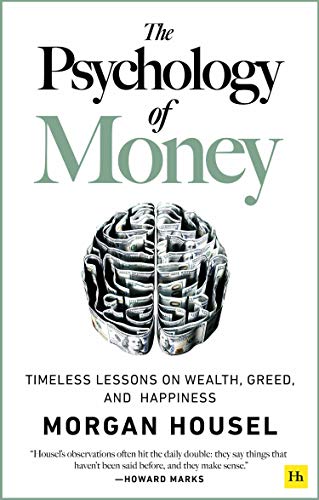
The Psychology of Money Book Summary
Book by Morgan Housel
Summary
The Psychology of Money is a fascinating look at the strange ways people think about money and teaches you how to make better sense of one of life's most important topics. Doing well with money isn't necessarily about what you know; it's about how you behave, and behavior is hard to teach, even to really smart people.
Your Personal Experiences With Money Shape Your Beliefs
Everyone has different experiences with money based on their upbringing, circumstances, and place in history. This leads to very different beliefs and behaviors around money, even if on the surface they seem illogical or "crazy" to others. Two people can look at the same facts or event but interpret them very differently based on their own unique lens. Rather than judging, the key is to recognize that everyone's views make sense to them based on their personal experiences. What seems crazy to you might make perfect sense to me.
Section: 1, Chapter: 1
Be Careful Who You Praise And Admire
When judging others, attributing success to luck/risk and failures to poor decisions is often overly simplistic. You should:
- Avoid lionizing the successful and demonizing the failures, as if they had complete control over outcomes
- Recognize the role of luck, both good and bad, in success and failure
- Evaluate decisions based on the information available at the time, not just the results; focus more on broad patterns of success/failure than individual examples
Section: 1, Chapter: 2
Knowing When You Have "Enough"
There's a point where having more money has no impact on your wellbeing. Beyond a certain level, additional wealth and income becomes a game of ego and comparison. To avoid this trap:
- Focus on attaining a level of wealth that allows you freedom and comfort
- Avoid being sucked into the never-ending race to have more than your peers
- Don't risk what you have and need for what you don't have and don't need
Having "enough" looks different for everyone. But not endlessly chasing more is key to satisfaction.
Section: 1, Chapter: 3
Rajat Gupta And Bernie Madoff Show The Danger Of Insatiable Appetites
The chapter highlights two examples of wealthy, successful men who ended up in ruin because they couldn't escape the "never enough" trap:
- Rajat Gupta was a Harvard-educated CEO of McKinsey worth hundreds of millions. But he craved the billionaire status of his peers. He engaged in insider trading to chase more wealth and ended up in prison.
- Bernie Madoff had a legitimate, successful market-making business but couldn't resist the allure of more. He set up a ponzi scheme to inflate his returns and wealth. It ultimately collapsed, wiping him out.
Both men had everything - success, prestige, wealth beyond imagination. But they threw it away chasing unrealistic dreams of ever more. Their need to have enough was overpowered by their need to have more than others.
Section: 1, Chapter: 3
Warren Buffet and The Power of Compounding
Warren Buffett is the most famous example of the power of compounding. What's lesser known is just how much of his fortune was accumulated late in life:
- Buffett started investing at age 10 in the 1930s
- By age 30, he had a net worth of $1 million (in today's dollars)
- By age 65, he was worth $6 billion - an impressive sum
- But over the next 23 years, his wealth grew to over $84 billion
- $81.5 billion, or 97% of his net worth, came after his 65th birthday
This illustrates the nature of compounding - the gains are relatively small early on, but grow exponentially larger over longer periods of time. Even for the world's most successful investor, the vast majority of wealth came very late in life.
Section: 1, Chapter: 4
The Counterintuitive Nature of Compounding
We underestimate compounding because it seems slow and boring at first. This leads to poor financial decisions:
- We underestimate the potential of saving/investing small sums early on, so we don't bother
- We attempt to earn the highest investment returns, even if it means taking irrational risks, because 8% doesn't feel like enough
- We underappreciate the value of simplicity, because a simple strategy earning "only" 8% seems inferior to complex ones that attempt to earn more
The rational strategy is to harness compounding through consistent saving and investment in simple, diversified portfolios. But our bias for quick results blinds us to the power of compounding small sums over long periods.
Section: 1, Chapter: 4
Getting Wealthy vs. Staying Wealthy
Many people are good at getting wealthy but terrible at staying wealthy. That's because staying wealthy requires a different approach:
Getting wealthy:
- Takes risks, often big ones
- Is driven by optimism and a focus on potential gains
- Requires a willingness to take chances and put yourself out there
Staying wealthy:
- Relies on humility, frugality, and paranoia about potential losses
- Requires conservative decision-making that prioritizes avoiding catastrophic losses
- Means accepting that a portion of what you've made is attributable to luck
The skills that got you rich - risk-taking, optimism, salesmanship - can actually work against you when trying to maintain wealth. The ability to adjust from "growth mode" to "stability mode" is rare but essential.
Section: 1, Chapter: 5
Survival Mentality Leads To Long-Term Success
To give yourself the best chance of success in the long run:
- Aim to not be a forced seller during downturns. Have enough liquidity to survive declines without locking in losses.
- Plan for things to take longer to play out than you expect. Don't rely on investment plans working on a specific short timeline.
- Diversify your investments to limit exposure to any one risk. Don't risk catastrophic losses.
- Focus on survival and avoiding ruin. You only need to get rich once; you have to stay rich forever.
The most important part of every plan is planning on your plan not going according to plan. Optimism and pessimism can coexist - expect the best but prepare for the worst.
Section: 1, Chapter: 5
Small Number Of Events Explain The Majority Of Outcomes
The distribution of success isn't even - a small number of outliers have a disproportionate impact. Consider:
- Venture capital: 65% of investments lose money, 4% earn 10x+, 1% earn 50x+. That tiny minority generates most returns.
- Stock markets: Less than 10% of public companies account for all the market's gains over time.
- Art: Most works have little value, but the tiny number that are considered masterpieces drive the market.
In many fields, a tiny proportion of successes explain the vast majority of results. Success is often driven by gaining exposure to such "tail events" - outcomes that are statistically unlikely but enormously impactful.
Section: 1, Chapter: 6
Related Content
Same as Ever Book Summary
Morgan Housel
"Same as Ever" reveals the surprising truth: while technology and society evolve at breakneck speed, our core behaviors and motivations remain remarkably unchanged. Discover the timeless lessons of human nature that hold the key to navigating an unpredictable future.
"Same as Ever" reveals the surprising truth: while technology and society evolve at breakneck speed, our core behaviors and motivations remain remarkably unchanged. Discover the timeless lessons of human nature that hold the key to navigating an unpredictable future.