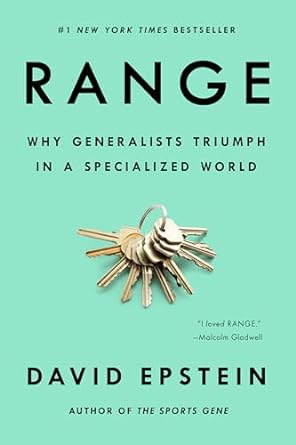
Range Book Summary
Why Generalists Triumph in a Specialized World
Book by David Epstein
Summary
"Range" challenges the conventional wisdom that early specialization is the key to success. Instead, Epstein argues that in our increasingly complex and unpredictable world, it is those with broad experience and diverse skills who are best equipped to thrive.
Range, by David Epstein
"Range" challenges the conventional wisdom that early specialization is the key to success. Instead, Epstein argues that in our increasingly complex and unpredictable world, it is those with broad experience and diverse skills who are best equipped to thrive. He presents a compelling case for the value of exploration, experimentation, and learning across disciplines. The book is filled with inspiring stories of individuals who have achieved success through unconventional paths, from athletes and musicians to scientists and entrepreneurs.
The key takeaway from "Range" is that we should not be afraid to explore different options and to change course as we learn and grow. Early specialization can lead to tunnel vision and a lack of adaptability. By embracing a more flexible approach to learning and development, we can expand our range and increase our chances of finding our best fit in the world. The book encourages us to cultivate a growth mindset, to embrace challenges, and to learn from our mistakes. Ultimately, "Range" is a call to action to embrace the power of breadth and to break free from the limitations of narrow expertise.
The Paths of Roger and Tiger
Tiger Woods: Represents the "head start" approach, with early specialization and intense, deliberate practice from a young age.
Roger Federer: Embodies the benefits of sampling different sports and experiences before specializing later, developing broader athleticism and adaptability.
While the "Tiger Path" is often touted as the key to success, research suggests the "Roger Path" is more prevalent and beneficial in many fields, including sports, business, and science.
Section: 1, Chapter: 0
Challenging the Cult of the Head Start
Kind vs. Wicked Learning Environments: Psychologist Robin Hogarth's concept of "kind" (predictable, with immediate feedback) and "wicked" (unpredictable, with delayed or inaccurate feedback) learning environments is introduced.
Expertise and Experience: The relationship between experience and expertise depends on the domain. While deliberate practice is crucial in "kind" domains like chess or golf, it may not translate to success in "wicked" domains like business or politics.
Cognitive Entrenchment: Over-specialization can lead to "cognitive entrenchment," where experts become inflexible and struggle to adapt to new situations or rules.
Section: 1, Chapter: 1
The Diversity of Nobel Laureates
"Compared to other scientists, Nobel laureates are at least twenty-two times more likely to partake as an amateur actor, dancer, magician, or other type of performer."
Section: 1, Chapter: 1
Learning in a Wicked World
“In a wicked world, relying upon experience from a single domain is not only limiting, it can be disastrous.”
Section: 1, Chapter: 1
The Polgar Sisters: Early Specialization in Chess
Laszlo Polgar's experiment with his daughters, Susan, Sofia, and Judit, demonstrates the effectiveness of early specialization and deliberate practice in achieving mastery within a kind learning environment like chess. He homeschooled his daughters, focusing on intense chess training from a young age. Consequently, all three became chess prodigies, with Susan and Judit achieving grandmaster status.
Section: 1, Chapter: 1
Kind vs Wicked Learning Environments
Learning environments can be categorized as either "kind" or "wicked." Kind environments, like chess or golf, have clear rules, consistent patterns, and immediate feedback. In such environments, early specialization and deliberate practice are highly effective. Wicked environments, like the world of business or politics, are characterized by ambiguity, changing rules, and delayed or inaccurate feedback. Here, broad experience and adaptability are more valuable than narrow specialization.
Section: 1, Chapter: 1
Modern Work Demands Range
“Modern work demands knowledge transfer: the ability to apply knowledge to new situations and different domains. Our most fundamental thought processes have changed to accommodate increasing complexity and the need to derive new patterns rather than rely only on familiar ones. Our conceptual classification schemes provide a scaffolding for connecting knowledge, making it accessible and flexible.”
Section: 1, Chapter: 2
From Tabula Rasa to Master: The Rise of AI
AI programs like AlphaZero have achieved mastery in games like chess and Go, demonstrating the power of machine learning in kind learning environments. However, these programs still operate within defined rules and lack the ability to adapt to open-ended problems or formulate creative strategies. This highlights the unique value of human strategic thinking and adaptability in navigating the complexities of the real world.
Section: 1, Chapter: 2
The Flynn Effect: Our Evolving Minds
The Flynn effect refers to the consistent rise in IQ test scores across generations throughout the 20th century. This phenomenon suggests that modern societies have fostered improved abstract thinking and problem-solving skills, likely due to increased exposure to complex and interconnected systems.
Section: 1, Chapter: 2
From Illiteracy to Abstract Thinking: Luria's Experiment in Uzbekistan
Psychologist Alexander Luria's study of individuals in Uzbekistan during its modernization period revealed the impact of exposure to modern work and education on cognitive abilities. He found that individuals engaged in collective farming and formal education demonstrated greater capacity for abstract thinking and problem-solving compared to those in remote villages who relied on traditional ways of life.
Section: 1, Chapter: 2
Education's Narrow Focus: The Need for Broader Thinking Skills
Despite the Flynn effect and our evolving cognitive abilities, education systems often prioritize narrow specialization over the development of broad thinking skills. To thrive in a complex world, individuals need to cultivate skills like Fermi estimation and computational thinking, enabling them to apply knowledge across diverse domains and solve novel problems.
Section: 2, Chapter: 1
Breadth of Training = Breadth of Transfer
“breadth of training predicts breadth of transfer. That is, the more contexts in which something is learned, the more the learner creates abstract models, and the less they rely on any particular example. Learners become better at applying their knowledge to a situation they’ve never seen before, which is the essence of creativity.”
Section: 1, Chapter: 3
The Figlie del Coro: Musical Virtuosos from the Venetian Ospedali
The figlie del coro, orphaned girls raised in Venetian ospedali, became renowned musicians during the Baroque period. Their mastery of multiple instruments and diverse musical styles challenged conventional notions of specialization and highlighted the benefits of broad musical training in fostering creativity and adaptability.
Section: 1, Chapter: 3
Beyond Deliberate Practice
Research on musical expertise, including studies by John Sloboda, indicates that early specialization and intensive practice are not always the optimal path to success. Instead, a sampling period where individuals explore various instruments and musical styles often precedes focused practice and leads to greater creativity and skill development.
Section: 1, Chapter: 3
Big Mistakes Provide Opportunities For Learning
“The more confident a learner is of their wrong answer, the better the information sticks when they subsequently learn the right answer. Tolerating big mistakes can create the best learning opportunities.*”
Section: 1, Chapter: 4
The Best Learning is Slow
"It is difficult to accept that the best learning road is slow, and that doing poorly now is essential for better performance later. It is so deeply counterintuitive that it fools the learners themselves, both about their own progress and their teachers' skill"
Section: 1, Chapter: 4
Improvisation and the Power of Experimentation
The stories of jazz legends like Duke Ellington, Johnny Smith, and Django Reinhardt demonstrate the power of improvisation and experimentation in musical development. These self-taught musicians embraced diverse musical experiences and developed their skills through trial and error, ultimately achieving mastery and innovation in their respective domains. This highlights the importance of fostering a playful and exploratory approach to learning, allowing individuals to discover their own unique voice and adapt to new challenges.
Section: 1, Chapter: 3
Learning is About the Journey
Learning deeply means embracing the struggle. The most effective learning looks inefficient, with progress that comes slowly. We all reflexively assess our progress by how we are doing right now, but this often leads us to mistake fleeting progress for deep learning. In reality, frustration is often a sign you are learning, while ease is not.
Desirable Difficulties: These are obstacles that make learning more challenging, slower, and more frustrating in the short term, but better in the long term.
Generation Effect: Struggling to generate an answer on your own, even a wrong one, enhances subsequent learning.
Hypercorrection Effect: The more confident a learner is of their wrong answer, the better the information sticks when they subsequently learn the right answer.
Spacing Effect: Leaving time between practice sessions for the same material, improves long-term retention.
Section: 1, Chapter: 4
Related Content
Atomic Habits Book Summary
James Clear
Atomic Habits reveals the surprising power of small habits, demonstrating how tiny changes can compound into remarkable results over time. By focusing on systems over goals and building identity-based habits, you can create lasting change and unlock your full potential.
Atomic Habits reveals the surprising power of small habits, demonstrating how tiny changes can compound into remarkable results over time. By focusing on systems over goals and building identity-based habits, you can create lasting change and unlock your full potential.
Productivity
Personal Development
Psychology