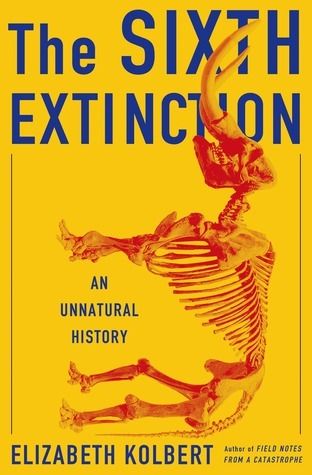
The Sixth Extinction Book Summary
An Unnatural History
Book by Elizabeth Kolbert
Summary
In "The Sixth Extinction," Elizabeth Kolbert takes us on a riveting journey through the tumultuous history of life on Earth, revealing how human activity is driving a catastrophic modern extinction event that may ultimately imperil our own survival.
Panamanian Golden Frog Driven to Brink of Extinction
The Panamanian golden frog, once prevalent in streams near El Valle, has been nearly eradicated by a deadly fungal disease called chytridiomycosis. This disease, caused by the chytrid fungus Batrachochytrium dendrobatidis (Bd), has spread across Panama, decimating frog populations.
Scientists quickly gathered the remaining golden frogs to create a captive breeding program, housing them initially in a "frog hotel" and later at the El Valle Amphibian Conservation Center. Despite these efforts, the species is now extinct in the wild, underscoring the severity of the global amphibian extinction crisis.
Section: 1, Chapter: 1
Current Extinction Rate Far Exceeds Historical Background Rate
The current rate of species extinction is estimated to be 100 to 1000 times higher than the background extinction rate, which is about 0.1 extinctions per million species per year. Amphibians have been hit especially hard, with an extinction rate as much as 45,000 times the background rate. This means we are likely in the midst of the sixth mass extinction in Earth's history, this time primarily caused by human activities. Species are disappearing so fast that biologists feel they are "running through a museum and knowing that the collection's on fire."
Section: 1, Chapter: 1
Characteristics of Mass Extinctions According to Paleontologists
Paleontologists have identified several key characteristics of mass extinction events:
- Significant proportion of the world's biota eliminated in a geologically short time frame (Hallam and Wignall)
- Substantial biodiversity losses occurring rapidly and globally (Jablonski)
- Vast swathes of the tree of life cut short simultaneously, as if attacked by "axe-wielding madmen" (Benton)
- Long periods of stasis in extinction rates punctuated by sudden spikes in species loss (Raup)
While causes and speed vary between the "Big Five" mass extinctions, they share devastating consequences across many taxa and ecosystems worldwide.
Section: 1, Chapter: 1
Cuvier Discovers Extinction and a Pre-Human "Lost World"
In revolutionary France, naturalist Georges Cuvier studied fossilized elephant and mastodon bones, including specimens discovered in North America. He recognized that their anatomy was distinct from living species. This led him to propose that some species had gone extinct - a radical idea at the time. He identified the mastodon, mammoth, giant ground sloth, and more as "lost species." Cuvier envisioned a pre-human world populated by unfamiliar creatures that had been wiped out by sudden catastrophes.
His work established extinction as a scientific fact and the existence of a "former world" before humans, though his catastrophist views were later overturned.
Section: 1, Chapter: 2
"The Present Is the Key to the Past": Lyell's Uniformitarian Geology
"The present is the key to the past."
This famous maxim encapsulates geologist Charles Lyell's uniformitarian view. He argued the same gradual geological processes observable today, like erosion and sedimentation, shaped Earth's features over immense time. This contrasted with Cuvier's catastrophism. Lyell claimed the apparent "revolutions" in the fossil record simply reflected its incompleteness. Species extinctions occurred piecemeal, not en masse. Lyell's "Principles of Geology" was hugely influential, though he was ultimately wrong about the continuity of the fossil record and the ability of modern causes to explain mass extinctions.
Section: 1, Chapter: 3
Darwin Confronts the Contradiction of Human-Caused Extinctions
Darwin recognized some species went extinct suddenly, like the great auk and ammonites. But wedded to Lyell's gradualism, he argued the apparent abruptness merely reflected gaps in the fossil record. Extinctions actually occurred slowly, through competition in the "struggle for existence."
However, as evidence of human-caused extinctions accumulated, a paradox emerged. How could humans overturn the "natural" pace of extinction? It implied either 1) people were unbound by nature's laws, having a "special status," or 2) catastrophic extinctions did occur, meaning Cuvier was right. Darwin sidestepped this problematic conclusion, even as he chronicled human-caused extinctions like the Charles Island tortoise.
Section: 1, Chapter: 3
Alfred Newton Lobbies for Bird Conservation Laws
Witnessing the great auk's extinction spurred ornithologist Alfred Newton to action. He realized that many seabird populations were being decimated by hunting, especially during breeding season when the birds were most vulnerable.
Newton argued: "The bird that is shot is a parent. We take advantage of its most sacred instincts to waylay it, and in depriving the parent of life, we doom the helpless offspring to the most miserable of deaths, that by hunger." In response, Newton lobbied for legal protection.
His efforts led to one of the first wildlife protection laws, the Act for the Preservation of Sea Birds in 1869. This underscores the importance of
- studying species declines,
- determining the anthropogenic threats, and
- pushing for policy solutions. Individuals who experience biodiversity loss firsthand can be powerful advocates for conservation.
Section: 1, Chapter: 3
Ammonites Thrived for Millions of Years Before Sudden Extinction
Ammonites, a group of marine mollusks, inhabited the seas for over 300 million years. They survived several mass extinctions, but finally succumbed during the End-Cretaceous event 66 million years ago. Ammonites came in a dizzying array of shapes and sizes, from tiny species to 6-foot giants.
They were abundant, diverse, and highly successful - until they rather abruptly disappeared from the fossil record. Their sudden decline, coinciding with the extinction of the dinosaurs, belies the notion that mass extinctions unfold gradually. Instead, they demonstrate that long-thriving groups can be rapidly eliminated when conditions change faster than they can adapt.
Section: 1, Chapter: 4
Related Content

This Changes Everything Book Summary
Naomi Klein
In "This Changes Everything," Naomi Klein argues that the climate crisis challenges us to abandon the core "free market" ideology of our time, restructure the global economy, and remake our political systems - and that in the process, we have the chance to create a safer and more just world.
In "This Changes Everything," Naomi Klein argues that the climate crisis challenges us to abandon the core "free market" ideology of our time, restructure the global economy, and remake our political systems - and that in the process, we have the chance to create a safer and more just world.
Sustainability
Climate Change
Economics
Politics