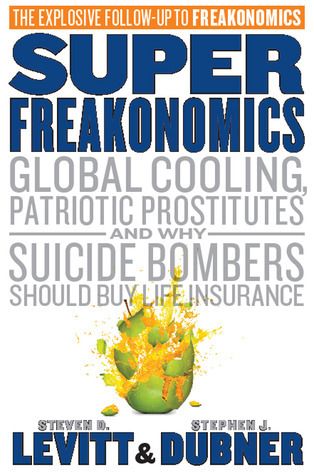
Super Freakonomics Book Summary
Global Cooling, Patriotic Prostitutes And Why Suicide Bombers Should Buy Life Insurance
Book by Steven D. Levitt , Stephen J. Dubner
Feeling Lazy?Read 1 Minute Summary
Summary
In Superfreakonomics, Levitt and Dubner challenge conventional wisdom on topics ranging from prostitution to terrorism to global warming, using data and economic principles to uncover surprising insights and challenge readers to think like a Freak.
The Perils Of Walking Drunk
The introduction opens with an interesting statistic - on a per mile basis, walking drunk is 8 times more likely to result in death compared to driving drunk. This counterintuitive finding demonstrates how the authors will challenge conventional wisdom in the rest of the book by looking at data and incentives.
Levitt and Dubner define their approach as looking at the world through the lens of incentives, unintended consequences, and using data to challenge conventional wisdom. They call this blend of economics and rogue curiosity "Freakonomics." The key is to ask interesting questions and follow data, even if it leads to uncomfortable truths.
Section: 1, Chapter: 1
Does Television Cause Crime?
Levitt and Dubner analyze an interesting natural experiment based on when cable TV was introduced to different U.S. cities in the 1940s-1950s. They find that cities that got TV earlier saw a 50% increase in property crime and 25% increase in violent crime compared to late-adopting cities in the following years. The authors suggest TV may have had a causal effect by exposing people to more violent content and reducing social interaction. This surprising finding highlights how even seemingly benign technologies can have major unintended social consequences.
Section: 1, Chapter: 1
Thinking From a Baseline
“In a complex world where people can be atypical in an infinite number of ways, there is great value in discovering the baseline. And knowing what happens on average is a good place to start. By so doing, we insulate ourselves from the tendency to build our thinking - our daily decisions, our laws, our governance - on exceptions and anomalies rather than on reality.”
Section: 1, Chapter: 1
A Day In The Life Of A Chicago Prostitute
The chapter opens by profiling LaSheena, a Chicago prostitute who earns money through an array of both legal and illegal activities - shoplifting, serving as a gang lookout, cutting hair, and turning tricks. The authors interview her to understand the economic realities of her life. Surprisingly, prostitution pays about 4 times more per hour than her other income streams, providing a strong financial incentive despite the many risks and downsides. This vivid personal example draws the reader in while setting up the central economic themes around wage differentials the chapter will explore.
Section: 1, Chapter: 1
How The Feminist Revolution Accidentally Hurt Schoolchildren
As new career opportunities opened up for women outside of teaching in the 1960s-1970s, the most talented female teachers increasingly left education for higher-paying professions like law, medicine, and business. The result was a "brain drain" where the average quality of teachers declined. Levitt and Dubner cite evidence showing that while nearly half of teachers scored in the top 10% on standardized tests in 1960, under 10% did by 1980.
This reduction in teacher quality, the authors argue, likely contributed to the puzzling 1.25 grade-level decline in student test scores from 1967-1980 (equivalent to erasing 3 months of learning per year). While well-intentioned, women's lib seemed to have an unintended consequence of worsening education for the next generation. The chapter highlights how social progress in one area can have surprising ripple effects in other domains.
Section: 1, Chapter: 1
Prostitution Economics 101
Levitt and Dubner lay out a simple economic framework for understanding the business of prostitution:
- Supply and Demand: When demand from male customers outstrips supply of female prostitutes, prices are high. This explains why prostitutes could earn the equivalent of over $76,000/year in early 1900s Chicago.
- Substitute Goods: Competition from other women willing to have unpaid sex acts as a substitute good, eating into prostitutes' earning power. As premarital sex became more common, demand for paid sex fell.
- Pimps as Managers: Pimps provide legitimate business services (protection from police/johns, marketing, price discrimination) in exchange for a 25% cut. Prostitutes working with pimps earn more per trick.
- Price Discrimination: Pimps charge different prices to black vs white customers to maximize revenue. This first-degree price discrimination extracts more total surplus.
Section: 1, Chapter: 1
Why Did Oral Sex Get So Cheap?
One of the starkest findings from the prostitution data is how the price of oral sex has fallen dramatically relative to vaginal sex compared to the early 1900s. While oral sex used to command a significant price premium, it now sells for a 20% discount. The authors propose two main hypotheses for why this might be:
- Oral sex carries lower risks of pregnancy and disease transmission for the prostitute, making it less costly to provide
- Social taboos around oral sex have diminished over time, increasing supply
This example illustrates how shifting technological realities (birth control/STD risk) and cultural norms (sexual taboos) can reshape the relative value of goods and services. Business leaders can apply this same framework of analyzing how macro trends will impact their industry. Anticipating such shifts allows companies to adapt their offerings, pricing, and positioning to stay ahead of the curve.
Section: 1, Chapter: 1
The Dangers Of Daytime Fasting During Pregnancy
Levitt and Dubner examine data on babies born to Muslim mothers who fasted during daylight hours while pregnant during the holy month of Ramadan. Remarkably, they find these babies have a 20% higher likelihood of developing disabilities as adults compared to siblings born in non-Ramadan months.
The effect is most pronounced in summer months in high latitude areas like Michigan, when daylight fasting periods are longest (up to 15 hours). The authors speculate that the extended disruption to the mothers' nutritional intake and circadian rhythms harms fetal development. This powerful example shows how even a short-term shock (1 month out of a 9-month pregnancy) can have lifelong impacts if it occurs during a critical developmental window. More broadly, it highlights the overwhelming importance of prenatal conditions in shaping adult outcomes.
Section: 1, Chapter: 2
Want To Prevent Terrorism? Make Them Buy Life Insurance
Based on an analysis of data on captured terrorists and would-be terrorists, Levitt and Dubner identify some common traits. Compared to the average person, terrorists are more likely to:
- Rent rather than own a home (due to not expecting to live long)
- Not have a life insurance policy (since it doesn't pay out for suicides)
- Make purchases in cash rather than credit/checks (to avoid paper trail)
- Have multiple ATM withdrawals of just under $3000 (to evade mandatory reporting limits)
The authors propose that banks and insurance companies could potentially use these insights to identify individuals at high risk of committing terrorist acts based on their financial and personal records. Of course, such profiling raises major privacy concerns and could ensnare some innocent people exhibiting these same behaviors. But in theory, companies and law enforcement could leverage this data to proactively intervene with would-be terrorists.
Section: 1, Chapter: 2
What Do Doctors And Terrorists Have In Common?
While doctors and terrorists operate in vastly different fields, they share one key trait - their individual actions directly impact the lives and wellbeing of others. Sadly, in both professions, misaligned incentives often lead to poor outcomes:
- ER doctors frequently fail to consistently wash their hands between patients, contributing to hospital-acquired infections that kill 100,000 people per year. Doctors lack strong incentives to take this precaution.
- Terrorists are not deterred by the massive societal damage caused by their attacks because they do not bear those costs directly. In fact, the whole point is to inflict pain on others.
The authors argue that restructuring incentives to ensure people fully internalize the positive and negative impacts of their choices could help improve outcomes in medicine, terrorism, and beyond. For example, hospitals that tie physician compensation to infection reduction metrics see hygiene compliance rise.
Section: 1, Chapter: 2
Related Content
Freakonomics Book Summary
Steven D. Levitt, Stephen J. Dubner
Freakonomics is a rogue economist's exploration of the hidden side of everything, from cheating teachers and bizarre baby names to self-dealing realtors and crack-selling mama's boys, teaching you to question the world with data, dig deeper than conventional wisdom, and discern how people get what they want.
Freakonomics is a rogue economist's exploration of the hidden side of everything, from cheating teachers and bizarre baby names to self-dealing realtors and crack-selling mama's boys, teaching you to question the world with data, dig deeper than conventional wisdom, and discern how people get what they want.
Psychology
Sociology
Economics