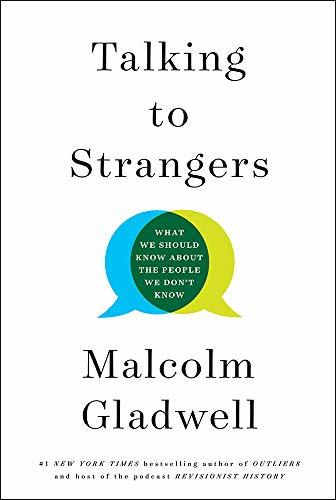
Talking to Strangers Book Summary
What We Should Know About the People We Don’t Know
Book by Malcolm Gladwell
Summary
In "Talking to Strangers," Malcolm Gladwell argues that our natural instincts are ill-suited for a world of frequent stranger interactions. Through case studies and research, he reveals how misguided assumptions lead to disastrous misunderstandings and offers insights on more thoughtful engagement.
Spies and Diplomats: Two Puzzles
Fidel Castro's Revenge
In 1987, Cuban intelligence officer Florentino Aspillaga defected to the U.S. and revealed a shocking truth to the CIA: nearly their entire network of spies and informants inside Cuba actually consisted of double agents, carefully selected and controlled by Fidel Castro to feed disinformation to the Americans. For years, the U.S. intelligence community had been duped, their secret intelligence coming from agents who were really loyal to Castro all along. It was an astonishing failure to detect deception on a massive scale.
Section: 1, Chapter: 1
The Failure of CIA's Polygraph Tests
The CIA requires its spies and informants to periodically take polygraph (lie detector) tests to verify their truthfulness and loyalty. However, as Aspillaga revealed, Cuba's double agents had little trouble passing these tests:
"The head of the polygraph division personally gave a clean bill of health to six Cuban agents who ended up being doubles. Other times, the Cubans would fail. But what happened when they did? The people running the Cuban section dismissed it."
The CIA personnel were so confident in their agents, they explained away the failed tests rather than confront the difficult truth that they were being deceived.
Section: 1, Chapter: 1
Strategies for detecting deception almost never work in real-time
As the Aspillaga case illustrates, even highly trained experts using sophisticated methods frequently fail to catch lies and deception in face-to-face interactions. Humans have a strong tendency to default to believing others are telling the truth. While we may pick up on suspicions or doubts, it often takes an overwhelming amount of evidence for us to conclude with certainty that someone is lying to us directly. Catching deception in real-time is exceedingly difficult. Understanding this limitation can make us more cautious about the ability to sniff out lies when dealing with strangers.
Section: 1, Chapter: 1
The Clarity of Distance
Snippet Body: Gladwell highlights how Chamberlain's cabinet members back in London, who never interacted with Hitler directly, were much more clear-eyed about the German dictator's untrustworthiness and belligerent intentions:
"Winston Churchill, for example, never believed for a moment that Hitler was anything more than a duplicitous thug. Churchill called Chamberlain's visit "the stupidest thing that has ever been done." But Hitler was someone he'd only ever read about. Duff Cooper, one of Chamberlain's cabinet ministers, was equally clear-eyed. He listened with horror to Chamberlain's account of his meeting with Hitler. Later, he would resign from Chamberlain's government in protest."
By only reading Hitler's own writings and speeches, rather than getting enchanted by his charisma in person, they maintained a healthy skepticism.
Section: 1, Chapter: 2
The Partiality of Court Judges
Gladwell cites a striking study by economist Sendhil Mullainathan comparing the bail decisions made by experienced judges to a basic computer algorithm. The algorithm only considered the defendant's age and criminal record, while the judges met the defendants face-to-face and could evaluate their character and credibility. Yet the algorithm dramatically outperformed the judges:
"The people on the computer's list were 25 percent less likely to commit a crime while awaiting trial than the 400,000 people released by the judges of New York City. 25 percent! In the bake-off, machine destroyed man."
With just a fraction of the information available to judges, the simple algorithm made far more accurate judgments about which defendants could be safely released. The study highlights the limits of relying on intuitive character judgments from in-person interactions.
Section: 1, Chapter: 2
Default to Truth
The Spy Who Duped the DIA
Ana Montes, a high-ranking analyst at the Defense Intelligence Agency (DIA), was considered the U.S. government's top Cuban expert. However, she was actually a Cuban spy who had been feeding classified information to Havana for years. Despite some of her colleagues having doubts about her loyalty, Montes successfully deceived the DIA for nearly two decades before finally being caught. Her case illustrates how even well-trained intelligence professionals can fail to detect a spy in their midst.
Section: 2, Chapter: 3
The Default to Truth: Why We're Wired to Believe
According to psychologist Tim Levine's "Truth-Default Theory":
- Humans are inherently trusting and tend to assume others are honest by default
- Believing is cognitively easier than doubting, so we default to truth to conserve mental energy
- Doubts about someone's honesty must reach a high threshold before we abandon our default trust
- Most lies go undetected because suspicion doesn't rise to the level of sustained, conscious questioning
In short, we're not built to be naturally skeptical, but to take people at their word unless faced with overwhelming evidence to the contrary. This leaves us vulnerable to deception.
Section: 2, Chapter: 3
We Default to Truth
"We have a default to truth: our operating assumption is that the people we are dealing with are honest."
Section: 2, Chapter: 3
The Convincing Liar: A Disturbing Demonstration
In an unsettling experiment, Levine had students engage in a trivia game where some were incentivized to cheat. Afterward, Levine interviewed them about whether any cheating occurred, with some lying and others telling the truth. When outside observers watched recordings of the interviews, they were only able to detect the liars 54% of the time - barely better than flipping a coin. Even more troubling, trained law enforcement officers performed even worse, correctly identifying only 20% of liars who didn't fit stereotypical behaviors. The study reveals how poor humans are at intuiting dishonesty from demeanor alone.
Section: 2, Chapter: 3
Why We Believe in Someone
"Belief is not the absence of doubt. You believe someone because you don't have enough doubts about them."
Section: 2, Chapter: 3
Bernie Madoff's Mighty Downfall
Bernie Madoff orchestrated the largest Ponzi scheme in history, duping thousands of investors out of billions of dollars. Despite numerous red flags raised by whistleblower Harry Markopolos, Madoff evaded detection for years. While many Wall Street insiders harbored doubts about Madoff's unrealistically steady returns, they failed to act on those doubts, instead giving Madoff the benefit of the doubt due to his reputation. The Madoff case showcases how our default to truth can blind us to warning signs of fraud.
Section: 2, Chapter: 4
The Holy Fool: Society's Skeptical Savior?
Gladwell profiles whistleblower Harry Markopolos, who doggedly tried to expose Madoff's Ponzi scheme for years. Unlike most people, Markopolos was inherently skeptical and didn't default to trusting Madoff's implausible claims. Markopolos represents the "Holy Fool" archetype:
- Willing to challenge respected authority figures and accepted narratives
- Not concerned with social approval or "rocking the boat"
- Faces criticism and scorn for unconventional stances
- Provides a valuable societal role by voicing unpopular truths
While Holy Fools can help us confront uncomfortable realities, Gladwell argues we can't all adopt their degree of cynicism without grinding society to a halt. A certain level of trust is necessary for social functioning.
Section: 2, Chapter: 4
The Penn State Puzzle: Unraveling the Jerry Sandusky Scandal
The shocking child molestation case against former Penn State football coach Jerry Sandusky rocked the university. Assistant coach Mike McQueary testified he saw Sandusky sexually assaulting a boy in the locker room showers, but at the time only reported it to head coach Joe Paterno and two university officials. They also failed to alert law enforcement. Years later, McQueary's story, along with victim testimonies, led to Sandusky's conviction and raised questions of a university cover-up. However, a closer look reveals a more complex picture of officials struggling to make sense of an ambiguous situation involving a respected community figure.
Section: 2, Chapter: 5
Transparency
Lessons
Coupling
Related Content
Super Communicators Book Summary
Charles Duhigg
Who and what are supercommunicators? They're the people who can steer a conversation to a successful conclusion. They are able to talk about difficult topics without giving offence. They're brilliant facilitators and decision-guiders. How do they do it?
Who and what are supercommunicators? They're the people who can steer a conversation to a successful conclusion. They are able to talk about difficult topics without giving offence. They're brilliant facilitators and decision-guiders. How do they do it?
Self-Help
Psychology
Leadership
Business
Communication