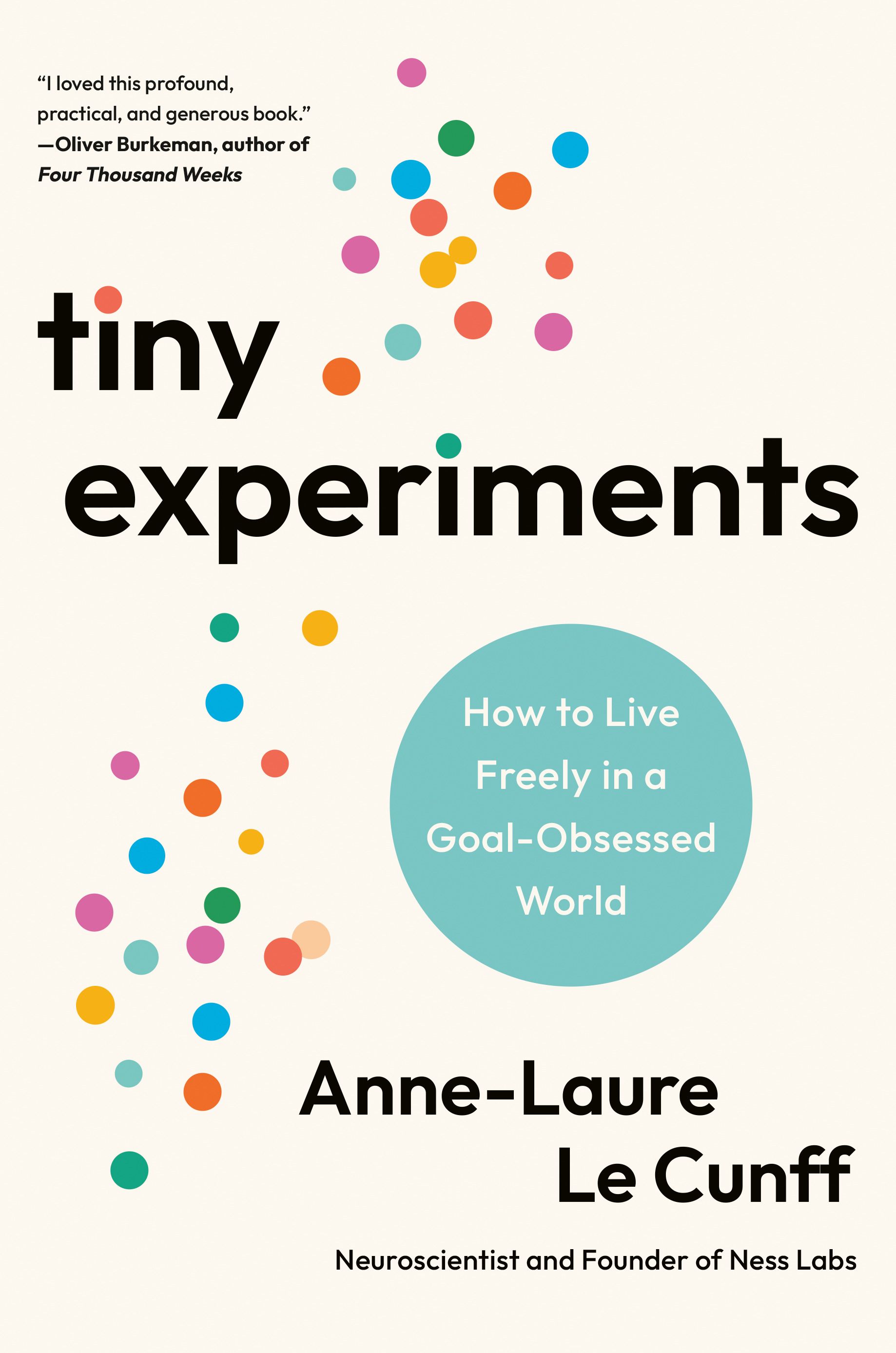
Tiny Experiments Book Summary
How to Live Freely in a Goal-Obsessed World
Book by Anne-Laure Le Cunff
Summary
Tiny Experiments offers not just practical tools to make sure your most vital work gets done, but a guide to reawakening your curiosity and drive in a noisy, busy, disaffected world, so that you can discover and pursue your most authentic ambitions while making a meaningful contribution.
The Courage To Leave Your Dream Job
At 27, Anne-Laure Le Cunff resigned from her dream job at Google, a position that offered excellent pay, international travel, challenging work, and limitless career potential. Her resignation puzzled her manager, who asked, "Are you sure?" This seemingly irrational career move came after a health scare—a blood clot that required surgery—and a Christmas visit home where she realized she had become disconnected from herself.
Despite being trained to climb the corporate ladder with clearly mapped metrics for success, she found herself burned out, bored, and blindly pursuing predefined goals. The once-enthusiastic employee had lost touch with her natural curiosity and creative spirit that had driven her earlier adventures, including leaving her native France to study in Japan and later Canada.
Section: 1, Chapter: 0
From One Linear Path To Another
After quitting Google, Le Cunff immediately jumped into what she calls "another kind of hyperfocused, outcome-driven pursuit"—founding a tech startup. Though initially successful, with her venture being highlighted in WIRED magazine as one of "the healthcare startups you need to know about," the company eventually failed to advance in its accelerator program.
This forced failure created space for reflection. Le Cunff describes this moment as liberating: "I admitted that I was lost. And that was the most liberating thought I'd ever had." Instead of immediately seeking another linear career path, she embraced the uncertainty and reconnected with her curiosity, following her interests to neuroscience studies and creating a blog where she committed to writing 100 articles in 100 workdays.
Section: 1, Chapter: 0
The Value Of In-Between Spaces
Le Cunff introduces two contrasting responses to liminal spaces—those in-between territories where old rules no longer apply:
1. Response 1: Discomfort and fear - When faced with uncertainty, many react with anxiety, trying to escape or numb the experience, praying for someone else to take control.
2. Response 2: Delight and curiosity - An alternative response embraces the in-between state as an opportunity for exploration, relaxation, and discovery—engaging with new ideas or connecting with strangers.
This framework helps explain why uncertainty is so challenging: our brains are wired to quickly label situations as good or bad. Research shows uncertainty causes more stress than inevitable pain. When we don't know what's coming, we often fall back on defense mechanisms like cynicism, escapism, or perfectionism, abandoning both curiosity and ambition.
Section: 1, Chapter: 0
Tools For The Experimental Life
The book offers a four-part framework for replacing linear models of success with an experimental model of growth:
1. Pact: Commit to curiosity - Get started by creating small experiments rather than setting rigid goals
2. Act: Practice mindful productivity - Keep going through sustainable approaches to work and rest
3. React: Collaborate with uncertainty - Stay flexible by viewing disruption as data rather than disaster
4. Impact: Grow with the world - Dream bigger by connecting with others and building in public
These tools collectively foster what Le Cunff calls "systematic curiosity"—a conscious commitment to inhabit the space between what you know and what you don't with interest and openness rather than fear and anxiety.
Section: 1, Chapter: 0
Amelia Earhart's Experimental Life
Amelia Earhart, famous for being the first woman to fly solo across the Atlantic, actually took a far more experimental path than most history books record. Five years before her legendary solo flight, she accepted an offer to be a passenger (not pilot) on a transatlantic flight when another woman deemed it too risky. This first experience enabled her to gather resources for her later solo venture.
Beyond aviation, Earhart continually experimented in diverse fields. She worked as a telephone company clerk to fund her flying, started a portrait photography business, launched a trucking company, designed a functional women's clothing line, and became a university consultant supporting women in male-dominated fields. She even experimented in her personal life, telling her husband she wouldn't be bound by "any medieval code of faithfulness" in their marriage.
Earhart described "liking to experiment" as the common thread in her life—"the something inside me that has always liked to try new things." Her willingness to swerve repeatedly in pursuit of her ambitions made her life extraordinary.
Section: 1, Chapter: 1
The Flaws Of Linear Goals
Traditional goal-setting approaches based on linear progression suffer from three major flaws:
1. Linear goals stimulate fear : Starting something new outside our comfort zone is daunting. Without expertise from experience, we're uncertain where to begin. The sheer number of options can lead to analysis paralysis, while concerns about qualifications, resources, or potential failure can trigger debilitating anxiety.
2. Linear goals encourage toxic productivity : Research shows many goals people pursue "may be merely justifications to keep themselves busy." This mindset creates an overly strict relationship with work where we believe missing any task will cause everything to collapse. We work while sick, cancel social plans, and feel guilty about breaks—creating a treadmill that leaves us mentally drained and paradoxically less productive.
3. Linear goals breed competition and isolation : When everyone climbs the same ladder, we become competitive for the wrong reasons, viewing potential collaborators as rivals. This isolating mentality prevents the pooling of resources and collaborative learning that could benefit our careers and communities.
Section: 1, Chapter: 1
From Fixed Ladders To Growth Loops
Le Cunff proposes three mental shifts to move away from rigid linear goals:
1. From Response 1 to Response 2 : Shift from automatic anxiety-based reactions to uncertainty (Response 1) toward autonomous, agency-based engagement (Response 2). When you develop this skill, uncertainty transforms from something to escape into somewhere to explore. Instead of being a passive passenger, you become actively engaged in possibilities.
2. From fixed ladders to growth loops : Replace the mental model of linear progression up a ladder with iterative cycles of experimentation. Rather than focusing on predictable steps along a planned trajectory, widen each loop by nurturing creativity and exploring promising tangents instead of dismissing them as distractions.
3. From outcome to process : Move away from measuring success by achieving big, ambitious goals and toward defining progress through incremental experimentation. Success becomes an unfolding path rather than a fixed target, allowing change to become a source of reinvention rather than disruption.
Section: 1, Chapter: 1
Ron Finley's Multiple Paths To Impact
Ron Finley began his career as a successful clothing designer who created collections sold in major retail stores across America. When recession struck and stores stopped calling, he unexpectedly found a new passion. Frustrated by living in a food desert where it was "easier to buy street drugs than organic tomatoes," he started growing fruits and vegetables on the strip of land between sidewalk and curb outside his house.
When cited for gardening without a permit, Finley fought back with a petition that ultimately changed Los Angeles law. His TED talk sparked the guerrilla gardening movement, positioning urban gardening as a revolutionary act against broken food systems. Today, his once-simple garden teems with pears, oranges, figs, pomegranates, and even banana trees.
Interestingly, Finley's gardening fame opened new doors for his fashion career, showing how multiple interests can strengthen rather than dilute one's impact. "I didn't go from fashion to gardening to being a humanitarian," Finley explains. "As a gardener, I was already a humanitarian. When I'm designing, I'm still a gardener. I'm still creative. This is about freedom. It's all already within us."
Section: 1, Chapter: 2
The Three Scripts That Limit Our Potential
Our lives are constrained by three cognitive scripts that quietly dictate our choices:
1. The Sequel Script : We feel compelled to make decisions that conform with our past behaviors, creating artificial limits through what psychologists call "continuation bias" and what Le Cunff terms the "self-consistency fallacy." If the next logical step after business school is joining a consulting company, starting your own firm might feel like too much of a departure. This script makes us rehash old tales rather than facing the discomfort of a blank page.
2. The Crowdpleaser Script : We adjust our decisions to meet others' expectations, driven by fear of social exclusion or guilt about diverging from conventional paths. Neuroimaging shows that the same brain region handling conflict activates when our choices differ from the group's. This script leads us to pursue socially sanctioned success rather than following our authentic curiosity.
3. The Epic Script : We chase grand narratives like "follow your passion" or "find your purpose." This script creates the illusion that we should have a single overarching purpose, and that pursuing it will automatically lead to success. Research shows mantras like "find your passion" actually increase the likelihood of giving up when inevitable challenges arise.
Section: 1, Chapter: 2
Field Notes: Becoming The Anthropologist Of Your Life
Instead of trying to discover one predetermined purpose, approach your life like an anthropologist conducting fieldwork. For just one day, create a note on your phone called "Field Notes" and record observations about your experiences:
1. Capture in real-time : Throughout the day, jot down brief notes with timestamps whenever something crosses your mind—inspiring articles, thought-provoking conversations, ideas that come to you on the train, or feelings before an important presentation.
2. Focus on categories like :
- Insights: Moments of curiosity, random thoughts, and questions that spark interest
- Energy: Shifts in energy levels and what gives or drains your energy
- Mood: Emotions during or after specific experiences
- Encounters: Social interactions and insights from connections
3. Analyze patterns : After 24 hours, review your notes to identify recurring themes and feelings. Look for what gives you joy, what drains you, what you want more or less of. Pay attention to invisible gaps and "curiosity attractors"—areas where you feel a yearning toward something different.
Section: 1, Chapter: 2
The Power Of A Pact
A pact is a pledge to engage in a particular activity for a predetermined period of time. It follows a simple format: "I will [action] for [duration]."
What makes a pact effective is that it focuses on outputs (e.g., "publish 25 newsletters over 25 weeks") rather than outcomes (e.g., "get 5,000 newsletter subscribers in 25 weeks"). It gives you confidence to start because there's no wrong choice—you simply need to show up.
An effective pact has four key characteristics:
1. Purposeful : Though freed from fixating on outcomes, a pact should feel exciting and provide meaning through the learning journey itself.
2. Actionable : Based on actions you can reliably perform with current resources, enabling immediate action rather than endless planning.
3. Continuous : Built around simple, repeatable actions to collect consistent data (e.g., something you do daily, weekly, or on weekends).
4. Trackable : Measured with a binary question—Have you done it or not?—making progress monitoring straightforward.
Section: 1, Chapter: 3
How Repeated Trials Build Confidence And Skills
Khe Hy, who left Wall Street after fifteen years to become an internet creator, committed to trying experiments for specific durations: "I'm going to try Snapchat for a month and see what happens, or I'm going to try a podcast for fifty-two weeks."
Committing in advance to a specific duration has a crucial advantage: it forces you to wait until after a pre-agreed number of iterations before making a decision. This makes you less likely to abandon your pact because of one particularly challenging week.
Repeated trials are essential for building both skills and confidence. The "serial-order effect," considered "one of the oldest and most robust findings in modern creativity work," shows that later responses to a creative problem are typically better than earlier ones. This principle applies not just to short-term tasks but to creativity throughout life—contrary to startup mythology glorifying youth, founders in their fifties are almost twice as likely to reach a successful exit as those in their thirties.
Section: 1, Chapter: 3
Start Small To Make Big Progress
When Corin Delgay's scented candles business failed, he learned he didn't enjoy running numbers and balance sheets. Yet throughout this venture, people had praised his creative thinking. Delgay decided to explore his artistic side with a tiny experiment: "I said, let me paint twenty paintings without trying to create a masterpiece."
The first paintings were far from perfect, but he remained committed to his daily practice, using online tutorials to refine each version. "I was just looking for mistakes to learn from," he explained. "It came from a place of no ego and the confidence that I would get better over time."
After only three weeks, he organized an event where he sold five paintings. Today, his gallery in Barcelona is thriving, with art aficionados visiting from around the world. And Delgay still paints daily, often in public at the gallery or live events. "Once you have this positive momentum, it doesn't feel like work," he says.
His example illustrates the importance of starting with the smallest possible version of your experiment—especially when choosing between two versions of a pact.
Section: 1, Chapter: 3
The Productivity Obsession
Modern culture's obsession with productivity creates a toxic relationship with time. Le Cunff describes interviewing numerous "recovering productivity junkies" who shared similar stories—engineers, startup founders, educators, nurses, and executives who had pushed themselves to burnout through relentless execution.
This pressure to maximize productivity stems from multiple sources. Culturally, being productive is seen as a moral imperative; as management theorist Peter Drucker noted, "On [productivity] rest all of the economic and social gains of the 20th century." Growing up with role models who highly value productivity—praising grades over effort, obsessing over learning new skills, packing activities into weekends—can cause us to internalize this mindset.
Major life transitions can also trigger productivity mania as we seek control during uncertain times. One community member described meticulously logging even his limited leisure time on spreadsheets after starting a high-stress startup job. For neurodivergent individuals, productivity can become a fixation, leading to endless research of tools and techniques that paradoxically become distractions from actual work.
Section: 2, Chapter: 4
Chronos Versus Kairos: Two Ways To Experience Time
The ancient Greeks had two distinct words for time that reveal profoundly different ways of experiencing it:
1. Chronos : The quantitative, mechanical time of clocks and calendars. It's depicted as identical units marching inexorably forward, creating a sense of scarcity and urgency. The image "Your Life in Weeks" exemplifies this view—showing life as identical boxes that will eventually run out.
2. Kairos : The qualitative, fluid experience of time. It recognizes that some moments carry special weight or potential. Le Cunff likens Kairos moments to what she calls "magic windows"—periods of flow that occur when we're immersed in captivating activities, connecting with loved ones, or engaged in self-reflection.
While Chronos rules most of our modern existence, our actual experience is more like Kairos. Research confirms that our perception of time is elastic—emotional experiences, physiology, cognitive engagement, and even cultural factors all influence how time feels to us. The week you submitted an important proposal likely felt much longer than a typical week, while time seems to speed up as we age.
Section: 2, Chapter: 4
Mindful Productivity: Managing Your Resources
Instead of managing time (a Chronos approach), mindful productivity focuses on managing three interrelated resources:
1. Physical Resources: Managing Energy - Honor your chronotype (morning lark, night owl, or "third bird")
- Track energy levels throughout the day to identify your personal peaks and valleys
- Schedule demanding tasks during your natural energy peaks
- Respect biological rhythms including daily cycles, hormonal shifts, and seasonal changes
2. Cognitive Resources: Managing Executive Function - Recognize limits to attention and working memory
- Practice sequential focus (one thing at a time) to work with cognitive bottlenecks
- Consider your environment when choosing tasks
- Close unnecessary apps and eliminate distractions during focused work
3. Emotional Resources: Managing Emotions - Distinguish between eustress (positive stress) and distress (harmful stress)
- Notice when stress accumulates to a critical point
- Use conscious movement to stimulate your parasympathetic nervous system
- Develop emotional agility to navigate your emotional landscape
Section: 2, Chapter: 4
Creating A Kairos Ritual
To shift from Chronos (mechanical time) to Kairos (qualitative time) when life demands productivity, develop a personal Kairos ritual—a simple practice that helps you open a magic window for focused work:
1. Choose a simple, repeatable action that can quickly shift your state of being:
- Agathe Cury sits in a corner of the room and does a quick breathing exercise
- François Singer walks slowly in circles or briefly lies down
- Anaïs Ait Ouazzou listens to mood-boosting music
- Manuela Da Cunha goes to another room, closes the door, and takes deep breaths
- Jem Chevillotte makes a cup of tea in a five-minute disconnect
2. Focus on practicality : Choose something you can easily do in your typical work environment
3. Make it personally meaningful : Select something you enjoy and look forward to
These rituals work by physically guiding you to pause and recalibrate energy, cognitively interrupting autopilot mode, and emotionally offering a sanctuary to acknowledge feelings and reconnect with yourself.
Section: 2, Chapter: 4
Related Content
Atomic Habits Book Summary
James Clear
Atomic Habits reveals the surprising power of small habits, demonstrating how tiny changes can compound into remarkable results over time. By focusing on systems over goals and building identity-based habits, you can create lasting change and unlock your full potential.
Atomic Habits reveals the surprising power of small habits, demonstrating how tiny changes can compound into remarkable results over time. By focusing on systems over goals and building identity-based habits, you can create lasting change and unlock your full potential.
Productivity
Personal Development
Psychology