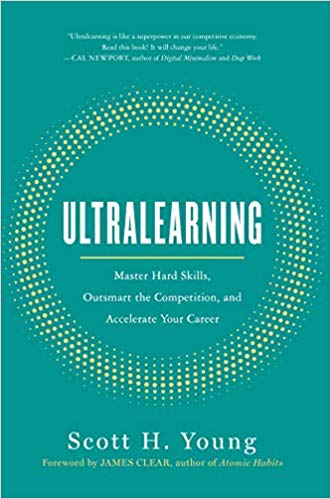
Ultralearning Book Summary
Master Hard Skills, Outsmart the Competition, and Accelerate Your Career
Book by Scott Young
Summary
In "Ultralearning," Scott Young reveals the powerful principles and strategies used by elite self-directed learners to rapidly master hard skills and tackle ambitious projects, showing you how to create your own custom learning journeys to accelerate your career, expand your knowledge, and maximize your potential.
MIT Challenge: Learning 4 Years of Computer Science in 12 Months
Scott Young undertook the MIT Challenge, attempting to learn MIT's 4-year computer science curriculum in just 12 months using their freely available course materials. He aimed to pass the final exams and complete the programming projects. This self-directed learning project demonstrated the potential of intensive, focused learning outside of formal education.
Similarly, To prepare for Jeopardy!, Roger Craig downloaded tens of thousands of questions and answers from past shows. He analyzed the data to uncover common topics, patterns in where Daily Doubles appeared, and studied using spaced-repetition software. This data-driven, systematic approach led him to break records on the show.
Section: 1, Chapter: 1
Average Is Over: Thriving in an Era of Technological Change
Due to computerization, automation and outsourcing, the job market is facing "skill polarization" where middle-skill jobs are disappearing and high-skill, technology-focused jobs are in demand. To succeed, individuals will need to develop specialized skills through aggressive self-education. Ultralearning provides a path to rapidly acquiring the skills needed to thrive in this new landscape.
College tuition costs are skyrocketing, saddling students with debt, while often failing to teach in-demand job skills. For those unable to attend college, ultralearning provides an alternative path to gain career-relevant abilities. Even college graduates often have skill gaps that ultralearning can fill. The self-directed nature of ultralearning makes it adaptable to a wider range of life situations compared to formal education.
Section: 1, Chapter: 2
The 3 Steps to Become an Ultralearner
Tristan de Montebello went from no public speaking experience to finalist in the World Championship of Public Speaking in 7 months by following the 3 steps to become an ultralearner:
- Do your research - benchmark how others have learned the skill and gather resources
- Schedule your time - decide how much time to commit and make a consistent learning schedule
- Execute your plan - start learning, notice when you deviate from ultralearning principles, and course-correct
Section: 1, Chapter: 3
The 9 Universal Principles of Ultralearning
Ultralearning projects follow 9 universal principles:
- Metalearning - draw a map by learning how to learn the skill effectively
- Focus - cultivate deep concentration and make learning your primary focus
- Directness - learn by directly doing the thing you want to become good at
- Drill - attack your weakest points through targeted exercises
- Retrieval - test yourself to learn, don't just passively review
- Feedback - don't avoid negative feedback, use it as valuable data to improve
- Retention - understand what you forget and why, learn to remember
- Intuition - play with concepts to develop intuitive understanding
- Experimentation - explore outside your comfort zone, don't stick to preset methods
Section: 1, Chapter: 3
Metalearning: Learning How to Learn for Rapid Skill Acquisition
Metalearning is the process of learning how to learn a subject or skill efficiently. By understanding how knowledge is structured in the domain you're learning, and what methods are effective for learning it, you can create a "map" that accelerates your learning. Metalearning research helps you avoid wasting time on suboptimal methods.
Take the following example: Linguist Daniel Everett can decipher the basics of a new language in just a few hours of interaction with a native speaker. He does this by using metalearning - his extensive knowledge of linguistic concepts and his practiced techniques for eliciting example words and phrases. This allows him to quickly build a "map" of an unfamiliar language.
Section: 1, Chapter: 4
The 3 Questions of Metalearning: Why, What, and How
To reap the benefits of metalearning for your own learning projects, create a metalearning map by asking yourself three key questions:
- Why am I learning this, and what do I want to do with this skill/knowledge? Get clear on your purpose and the specific situations in which you want to apply what you're learning. This will help you zero in on the highest-value knowledge to focus on.
- What concepts, facts, and procedures do I need to learn to reach my goal? Deconstruct the skill into its component concepts, identifying which ones are most essential. Not everything is equally important.
- How can I learn this most efficiently? What learning resources and techniques work best for mastering this skill? Research the experiences of experts and past learners to uncover what methods work best. Adopt their strategies while tailoring your approach to your own situation and needs.
Section: 1, Chapter: 4
Learning How to Learn is a Superpower
"Each project you do will improve your general metalearning. Every project has the opportunity to teach you new learning methods, new ways to gather resources, better time management, and improved skills for managing your motivation...Ultimately, this effect far outweighs the effect of doing a specific project."
Section: 1, Chapter: 4
The Arch-Enemies of Focus: Start Friction, Distraction, and Failing to Engage
For many, the hardest part of learning is simply summoning the focus to get started and maintain concentration in the face of distractions. There are three main enemies of focus that you need to conquer to learn effectively:
- Failing to start due to procrastination - This "start friction" often stems from an aversion to a challenging or boring task, or an attraction to more instantly gratifying distractions. Make starting as easy as possible with techniques like the 5-minute rule (commit to focusing for just 5 minutes, then see if you want to continue) or the Pomodoro method of timing focused work sessions.
- Failing to sustain focus due to interruptions - External distractions like noise or notifications can derail your focus. Eliminate these interruptions as much as possible by controlling your environment and devices.
- Failing to engage the right type of focus for the task at hand - A scattered, reactive focus works for creative tasks, but analytical work requires deep, narrow concentration and reflection. Match your focus type to the demands of the task - whether it requires more open awareness or narrow precision.
Section: 1, Chapter: 5
Don't Chase Flow States - Embrace Struggle as Part of the Learning Process
Many people have internalized the idea that learning should always feel smooth, easy, and pleasurable - a constant flow state. But this conception is misleading and counterproductive. Challenging learning often involves struggle, even a sense of being lost and confused.
Embrace a degree of struggle as not just normal but desirable for growth. Focus on creating conditions for focused concentration - blocking distractions, working on one thing at a time, and giving your full effort. But don't put pressure on yourself to always feel perfectly locked in.
Trust the process. Throw your focus fully into the task, even when it feels hard, and trust that with time, the concepts will clarify. Skill development is a cycle of challenge and mastery. Embrace both phases, knowing that the discomfort is temporary but the competence you're building is long-term.
Section: 1, Chapter: 5
Transfer Is the Holy Grail of Education
"Transfer, the ability to apply classroom learning to real-world problems, is startlingly rare. In many studies, students with years of classroom learning failed to transfer basic concepts to new situations. Even small changes in problem formats caused students' learning to break down. Transfer is the "Holy Grail" of education that is seldom achieved through standard classroom instruction."
Section: 1, Chapter: 5
The Problem With Classroom Learning
Achieving transfer - the ability to apply abstract classroom learning to messy real-world problems - has been called the "Holy Grail" of education. Yet research shows that even top students frequently fail to transfer their knowledge to new situations.
The issue stems from how formal education is structured. Classroom learning is often abstract and de-contextualized from real-world applications. It prioritizes memorizing facts and procedures over practicing skills in context. This trains students to execute set problem types but leaves them ill-equipped to transfer that knowledge to novel situations.
Enter the directness principle. Directness is ultralearning's answer to the transfer problem - learning a skill by doing it in the context you want to use it. The closer your practice matches your target environment, the more readily your skills will transfer.
Section: 1, Chapter: 6
Related Content

A Mind For Numbers Book Summary
Barbara Oakley
"A Mind for Numbers" by Barbara Oakley reveals the science-backed techniques and insights that can transform anyone's ability to excel in math, science and complex subjects by harnessing the brain's innate learning abilities.
"A Mind for Numbers" by Barbara Oakley reveals the science-backed techniques and insights that can transform anyone's ability to excel in math, science and complex subjects by harnessing the brain's innate learning abilities.
Learning
Education
Personal Development
Productivity
Make It Stick Book Summary
Peter Brown, Henry Roediger, Mark McDaniel
Make It Stick offers powerful, evidence-based strategies for deeper, more durable learning - spacing, retrieval, interleaving, elaboration, generation, and reflection - that challenge conventional study habits and unlock our full learning potential.
Make It Stick offers powerful, evidence-based strategies for deeper, more durable learning - spacing, retrieval, interleaving, elaboration, generation, and reflection - that challenge conventional study habits and unlock our full learning potential.
Learning
Education
Psychology
Productivity
Personal Development