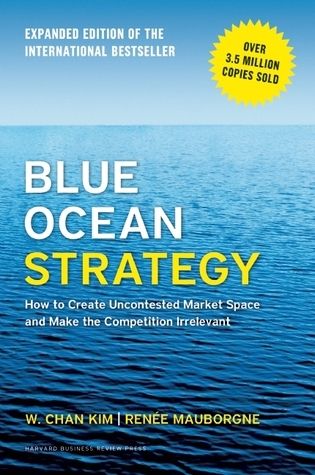
Blue Ocean Strategy Book Summary
How to Create Uncontested Market Space and Make the Competition Irrelevant
Book by W. Chan Kim and Renee Mauborgne
Summary
Forget battling sharks in bloody red oceans. Blue Ocean Strategy shows you how to create your own uncontested market space, making the competition irrelevant and opening a sea of opportunities for profitable growth.
Section 1: Blue Ocean Strategy
Section 1 of "Blue Ocean Strategy" sets the stage for the book's core message: escaping the "red ocean" of bloody competition by creating "blue oceans" of uncontested market space. It highlights the increasing challenges faced by businesses in overcrowded industries, where competition is fierce and profits are shrinking.
The authors argue that companies need to shift their focus from battling rivals to creating new demand and value innovation. They introduce the metaphor of red and blue oceans to vividly illustrate the contrast between these two strategic approaches. Additionally, the section explores several global trends that make blue ocean strategy even more crucial in today's business environment, such as the rising demand for creative solutions, the power of social media, and the increasing ease of global competition.
Chapter 1 Details
- The problem: Businesses face increasingly intense competition in existing industries, leading to shrinking profits and limited growth opportunities.
- The solution: Blue Ocean Strategy encourages businesses to break away from the competition by creating new market space, making the competition irrelevant.
- The Analogy: Red Oceans represent existing industries with defined boundaries and fierce competition, while Blue Oceans represent untapped market space with the potential for high growth and profitability.
- Value Innovation: This concept emphasizes creating a leap in value for both buyers and the company, thereby rendering the competition irrelevant. It challenges the traditional value-cost trade-off by pursuing differentiation and low cost simultaneously.
- Case Study: By offering a unique blend of circus and theater, Cirque du Soleil created a new market space, attracting a new customer base and achieving high profitability.
- Impact of Blue Oceans: Studies show that blue ocean initiatives, despite being fewer in number, generate a significantly higher proportion of total profits and growth compared to red ocean initiatives.
Section: 1, Chapter: 1
[yellow tail] case study
Case Study: [yellow tail] By applying the four actions framework and focusing on non-customers, [yellow tail] created a blue ocean in the US wine industry with a fun and easy-to-drink wine, achieving rapid growth and profitability.
Section: 1, Chapter: 2
Cirque du Soleil: A Case of Value Innovation
The book uses Cirque du Soleil as a prime example of value innovation. Instead of competing with traditional circuses, Cirque created a new market space by:
Eliminating costly elements: like animal shows and star performers.
Reducing elements: like the number of rings and the emphasis on thrilling stunts.
Raising elements: like the quality of the venue and the artistic value of the performances.
Creating elements: like a storyline and multiple productions.
Section: 1, Chapter: 1
Focus on Noncustomers
"To fundamentally shift the strategy canvas of an industry, you must begin by reorienting your strategic focus from competitors to alternatives, and from customers to noncustomers of the industry."
Section: 1, Chapter: 2
Quote from Chapter 1
"Instead of focusing on beating the competition, you focus on making the competition irrelevant by creating a leap in value for buyers and your company, thereby opening up new and uncontested market space."
Section: 1, Chapter: 1
From Red Oceans to Blue Oceans: The Tools You Need
Chapter 2 introduces a set of analytical tools and frameworks for creating blue oceans:
The Strategy Canvas: A visual tool to depict the current state of play in a market space and identify opportunities for differentiation and low cost.
The Four Actions Framework: A framework with four key questions to challenge an industry's strategic logic and reconstruct buyer value elements.
The Eliminate-Reduce-Raise-Create Grid: A grid to ensure that companies pursue all four actions of the framework to create a new value curve.
Section: 1, Chapter: 2
Six Paths to Uncharted Waters
The six paths framework, a systematic approach to reconstructing market boundaries and creating blue oceans. These paths involve looking across:
Alternative Industries: Explore industries that offer alternative solutions to the same customer need.
Strategic Groups within Industries: Analyze different strategic groups within your industry and identify factors that lead customers to trade up or down.
The Chain of Buyers: Consider the entire buyer chain, including purchasers, users, and influencers, and explore opportunities to shift focus.
Complementary Product and Service Offerings: Identify pain points in the customer experience and offer complementary products or services to create a total solution.
Functional or Emotional Appeal to Buyers: Challenge the conventional functional or emotional orientation of your industry.
Time: Analyze trends over time and consider how they will impact customer value and your business model.
Section: 1, Chapter: 3
Section 2: Analytical Tools and Frameworks
This section dives into the practical tools and frameworks that are essential for creating and capturing blue oceans. It introduces the strategy canvas, a visual tool for understanding the current state of play in a market and for developing a differentiated strategic profile. The four actions framework helps companies break the value-cost trade-off by asking four key questions: eliminate, reduce, raise, and create. Finally, the eliminate-reduce-raise-create grid serves as a visual aid for implementing the four actions framework and building a new value curve.
From Functional to Fun: QB House Haircuts
QB House created a blue ocean in the Japanese barbershop industry by shifting the focus from emotional appeal to functionality. They stripped away unnecessary services and focused on quick, efficient haircuts, attracting customers who valued speed and convenience.
Section: 1, Chapter: 3
From Red to Blue in Four Steps
Four-step process for visualizing strategy and creating blue oceans:
Visual Awakening: Draw the current strategy canvas to understand your position and the need for change.
Visual Exploration: Go into the field and observe customers, noncustomers, and alternatives to gain insights into new value opportunities.
Visual Strategy Fair: Present potential blue ocean strategies and get feedback from external parties.
Visual Communication: Communicate the new strategy visually to ensure clarity and understanding throughout the organization.
Section: 2, Chapter: 4
The Power of Visual Strategy
Chapter 4 introduces an alternative approach to strategic planning that focuses on the big picture instead of numbers. This approach involves drawing a strategy canvas to visualize the current state of play in a market and identify opportunities for creating blue oceans.
Section: 2, Chapter: 4
Section 3: Formulating Blue Ocean Strategy
1. Reconstruct Market Boundaries: This principle, explored through the six paths framework, encourages companies to look beyond the confines of their current industry and explore new market spaces by looking across alternative industries, strategic groups, buyer groups, complementary offerings, functional-emotional orientations, and time.
2. Focus on the Big Picture, Not the Numbers: This principle advocates for a visual approach to strategy formulation using tools like the strategy canvas and the pioneer-migrator-settler (PMS) map to develop and communicate a clear and compelling strategic profile.
3. Reach Beyond Existing Demand: To maximize the size of a blue ocean, companies should focus on noncustomers and their commonalities, rather than getting caught up in finer segmentation and catering to existing customer preferences. Understanding the three tiers of non-customers (soon-to-be, refusing, and unexplored) is key to unlocking new demand and expanding the market.
4. Get the Strategic Sequence Right: This principle emphasizes the importance of building a robust business model by following a specific sequence: buyer utility, price, cost, and adoption. Tools like the buyer utility map, the price corridor of the mass, and the three levers of target costing help ensure the commercial viability of blue ocean ideas.
Conclusion
Blue Ocean Strategy presents a compelling and actionable framework for breaking away from the cutthroat competition of red oceans and creating uncontested market space – blue oceans – where companies can achieve sustainable high performance. The book challenges conventional strategic thinking and provides a set of analytical tools and frameworks, such as the strategy canvas, the four actions framework, and the six paths framework, to guide companies in formulating and executing blue ocean strategies. By focusing on non-customers, creating a leap in value for buyers, and aligning the entire organization around the goals of differentiation and low cost, companies can unlock new demand, achieve profitable growth, and build a strong and lasting brand.
Related Content
Crossing the Chasm Book Summary
Geoffrey Moore
"Crossing the Chasm" unveils the hidden challenges of launching disruptive technologies and provides a proven roadmap for navigating the treacherous gap between early adopters and mainstream markets, enabling companies to achieve market leadership and sustainable growth.
"Crossing the Chasm" unveils the hidden challenges of launching disruptive technologies and provides a proven roadmap for navigating the treacherous gap between early adopters and mainstream markets, enabling companies to achieve market leadership and sustainable growth.
Business
Management
Technology