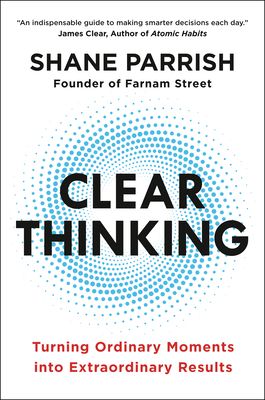
Clear Thinking Book Summary
Turning Ordinary Moments into Extraordinary Results
Book by Shane Parrish
Feeling Lazy?Read 1 Minute Summary
Summary
In "Clear Thinking", Shane Parrish provides a practical guide to overcoming our built-in mental biases and defaults in order to make better decisions, cultivate clear thinking, and align our actions with what truly matters for a life well-lived.
1. The Enemies of Clear Thinking
Our Biological Instincts Hold Us Back From Clear Thinking
Our biological instincts, while useful for survival in prehistoric times, often lead us astray in the modern world and prevent us from thinking clearly. These hardwired tendencies include defending our territory and ego, maintaining social hierarchies, and putting self-preservation above all else. While these instincts served our ancestors well, they frequently cause us to react emotionally rather than reasoning objectively.
Section: 1, Chapter: 1
We Mistake How We Want The World To Be With How It Actually Is
"Most people go through life assuming that they're right... We mistake how we want the world to be with how it actually is."
Parrish points out that we tend to assume our perspective is correct and have difficulty recognizing when our views are distorted by what we wish were true rather than objective reality. This prevents us from updating our beliefs and mental models even when faced with contradictory evidence.
Section: 1, Chapter: 1
The Four Main Biological Defaults That Derail Clear Thinking
The author identifies four main biological "defaults" that work against clear, rational thought:
- The Emotion Default: Reacting based on feelings rather than facts and logic
- The Ego Default: Seeking to protect and promote our self-image at all costs
- The Social Default: Conforming to group norms and fearing being an outsider
- The Inertia Default: Resisting change and clinging to familiar ideas and habits
Recognizing these defaults is the first step to overcoming them and creating space for reason.
Section: 1, Chapter: 1
Beware The Emotion Default Hijacking Your Thoughts
The emotion default is when we allow our feelings, rather than facts and reason, to drive our actions. Anger, fear, embarrassment and other intense emotions can completely derail clear thinking in an instant, causing us to do and say things we later regret.
The author gives the example of Olympic shooter Matthew Emmons, who was poised to win his second gold medal until his nerves got the best of him. Worrying about calming himself, he forgot a crucial step in his routine and ended up firing at the wrong target, losing the gold. Emotions can multiply our progress by zero if we let them take control.
Section: 1, Chapter: 2
The Ego Default Makes Us More Concerned With Being Right
The ego default is the tendency to protect and promote our self-image even when it leads us astray. We care more about feeling right and defending our ego than getting the best possible results.
General Benedict Arnold is a prime example. Passed over for promotions and feeling unappreciated, Arnold's bruised ego led him to betray his country - not because it was the wisest course of action, but to prove his importance and get revenge on those he felt slighted him. When the ego takes over, we lose sight of our goals and values.
Section: 1, Chapter: 3
Social Pressures Encourage Conformity
The social default stems from our biological drive to belong to the group and not risk being ostracized. While conforming had survival value in prehistoric times, it often leads to poor judgment today.
To combat this tendency, recognize that:
- It's easy to overestimate your willingness to go against the grain. Standing apart from the crowd is uncomfortable.
- Social rewards are felt immediately, while benefits of diverging are delayed. Steel yourself to weather short-term social friction.
- You can respect someone's opinion without agreeing with them. Have the courage to thoughtfully dissent.
Remember, if you do what everyone else does, you'll get the same results as everyone else. Thinking for yourself is key to extraordinary outcomes.
Section: 1, Chapter: 4
The Inertia Default Keeps Us Stuck In Our Comfort Zone
The author shares an example from his own investing experience of how the inertia default made him resistant to changing his mind, even in the face of mounting evidence.
He had invested heavily in a restaurant chain after the new CEO turned operations around. However, the CEO's ego inflated with the success, turning a fair partnership into a dictatorship. The author was reluctant to exit the position after making such great returns, even as the facts became more troubling. He finally sold after stepping back and honestly examining the situation, narrowly avoiding huge losses.
We resist change that goes against our established beliefs, habits and investments - even when it would benefit us. Regularly stepping back to rationally evaluate a situation is key to overcoming inertia.
Section: 1, Chapter: 5
Reprogram Your Defaults To Create Space For Clear Thinking
While we can't eliminate our biological defaults, we can "reprogram" them to work for us rather than against us. Some key ways to do this:
- View your patterns of thoughts, feelings and actions as algorithms. Identify which ones are helping you progress vs holding you back.
- Surround yourself with people whose "algorithms" represent your desired behaviors and thinking patterns. We unconsciously adopt the habits of those around us.
- Design your environment to make your desired actions the path of least resistance. Willpower is ineffective, but engineered defaults help us make better choices automatically.
By training beneficial default algorithms, inertia starts working in your favor, propelling you towards what you want consistently over time. Creating structure is how you slowly reprogram yourself.
Section: 1, Chapter: 6
2. Building Strength
Self-Accountability Is Taking Responsibility For Your Actions
Self-accountability means holding yourself responsible for developing your abilities, managing your weaknesses, and governing your actions with reason. It's realizing that even if you can't control everything, you always control your response - which makes the situation better or worse.
People who lack accountability believe things are never their fault. They make excuses, blame circumstances or other people, and see themselves as victims. But this victim mentality only breeds a sense of helplessness and passivity. Taking ownership, even when a situation isn't your fault, allows you to focus on making things better instead of finger-pointing.
Section: 2, Chapter: 1
"No One Cares About Your Excuses As Much As You Do"
"No one cares about your excuses as much as you do. In fact, no one cares about your excuses at all, except you."
Section: 2, Chapter: 1
Self-Knowledge Means Understanding Your Strengths And Limitations
Self-knowledge is clearly seeing what you are capable of and what you are not, what is in your control and what isn't. It's being aware of your blind spots and areas of vulnerability.
A key aspect of self-knowledge is calibrating the boundaries of your expertise. The size of your knowledge is not as important as recognizing its limits. Don't claim proficiency you don't have. The most valuable people aren't those with the most knowledge, but those who clearly acknowledge what they do and don't know.
Self-knowledge also means understanding the circumstances that trigger your defaults. What situations tend to make you emotional, egotistical, inertial or conformist? Identifying your weaknesses is crucial to managing them.
Section: 2, Chapter: 2
3. Managing Weakness
4. Decision: Clear Thinking in Action
5. Wanting What Matters
Related Content
Thinking Fast and Slow Book Summary
Daniel Kahneman
Kahneman explores the two systems that drive the way we think: the intuitive, automatic System 1 and the deliberate, analytical System 2. It explores how these systems shape our judgments, decisions, and biases, revealing the surprising power of intuition and the pitfalls of overconfidence.
Kahneman explores the two systems that drive the way we think: the intuitive, automatic System 1 and the deliberate, analytical System 2. It explores how these systems shape our judgments, decisions, and biases, revealing the surprising power of intuition and the pitfalls of overconfidence.
Psychology
Personal Development
Business