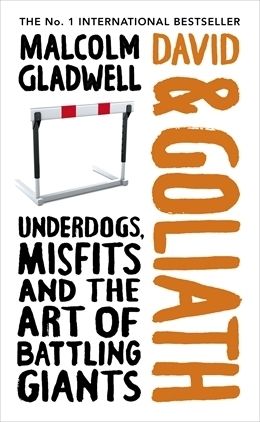
David and Goliath Book Summary
Underdogs, Misfits, and the Art of Battling Giants
Book by Malcolm Gladwell
Summary
In David and Goliath, Malcolm Gladwell challenges our assumptions about power, advantage, and success, showing how underdogs can triumph by turning their weaknesses into strengths and exploiting the hidden vulnerabilities of the powerful.
1. The Advantages of Disadvantages
David's Sling: An Unexpected Advantage in the Biblical Story
The biblical tale of David and Goliath is often misunderstood. It wasn't a miracle that David won - he actually had a big advantage.
As a slinger, with a sling and projectile, David had a huge advantage in range and power over Goliath. Ancient armies had three types of warriors: cavalry, infantry, and projectile warriors (slingers/archers). Slingers beat infantry. So in reality, Goliath as infantry was vulnerable to David's long-range weapon.
Additionally, many medical experts now believe Goliath had acromegaly, impaired vision and mobility issues. So David, who refused to fight Goliath in close combat and instead exploited his weakness, had the upper hand the whole time, not the underdog.
Section: 1, Chapter: 1
Vivek Ranadivé Coaches His Daughter's Basketball Team
When Vivek Ranadivé decided to coach his daughter's basketball team, he settled on two principles: 1) Never raise his voice, and 2) Apply a full-court press for the entire game. His team of unskilled 12-year-old girls went on to make the national championships.
Ranadivé realized his team was at a disadvantage in skill, so he based his strategy around effort. By constantly pressuring the inbounds pass and trapping players, his team outsmarted and out-hustled more skilled opponents. The full-court press exploited the fact that "effort can trump ability."
Section: 1, Chapter: 1
Inverted U-Curves In Wealth, Parenting and Class Size
Many advantages and disadvantages actually operate on an inverted U-curve:
- Money makes parenting easier up to a point, after which it actually makes it harder again as the parent struggles to say no or set limits
- Smaller class sizes are better up to a point, then actually become worse again if they get too small, as students feel self-conscious and teachers lower standards
The problem is we often fail to see how certain seeming advantages can cross the curve and turn into disadvantages. Having more resources is not always optimal.
Section: 1, Chapter: 2
Caroline Sacks Chooses Between an Elite and Accessible College
Caroline Sacks, a gifted student passionate about science, had to choose between going to Brown University or University of Maryland. Despite loving science, Caroline struggled in Brown's demanding science program, getting discouraged and switching majors.
In going to Brown, Caroline fell victim to a common error - what Gladwell calls "elite institution cognitive disorder." In choosing the more elite school, she actually put herself at a disadvantage by surrounding herself with more competitive peers and making herself feel inadequate. She would have likely had a more successful science career if she went to Maryland.
This illustrates the concept of "relative deprivation" - how we compare ourselves to our immediate peers. Our sense of self-worth and motivation depends on these local comparisons, not our global ranking.
Section: 1, Chapter: 3
The Big Fish-Little Pond Effect
The Big Fish-Little Pond Effect refers to the fact that we form our self-concept not in absolute terms, but relative to our immediate peer group. In school, this means our self-image is shaped by how we rank compared to our classmates, not how we rank in ability nationally.
So a student with above-average intelligence can end up with a poor academic self-concept if they are placed in a gifted program where they are below-average compared to their peers. Meanwhile, a student of equal ability in a regular program will have a much more positive self-image.
This has major implications for academic effort, aspirations and career choice. Students are more likely to persevere in fields where their relative standing is high. Being a Big Fish in a Little Pond is often preferable to being a Little Fish in a Big Pond.
Section: 1, Chapter: 3
2. The Theory of Desirable Difficulty
3. The Limits of Power
Related Content
The Obstacle Is the Way Book Summary
Ryan Holiday
The Obstacle Is the Way presents a practical formula for overcoming life's challenges and achieving success by controlling perceptions, taking decisive action, and cultivating an indomitable will.
The Obstacle Is the Way presents a practical formula for overcoming life's challenges and achieving success by controlling perceptions, taking decisive action, and cultivating an indomitable will.
Philosophy
Personal Development
Leadership
Productivity