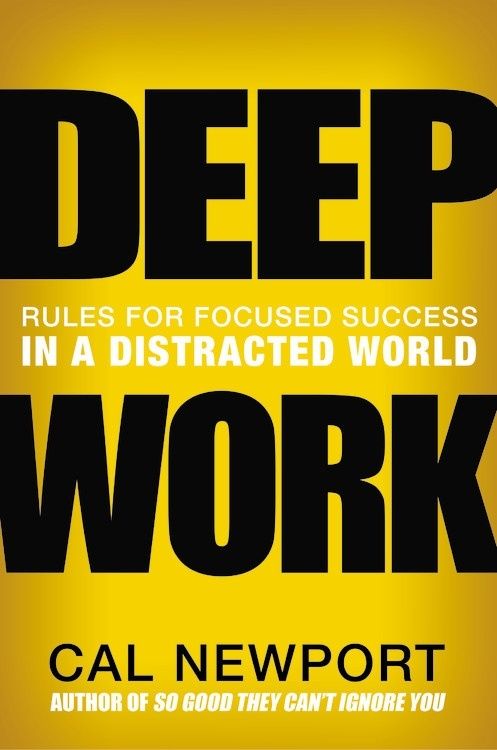
Deep Work Book Summary
Rules for Focused Success in a Distracted World
Book by Cal Newport
Feeling Lazy?Read 1 Minute Summary
Summary
In "Deep Work", Cal Newport argues that the ability to focus intensely on cognitively demanding tasks is becoming increasingly rare yet increasingly valuable in our economy, and provides a training regimen to cultivate this skill through the application of four rules: work deeply, embrace boredom, quit social media, and drain the shallows.
Deep Work Is Valuable In Today's Economy
In Chapter 1, the author argues that the ability to perform deep work is becoming increasingly valuable in our economy at the same time that it is becoming increasingly rare. He defines deep work as professional activities performed in a state of distraction-free concentration that push your cognitive capabilities to their limit. These efforts create new value, improve your skill, and are hard to replicate.
With technological and societal changes, the ability to quickly learn hard things and produce at an elite level are critical skills. Shallow work, which is non-cognitively demanding and often performed while distracted, is becoming less valuable. The author provides several examples of highly successful individuals who have leveraged deep work to stand out in a cognitively demanding world.
Section: 1, Chapter: 1
"The Ability To Quickly Master Hard Things Is Crucial For Thriving"
"If you can't learn, you can't thrive. To learn requires intense concentration. If you're comfortable going deep, you'll be comfortable mastering the increasingly complex systems and skills needed to thrive in our economy. If you instead remain one of the many for whom depth is uncomfortable and distraction ubiquitous, you shouldn't expect these systems and skills to come easily to you."
Section: 1, Chapter: 1
Adam Grant's Example Shows The Power Of Depth Over Busyness
Adam Grant, the youngest full professor at Wharton, published seven peer-reviewed articles in top journals in one year, an impressive feat in his field. Rather than working more hours than his peers, he consolidates his deep work into intense and uninterrupted pulses.
By maximizing his intensity when he works, he maximizes the results he produces per unit of time. Grant's approach of shutting himself off from the outside world to concentrate fully supports the idea that the type of work that optimizes performance is deep work. If you're not comfortable with depth, you'll struggle to achieve your peak performance.
Section: 1, Chapter: 1
High-Quality Work Produced = (Time Spent) x (Intensity of Focus)
The author proposes a formula to conceptualize the power of depth in producing valuable output. Your ability to produce high-quality work is a function of the time you spend and the intensity of your focus during this time. Maximizing both time and intensity will increase the quality and quantity of your output. This supports the practice of working deeply while avoiding distractions, as it allows you to maximize your intensity and results per unit of time worked.
Section: 1, Chapter: 1
Flow Generates Happiness, And Deep Work Enables Flow
Psychologist Mihaly Csikszentmihalyi found using the experience sampling method that people are happiest when they are in a state of flow - a state of deep concentration on a single task. This finding pushed back against the popular notion that relaxation makes people happy. Csikszentmihalyi argues jobs should be restructured to facilitate more flow. Deep work is well suited to generate a flow state:
- Stretching your mind to its limits
- Concentrating
- Losing yourself in the task
Decades of research show that the act of going deep orders the consciousness in a way that makes life worthwhile. To build your working life around the experience of flow generated by deep work is a proven path to deep satisfaction.
Section: 1, Chapter: 3
This concept is also discussed in:
Flow
Craftsmen Provide A Key To Reopening A Sense Of Sacredness And Meaning
In the book "All Things Shining", philosophers Hubert Dreyfus and Sean Dorrance Kelly argue that craftsmen provide a key to cultivating meaning and sacredness in today's secular age. A craftsman's task is to cultivate skill and discern the inherent meaning of the materials he works with rather than forcing his arbitrary will.
There is meaning inherent in material things. A wheelwright doesn't arbitrarily decide which properties of wood are valuable - its value is inherent to it and the task it is meant to perform. Craftsmanship provides an ordering of the world and source of meaning outside the individual. The same applies to knowledge work - your work is your craft. If you hone your skill and apply it with respect and care, you can generate meaning.
Section: 1, Chapter: 3
Cultivating Craftsmanship Requires Deep Work
To cultivate a deep work habit and leverage it for the goals of craftsmanship and generating meaning, you should:
- Identify a handful of ambitious outcomes to pursue with your deep work hours
- Focus on the quality of the deep work hours you spend on these goals, not just the quantity of hours
- Apply the utmost skill and focus you can muster to your craft, embracing the meaning and value inherent to the work itself
- Become so immersed in the work itself that you lose track of time and your sense of self
- Detach your ego from the external outcomes of your work and find reward in the work itself
The skill and appreciation inherent in craftsmanship, whether blacksmithing or computer programming, brings meaning. If you can see your work as a form of craftsmanship, you can generate meaning and purpose.
Section: 1, Chapter: 3
The Four Rules
Rule #1 - Work Deeply
To make the most of deep work, build rituals and routines that make it a regular and significant part of your schedule. These habits help overcome challenges like willpower depletion and distraction. Strategies include deciding on your depth philosophy, ritualizing deep work, leveraging radical changes to your environment, working with others who share your ethic, and executing your deep work habit like a business.
Section: 1, Chapter: 1
Decide On Your Depth Philosophy
There are several different approaches to integrating deep work into your schedule:
- The Monastic Philosophy: Eliminate or drastically minimize shallow obligations.
- The Bimodal Philosophy: Divide your time into stretches of deep work and leaving the rest open for everything else.
- The Rhythmic Philosophy: Transform deep work into a regular habit.
- The Journalistic Philosophy: Fit deep work wherever you can into your schedule.
Choose an approach that fits your circumstances and constraints.
Section: 2, Chapter: 1
Related Content

Flow Book Summary
Mihály Csíkszentmihályi
Flow reveals the secrets of optimal experience and shows how to transform even the most mundane moments into a source of enjoyment, creativity and meaning by learning to control consciousness itself.
Flow reveals the secrets of optimal experience and shows how to transform even the most mundane moments into a source of enjoyment, creativity and meaning by learning to control consciousness itself.
Psychology
Happiness
Productivity
Personal Development
Atomic Habits Book Summary
James Clear
Atomic Habits reveals the surprising power of small habits, demonstrating how tiny changes can compound into remarkable results over time. By focusing on systems over goals and building identity-based habits, you can create lasting change and unlock your full potential.
Atomic Habits reveals the surprising power of small habits, demonstrating how tiny changes can compound into remarkable results over time. By focusing on systems over goals and building identity-based habits, you can create lasting change and unlock your full potential.
Productivity
Personal Development
Psychology