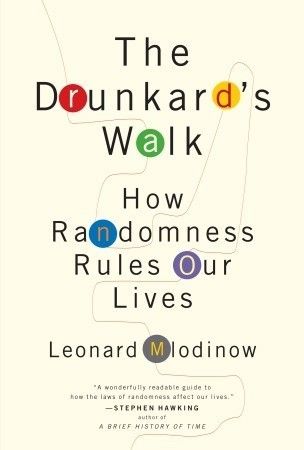
The Drunkard's Walk Book Summary
How Randomness Rules Our Lives
Book by Leonard Mlodinow
Summary
"The Drunkard's Walk" reveals how randomness and chance play a far greater role in our lives than we typically realize, challenging our perceptions of success, decision-making, and the patterns we think we see in the world around us.
The Illusion of Patterns in Hollywood
The film industry often appears to follow patterns, with certain actors, directors, or genres seeming to guarantee success. However, this perception is largely an illusion. The author discusses how even highly successful studio executives like Sherry Lansing can have their reputations rise and fall based on what is essentially random fluctuation in movie performance.
For instance, Lansing was praised for her ability to turn conventional stories into hits when Paramount was doing well, but later criticized for the same approach when the studio had a few underperforming years. This demonstrates how we tend to create narratives to explain what are often just random outcomes.
Section: 1, Chapter: 1
The Misinterpretation of Baseball Statistics
The author analyzes Roger Maris's record-breaking 61 home run season in 1961. While this feat was seen as extraordinary, statistical analysis shows it was not as improbable as it seemed. Given the number of skilled players over decades of baseball history, there was actually about a 50% chance that someone would have such an exceptional season by chance alone. This example illustrates how we often underestimate the likelihood of rare events occurring naturally in large samples, leading us to seek special explanations for what may be random occurrences.
Section: 1, Chapter: 1
The Role of Randomness in Success
Random factors play a much larger role in success than we typically acknowledge. Using examples from Hollywood, sports, and business, the author demonstrates how unpredictable events and timing often contribute significantly to outcomes. This doesn't mean skill and effort are irrelevant, but rather that their relationship to success is less direct than commonly believed. Understanding this can lead to a more realistic view of both success and failure in various fields.
Section: 1, Chapter: 1
The Prosecutor's Fallacy
The prosecutor's fallacy is a misapplication of conditional probability often seen in legal settings. It involves confusing the probability of evidence given innocence with the probability of innocence given evidence. For example, in the Collins case, prosecutors argued that the low probability of a couple matching the description of the perpetrators meant the defendants were likely guilty.
However, this ignores the base rate of innocent couples who might also match the description. This fallacy can lead to significant overestimation of guilt based on seemingly convincing statistical arguments.
Section: 1, Chapter: 2
Base Rate Neglect in Medical Diagnosis
When interpreting medical test results, it's crucial to consider the base rate of the condition being tested for, not just the accuracy of the test. The author gives an example of HIV testing, where a positive result on a 99.9% accurate test doesn't necessarily mean a 99.9% chance of having HIV. If the disease is rare in the population being tested, the chance of a false positive can be much higher than intuition suggests. This highlights the importance of considering all relevant probabilities, not just the most obvious ones, when making judgments under uncertainty.
Section: 1, Chapter: 2
The Monty Hall Problem
The Monty Hall problem, based on a game show scenario, demonstrates how counterintuitive probability can be. Contestants choose one of three doors, behind one of which is a prize. After the initial choice, the host opens a non-winning door and offers the contestant a chance to switch.
Counterintuitively, switching doubles the chances of winning from 1/3 to 2/3. This is because the host's action provides new information that changes the probabilities. The problem famously stumped many mathematicians and illustrates how our intuitions about chance can often be wrong.
Section: 1, Chapter: 3
Pascal's Contributions to Probability Theory
Blaise Pascal made significant contributions to probability theory in the 17th century. His work on the "problem of points" - how to fairly divide stakes in an interrupted game of chance - led to important developments in combinatorics and probability calculation. Pascal's triangle, a tool for calculating combinations, became a fundamental concept in probability theory. His work also laid the groundwork for expected value theory, which he applied to questions of faith in his famous "Pascal's Wager".
Section: 1, Chapter: 3
The Law of Large Numbers
The law of large numbers, formalized by Jakob Bernoulli, states that as the number of trials of a random process increases, the average of the results will tend to converge on the expected value.
This principle is crucial for understanding how probability manifests in the real world. For example, while a small number of coin flips might deviate significantly from 50% heads, a large number of flips will tend very close to this expected ratio. This law underpins many statistical methods and helps explain why large samples are generally more reliable than small ones.
Section: 1, Chapter: 3
The Concept of Mathematical Expectation
Pascal introduced the concept of mathematical expectation, which calculates the average outcome of a random process if it were repeated many times. This idea is crucial in decision theory and game theory. Pascal applied it to his famous "wager" about belief in God, arguing that the potential infinite gain of believing outweighs any finite cost. In modern times, expectation is used in various fields, from insurance to gambling, to quantify the likely outcome of uncertain events. Understanding expectation can help in making rational decisions under uncertainty.
Section: 1, Chapter: 4
The Surprising Birthday Problem
The birthday problem illustrates the counterintuitive nature of probability. It asks how many people need to be in a room for there to be a 50% chance that at least two share a birthday. The surprising answer is just 23 people, far fewer than most people intuitively guess. This unexpected result arises because we're not looking for a specific shared birthday, but any match among the group.
The calculation involves considering the probability of no matches and subtracting from 1. This problem has practical applications in fields like cryptography, where it's used to understand collision probabilities in hashing algorithms. It serves as a powerful reminder that our intuition about probability can often be misleading, emphasizing the importance of rigorous mathematical analysis in probability problems.
Section: 1, Chapter: 4
Avoiding the Gambler's Fallacy
The Gambler's Fallacy is the mistaken belief that if a random event occurs more frequently than normal during a given period, it will occur less frequently in the future (or vice versa). For example, if a roulette wheel has landed on black several times in a row, some might believe red is "due". This is a misunderstanding of random processes - each spin is independent and has the same probability regardless of past results. To avoid this fallacy:
- Remember that each trial is a new, independent event
- Focus on the unchanging probabilities, not recent outcomes
- Be skeptical of "hot streaks" or "cold streaks" in truly random events Recognizing this fallacy can prevent poor decision-making in gambling and other areas involving randomness.
Section: 1, Chapter: 5
Related Content
Subliminal Book Summary
Leonard Mlodinow
Subliminal: How Your Unconscious Mind Rules Your Behavior reveals the powerful influence of the unconscious mind on our thoughts, feelings, and actions - from how we perceive the world, to how we interact with others, make decisions, and understand ourselves.
Subliminal: How Your Unconscious Mind Rules Your Behavior reveals the powerful influence of the unconscious mind on our thoughts, feelings, and actions - from how we perceive the world, to how we interact with others, make decisions, and understand ourselves.
Psychology
Neuroscience
Business
The Success Equation Book Summary
Michael Mauboussin
The Success Equation is a comprehensive guide to understanding the relative roles of skill and luck in shaping outcomes, offering practical insights and tools for improving decision-making, performance, and predictions in a wide range of domains, from sports and business to education and investing.
The Success Equation is a comprehensive guide to understanding the relative roles of skill and luck in shaping outcomes, offering practical insights and tools for improving decision-making, performance, and predictions in a wide range of domains, from sports and business to education and investing.
Sports
Management
Psychology
Decision Making