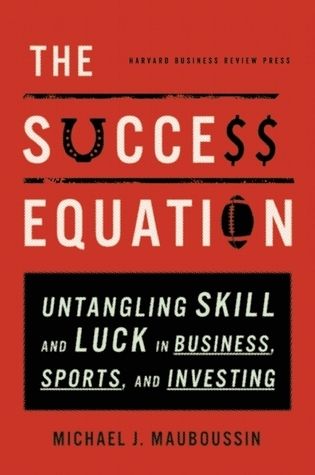
The Success Equation Book Summary
Untangling Skill and Luck in Business, Sports, and Investing
Book by Michael Mauboussin
Summary
The Success Equation is a comprehensive guide to understanding the relative roles of skill and luck in shaping outcomes, offering practical insights and tools for improving decision-making, performance, and predictions in a wide range of domains, from sports and business to education and investing.
Skill And Luck: Definitions And Impact On Success
Chapter 1 opens by defining the key concepts of skill and luck. Skill is "the ability to use one's knowledge effectively and readily in execution or performance." It can be developed through deliberate practice. Luck, on the other hand, is a chance occurrence outside of one's control that can be good or bad.
Most outcomes in life are due to a combination of skill and luck. The more an activity relies on skill, the more predictable the outcomes. The more an activity is influenced by luck, the less predictable it becomes. Understanding where an activity lies on the skill-luck continuum is critical for evaluating past results and forecasting future performance.
Section: 1, Chapter: 1
Skill, Luck, and Sample Size
One of the key lessons is the relationship between skill, luck, and sample size. In short:
- The more an activity is influenced by skill, the smaller the sample size needed to detect differences in skill
- The more an activity is influenced by luck, the larger the sample size needed to detect differences in skill
For example, if you want to know who the best chess player is, you might only need to see a small number of games. But if you want to know who the best investor is, you'd need to see results over a very long period, because short-term investing outcomes are heavily influenced by luck. Always consider sample size when evaluating performance. Don't read too much into small samples, especially where luck is involved.
Section: 1, Chapter: 1
Reversion To The Mean: The Cruel Equalizer
Chapter 1 also introduces the concept of reversion to the mean - the idea that an outcome that is far from the average will be followed by an outcome that is closer to the average. Reversion to the mean occurs whenever two measures are imperfectly correlated. The lower the correlation, the more extreme the reversion. In activities with a significant element of luck, reversion to the mean can be a powerful force. A few key implications:
- Don't overreact to extreme performances, good or bad. They are likely to revert toward the average.
- Be wary of paying for past performance. The "hot hand" may be nothing more than luck.
- Anticipate reversion in your own performance. If you have a great year, don't expect to maintain that level. If you have a terrible year, better times are likely ahead.
Section: 1, Chapter: 1
The Fooled By Randomness Bias
One of the key reasons we struggle to untangle skill and luck is that we tend to underestimate the influence of randomness. This "Fooled by Randomness" bias causes us to:
- See patterns in random noise
- Confuse correlation for causation
- Create narratives to explain chance events
- Attribute success to skill and failure to bad luck
To counter this bias:
- Be skeptical of simple cause-effect stories, especially in complex systems
- Don't overfit explanations to past data - it may just be noise
- Look for base rates and assess prior probabilities before judging
- Consider alternative histories - what else could have happened?
Section: 1, Chapter: 2
Storytelling Obscures Skill And Luck
Humans are natural storytellers. We crave narratives to make sense of the world. But this desire for causal explanations often leads us astray when assessing the relative roles of skill and luck.
We tend to craft narratives that attribute success to skill and hard work, while blaming failure on bad luck or external circumstances. We are quick to impute a causal relationship between action and outcome, even when the connection is tenuous or nonexistent.
The problem is compounded by our tendency to focus on a small number of highly successful people or companies, without considering the much larger number of failures. By sampling only the winners, we overestimate the impact of skill and underestimate the role of luck.
Section: 1, Chapter: 2
Visualizing The Skill-Luck Continuum
The luck-skill continuum is a powerful conceptual model for understanding the relative contribution of luck and skill in different domains. The key features of the continuum are:
- The extreme left represents pure luck (e.g. roulette) and the extreme right represents pure skill (e.g. chess)
- Most activities fall somewhere between these extremes, combining both luck and skill
- As you move from right to left, luck plays an increasingly important role and larger sample sizes are needed to detect skill
- Reversion to the mean is stronger on the left (luck) side of the continuum
- Differences in skill are easier to observe on the right side of the continuum
The continuum is useful for setting expectations and making better decisions. If you know where an activity lies on the continuum, you can better interpret past results and anticipate future outcomes.
Section: 1, Chapter: 3
Blending Skill And Luck To Match Real-World Results
Mauboussin illustrates the skill-luck continuum using the example of the NBA draft lottery. In the lottery, the worst teams get the highest probability of winning the top draft picks, in an effort to maintain competitive balance.
Mauboussin and his colleagues simulated the draft lottery under two scenarios: one with pure luck (a weighted coin flip) and one with pure skill (the worst team always gets the #1 pick). They then compared the actual results to these two extremes.
The results showed that the real NBA draft lottery results fell almost exactly halfway between pure luck and pure skill, suggesting that the lottery system does a good job of blending luck and skill to achieve its intended purpose. This type of simulation - comparing real-world results to luck and skill extremes - can be a useful tool for placing activities on the skill-luck continuum.
Section: 1, Chapter: 3
The Paradox Of Skill: Why Bigger Advantages Lead To Smaller Edges
The paradox of skill states that as the overall skill level in a field increases, luck becomes more important in determining outcomes. Consider baseball as an example. As training techniques and technology have improved, the average skill level of MLB players has increased over time. But the dispersion of skill has decreased. The best players today aren't as far above average as the best players 100 years ago. The paradox has important implications:
- In highly skilled fields, small differences in skill can lead to big differences in outcomes, because luck plays a larger role
- Sustaining a competitive advantage becomes harder as rivals get better at copying best practices
- Past success becomes less predictive of future success
- Forecasting becomes more difficult, because luck drowns out skill
- The key lesson: don't assume that an edge will persist, especially in highly skilled, competitive domains. What worked before may not keep working.
Section: 1, Chapter: 3
Related Content
Thinking Fast and Slow Book Summary
Daniel Kahneman
Kahneman explores the two systems that drive the way we think: the intuitive, automatic System 1 and the deliberate, analytical System 2. It explores how these systems shape our judgments, decisions, and biases, revealing the surprising power of intuition and the pitfalls of overconfidence.
Kahneman explores the two systems that drive the way we think: the intuitive, automatic System 1 and the deliberate, analytical System 2. It explores how these systems shape our judgments, decisions, and biases, revealing the surprising power of intuition and the pitfalls of overconfidence.
Psychology
Personal Development
Business
David and Goliath Book Summary
Malcolm Gladwell
In David and Goliath, Malcolm Gladwell challenges our assumptions about power, advantage, and success, showing how underdogs can triumph by turning their weaknesses into strengths and exploiting the hidden vulnerabilities of the powerful.
In David and Goliath, Malcolm Gladwell challenges our assumptions about power, advantage, and success, showing how underdogs can triumph by turning their weaknesses into strengths and exploiting the hidden vulnerabilities of the powerful.
Psychology
Business
Sociology