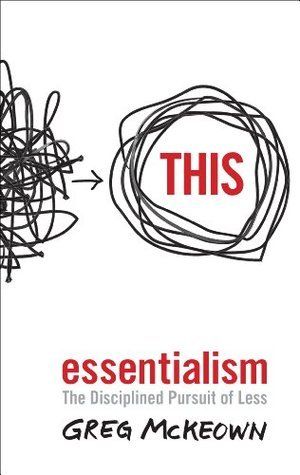
Essentialism Book Summary
The Disciplined Pursuit of Less
Book by Greg McKeown
Summary
Essentialism is a disciplined, systematic approach for determining where our highest point of contribution lies, then making execution of those things almost effortless. By applying the principles of "less but better" to every area of our lives, we can channel our time, energy and effort toward accomplishing the vital few things that really matter.
1. Essence
The Disciplined Pursuit Of Less
The way of the Essentialist is about living by design, not by default. It's a disciplined, systematic approach for determining where our highest point of contribution lies, then making execution of those things almost effortless. The Essentialist explores more options than the Nonessentialist to make better decisions, then eliminates the nonessentials to make execution easy. Essentialism is not about getting more things done, but getting the right things done.
To become an Essentialist requires a heightened awareness of our ability to choose:
- We have the power to choose how to spend our energy and time
- We can either allow nonessentials to overwhelm us, or deliberately choose where to focus our efforts
- If we don't prioritize our lives, someone else will
Section: 1, Chapter: 1
Less But Better
"The way of the Essentialist is the relentless pursuit of less but better. It doesn't mean occasionally giving a nod to the principle. It means pursuing it in a disciplined way."
Section: 1, Chapter: 1
Discerning The Vital Few From The Trivial Many
- Explore and evaluate a broad set of options before committing.
- Eliminate the nonessentials to make execution of the vital things almost effortless.
- It's not about just getting things done, but getting the right things done.
- Always ask "Is this the very most important thing I should be doing with my time and resources right now?"
Section: 1, Chapter: 2
The Choice Is Ours
When Greg was in law school in England, he realized he had a choice. He could continue down a path he had started, even though it wasn't the right path for him, or he could choose a different path. He chose to quit law school, leave England, and pursue a path of becoming a writer and teacher, which aligned more closely with his passions and strengths. This decision was pivotal in shaping the trajectory of his life and career. It taught him that while we may not always have control over our options, we always have control over how we choose among them.
Section: 1, Chapter: 2
Learned Helplessness
Psychologist Martin Seligman conducted experiments demonstrating "learned helplessness." Dogs who were given electric shocks with no ability to avoid them eventually stopped trying to escape the pain, even when later given the opportunity.
Similarly, people can learn to believe that their efforts don't matter. When people feel they have no choice, even in situations where they do, they tend to either give up or become overzealous and try to do everything. Both responses keep us from making the wisest decisions about where to invest our limited time and energy.
Section: 1, Chapter: 2
Pareto Principle And The Vital Few
The Pareto Principle states that 80% of results come from 20% of efforts. A few key activities contribute most of the value in any given situation:
- In business, 80% of profits come from 20% of customers
- In society, 20% of criminals commit 80% of crimes
- In personal lives, 20% of activities produce 80% of satisfaction
Essentialists invest their time and energy only in the vital few choices and activities that matter most, with the understanding that most things are unimportant distractions.
Section: 1, Chapter: 3
Tradeoffs Are An Inescapable Reality
"Essentialists see trade-offs as an inherent part of life, not as an inherently negative part of life. Instead of asking, 'What do I have to give up?' they ask, 'What do I want to go big on?' The cumulative impact of this small change in thinking can be profound."
Section: 1, Chapter: 3
Trade-offs Make Strategy Possible
Southwest Airlines succeeded by choosing a focused strategy of being THE low-cost airline. They made deliberate trade-offs like not serving meals or having premium seating. When competitors like Continental Lite tried to copy their model without fully committing to those trade-offs, they failed.
In both business strategy and life, ignoring the reality of trade-offs trying to "have it all" leads to underperforming across the board. Essentialists make strategic trade-offs deliberately. They ask "Which problem do I want to solve?" not "How can I do it all?". They choose carefully what not to do in order to invest more in what is really vital.
Section: 1, Chapter: 4
2. Explore
The Essentialist Creates Space To Escape And Explore
In our hyperconnected world, we rarely take time to deliberately disconnect and put space on the calendar to think and strategize. Essentialists create space in their schedules to escape and explore life. They use this space to discern what is truly essential, to connect with their purpose, and to determine what they want to go big on. They don't let the noise of the world drown out their inner voice. Examples of creating space include taking a walk in nature, meditating, turning off your phone for a set period each day, scheduling "blank space" on your calendar, and taking time to journal.
Section: 2, Chapter: 5
Jeff Weiner's Example Of Scheduling Nothing
Jeff Weiner, CEO of LinkedIn, schedules up to two hours of blank space on his calendar every day. He divides these buffers into thirty minute increments. He uses this space to think big and strategically about the company - product strategy, key priorities, culture and team dynamics, etc.
At first it felt like an indulgence, but he soon found it was his single most valuable productivity tool. It allowed him to better focus on the essential strategic questions rather than just reacting to the tactical needs of the day. He credits this practice for the company's success.
Section: 2, Chapter: 5
Become A Journalist Of Your Own Life
To discern the essential from the non-essential, we need to look at our choices through the lens of an investigative journalist:
- Search for the lead in the story of your life. What really matters?
- Stop hyper-focusing on all the details. Take a step back to see the bigger picture.
- Keep a journal. Writing forces you to think through what's essential.
- Get out of your own head. Go out into the field to gain real world insights.
- Be fully present. See what is right in front of you, not what might happen later.
- Clarify the question you are trying to answer before jumping into execution mode.
Section: 2, Chapter: 6
Play Is Essential For Strategic Exploration
Play is not trivial; it's essential. It allows us to explore unconventional ideas and strategies without getting stuck in the rut of the status quo. Play broadens our perspective, relieving tension and allowing creative ideas to flow more freely. It is in play where we discover our most essential selves and our most essential strategies.
Businesses like Twitter, Google and Pixar understand this - they foster play through unconventional office designs, improv comedy classes, hackathons, etc. These seemingly frivolous investments yield breakthroughs in creative problem solving. To be an Essentialist is to see play as necessary for high contribution, not an unnecessary distraction from it.
Section: 2, Chapter: 7
3. Eliminate
4. Execute
Related Content
Four Thousand Weeks Book Summary
Oliver Burkeman
"Four Thousand Weeks" offers a radical perspective on time management, urging us to abandon the futile quest for control and embrace our finite existence. By accepting our limitations and making conscious choices, we can discover a more meaningful and fulfilling way to spend our brief time on this planet.
"Four Thousand Weeks" offers a radical perspective on time management, urging us to abandon the futile quest for control and embrace our finite existence. By accepting our limitations and making conscious choices, we can discover a more meaningful and fulfilling way to spend our brief time on this planet.
Philosophy
Personal Development