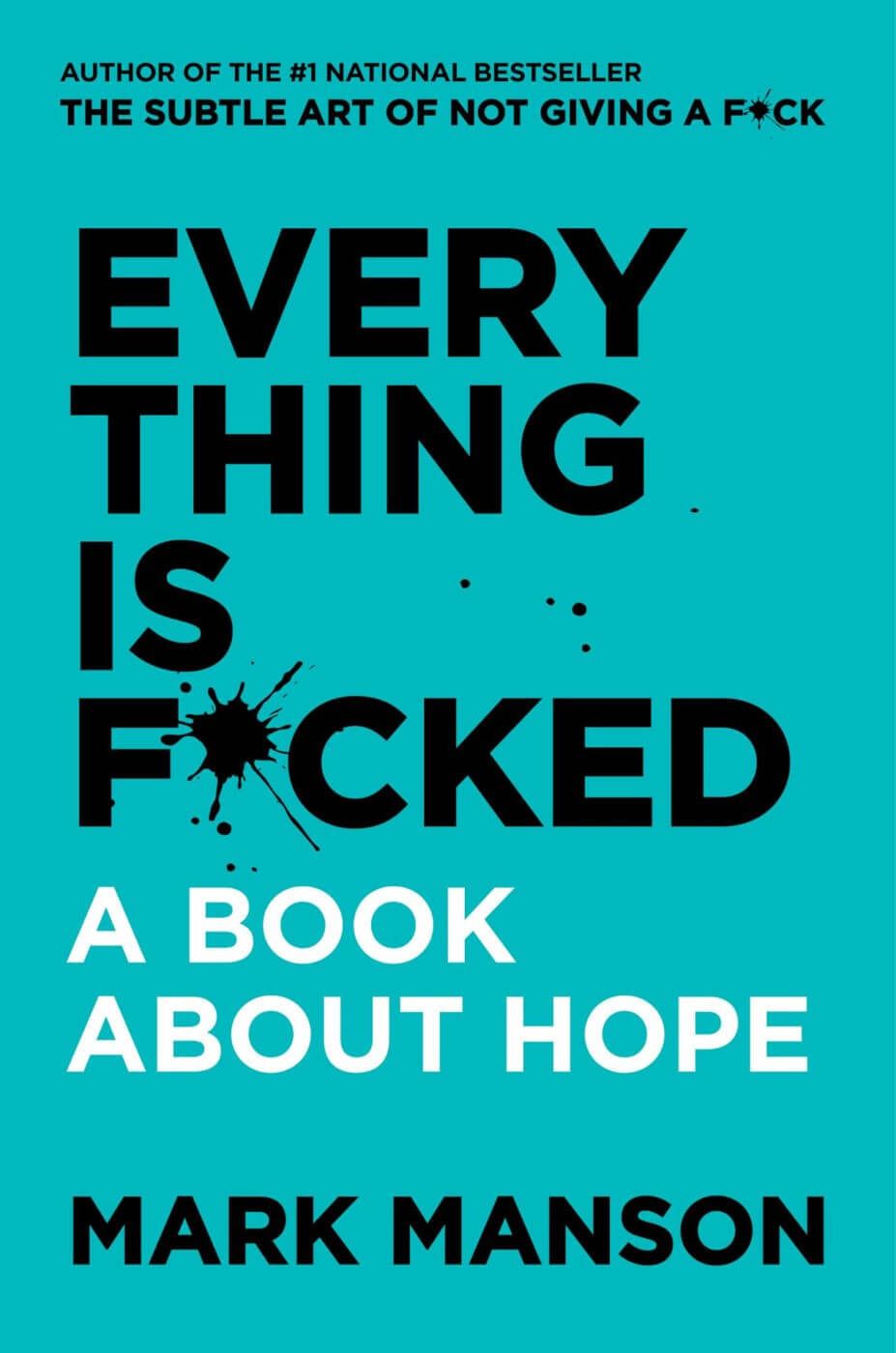
Everything is F*cked Book Summary
A Book About Hope
Book by Mark Manson
Summary
In a world where everything seems fcked, Manson provides a provocative exploration of the human condition, offering a counterintuitive perspective on the nature of hope, the illusion of self-control, and the quest for meaning amongst uncertainty
1. Hope
Hope Drives Us But Also Destroys Us
Despite immense progress and improvements in quality of life, people today seem to be losing hope. This is the "Paradox of Progress."
- While poverty, violence, oppression have declined, depression, anxiety, loneliness have increased.
- To feel hope, we need to feel we have control over our fate, we need to feel life has value/purpose, and we need a community.
- Religions provided hope in the past. Today, with the rise of individualism, finding hope is more difficult.
- Without anything to hope for, we face the "Uncomfortable Truth" - that we are insignificant and our lives are meaningless. To avoid this truth, we invent hope.
Section: 1, Chapter: 1
The "Thinking Brain" Versus The "Feeling Brain"
We have two "brains" - the Thinking Brain (rational, slow) and the Feeling Brain (emotional, quick).
- The Feeling Brain is what actually drives all our behavior and decision making. The Feeling Brain creates value judgments and hierarchies based on emotions and experiences. This determines what we find meaningful.
- The Thinking Brain just comes up with explanations. The Thinking Brain invents narratives to make sense of what the Feeling Brain has decided. It can influence but not control the Feeling Brain.
Section: 1, Chapter: 2
"Everything Always Sucks, Some Of The Time"
"This is your mission, your calling: to act without hope. To not hope for better. To be better. In this moment and the next. And the next. Everything is fucked. And hope is both the cause and the effect of that fuckedness."
Section: 1, Chapter: 2
The Never-Ending Pursuit Of Closing The "Moral Gap"
Newton's 1st Law of Emotion: For every action, there is an equal and opposite emotional reaction.
When we experience pain/loss, we feel there's a gap between how things are vs how they should be. This is the "moral gap." Our emotions then drive us to close that gap. Either by harming the perpetrator, helping the victim, or adjusting our values. But for every gap we close, another one opens. It's an endless cycle. Our minds equalize each emotional experience.
Section: 1, Chapter: 3
Your Identity Is A Collection Of Value-Based Stories
Newton's 3rd Law of Emotion: Your identity will stay your identity until a new experience acts against it. We develop our identities and values through the emotional experiences we have. Especially in childhood. Each experience creates a value-based story about people, the world, ourselves. These stories stack together to form our identity. The longer we've held onto a story/value, the more emotional weight it carries. And the harder it is to let go of or change, even if it's harming us.
Section: 1, Chapter: 3
Regularly Introspect On Your Values
Make a list of the 5-10 things you care about most in life. Really think about it. Be honest with yourself. Then, rank those values from most to least important to get a sense of your current value hierarchy. Next, journal about where those values came from. What experiences shaped them? Do they still serve you today? If a value seems unhelpful today, design new experiences that will help update that value over time. What could you do differently?
Section: 1, Chapter: 3
The Formula For Starting A Successful Religion
In this tongue-in-cheek chapter, Manson lays out a step-by-step guide for how to start a successful religion or cult:
- Step 1: Sell hope to the hopeless. Find people who lack hope, meaning and community. Promise them a brighter future.
- Step 2: Choose your faith. Come up with a set of values, beliefs and rituals for your religion. Decide what you worship - a God, a political ideology, another person.
- Step 3: Preemptively invalidate all criticism. Position anyone who questions the religion as immoral, evil or an existential threat. Polarize your followers against non-believers.
- Step 4: Ritual sacrifice. Create intense, cathartic rituals for your followers to undergo. The more painful, the more loyal they become. Sacrifice creates commitment.
- Step 5: Promise heaven, deliver hell. Always keep your followers wanting more. Make them feel like salvation is just around the corner... if only they believe a little harder.
- Step 6: Prophet for profit. Enjoy the fame, wealth and adoration. You've earned it!
Of course, Manson is being satirical with this formula. But he uses it to make a serious point - that many religions and ideologies throughout history have relied on these manipulative tactics to attract and control followers. And we're all susceptible to the allure of false hope.
Section: 1, Chapter: 4
The Three Types Of Religions That Drive Human Conflict
Manson argues that there are three types of religions that vie for power and influence over the human mind:
- Spiritual religions. These promise salvation in the afterlife through faith in supernatural beliefs. Examples are Christianity, Islam, Judaism, Hinduism.
- Ideological religions. These promise salvation in this life through devotion to a secular value system. Examples are capitalism, communism, environmentalism, liberalism.
- Interpersonal religions. These place faith in the salvation of other people or the relationships between people. Examples are romantic love, patriotism, celebrity fandoms.
While their content differs, the structure is the same. They tap into our need for hope, meaning and purpose. And they often end up clashing with each other in an endless struggle for dominance. Most of human conflict throughout history boils down to a war between competing religious value systems.
Section: 1, Chapter: 4
Pandora's Box: Is Hope The Most Destructive Force?
The ancient Greek myth of Pandora's Box warns of the dangers of hope. The gods give Pandora a box she is forbidden from opening. Curiosity gets the better of her, she opens it, and out flies all the evils and miseries of the world - death, sickness, war, famine.
But at the very bottom of the box, something else emerges - hope. What if hope is not a reprieve from suffering, but the worst evil of all? What if hope itself causes the most destruction?
Manson points to the atrocities of the 20th century as evidence that hope is dangerous when taken to extremes. The Nazis had hope for a better future - one without Jews. The Soviet Communists had hope for a better future - one without the bourgeoisie. When we become attached to a vision of how things "should" be, we can justify all sorts of horrors in the name of getting there.
So is a life without hope the answer? Manson says no. Some hope is necessary to keep us going. The challenge is to find a "healthy" form of hope not based on illusions or the desire to harm others. A mature hope grounded in acceptance of reality.
Section: 1, Chapter: 5
Nietzsche Predicted The Crisis Of Hope
In the late 19th century, the German philosopher Friedrich Nietzsche prophesied that the next century would bring a collapse of meaning and morality in the Western world. His famous proclamation that "God is dead" was a warning that science and secularism were eroding the traditional religious values that gave people hope and direction.
Nietzsche predicted that after "killing God," humans would have to become gods themselves, creating their own values in a chaotic world without transcendent meaning. He foresaw this leading to a massive clash between competing value systems, each trying to impose their own version of meaning on the world. Nietzsche called this the arrival of "nihilism" - the belief that life has no inherent purpose.
Manson argues that Nietzsche's predictions came true in the 20th century. Two World Wars, the rise of communism and fascism, and the spread of existentialist philosophy all pointed to a crisis of meaning and morality. And we're still living in Nietzsche's shadow today, struggling to find solid ground in a world where the old sources of hope and purpose no longer hold up.
Section: 1, Chapter: 5
"Amor Fati"
"Amor fati, for Nietzsche, meant the unconditional acceptance of all life and experience: the highs and the lows, the meaning and the meaninglessness. It meant loving one's pain, embracing one's suffering. It meant closing the separation between one's desires and reality not by striving for more desires, but by simply desiring reality."
Section: 1, Chapter: 5
2. Everything is Fucked
Immanuel Kant's Formula For Ethical Behavior
The 18th century German philosopher Immanuel Kant attempted to establish a universal principle for determining moral behavior. He called it the "Categorical Imperative" or the "Formula of Humanity." It states:
"Act that you use humanity, whether in your own person or in the person of any other, always at the same time as an end, never merely as a means."
- Always treat people as ends in themselves, never simply as means to an end
- Act as though the principles guiding your actions should become universal laws for everyone
Kant argued this principle is the foundation for all morality and ethics. It comes from the idea that conscious reasoning beings have a special dignity and worth. We must respect that dignity in ourselves and others.
Manson believes Kant was on to something profound. Living by this simple maxim would solve many ethical dilemmas. It also provides a way out of the childish and adolescent traps of chasing pleasure and trying to bargain with the world. The Formula of Humanity represents a more adult stance toward life, one of self-respect and respect for others.
Section: 2, Chapter: 6
Related Content
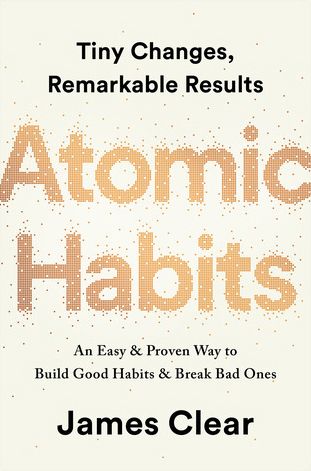
Atomic Habits Book Summary
James Clear
Atomic Habits reveals the surprising power of small habits, demonstrating how tiny changes can compound into remarkable results over time. By focusing on systems over goals and building identity-based habits, you can create lasting change and unlock your full potential.
Atomic Habits reveals the surprising power of small habits, demonstrating how tiny changes can compound into remarkable results over time. By focusing on systems over goals and building identity-based habits, you can create lasting change and unlock your full potential.
Productivity
Personal Development
Psychology