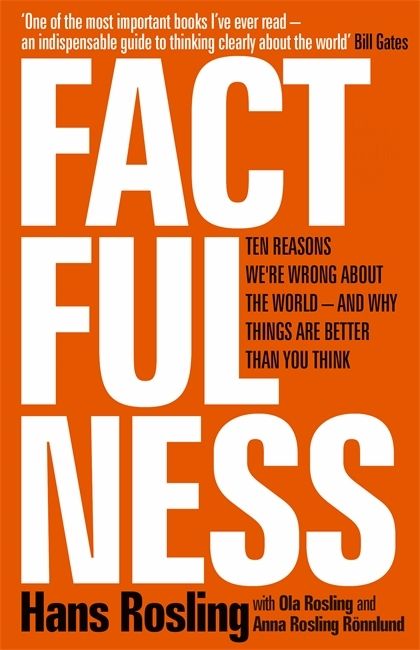
Factulness Book Summary
Ten Reasons We're Wrong About the World – and Why Things Are Better Than You Think
Book by Hans Rosling
Feeling Lazy?Read 1 Minute Summary
Summary
Factfulness by Hans Rosling reveals the ten instincts that distort our perspective on the world, and provides a fact-based framework for understanding global progress and thinking more clearly about the future.
The Gap Instinct - The Illusion Of A Divided World
In Chapter 1, Rosling explains the gap instinct - the tendency to divide things into distinct groups with a gap between them, such as rich vs poor countries. In reality, most of the world is in the middle and there is a continuous spread rather than a gap.
- 75% of humanity lives in middle-income countries, not low-income countries as many assume
- There are 4 income levels and most of the world population is on Levels 2-3
- Only 9% still live in low-income Level 1; the rest have electricity, food, education
Section: 1, Chapter: 1
Beware Comparisons Of Extremes And Averages
To control the gap instinct, Rosling recommends:
- Look for the majority. The majority is usually between the extremes, not in the gap.
- Beware comparisons of averages. If you look at spreads instead, the groups likely overlap.
- Beware comparisons of extremes, which are not representative of the groups.
- Beware "the view from up here." A high-level view exaggerates the gaps below.
Section: 1, Chapter: 1
Extreme Poverty Has Halved In The Past 20 Years
Many people still imagine most of the world lives in extreme poverty. However, the data shows the share in extreme poverty has halved in the past 20 years:
- In 1997, 42% of the population of both India and China lived in extreme poverty. By 2017, this was down to 12% in India and under 1% in China.
- Globally, those in extreme poverty fell from 29% in 1997 to 9% in 2017.
- This is one of the "most important changes in the world in my lifetime," says Rosling, but most people are unaware of this incredible progress.
Section: 1, Chapter: 2
Factfulness Means Recognizing The World Is Getting Better
Rosling provides a framework for "factfulness" to recognize that while bad things still happen, the world is getting better:
- Expect bad news. It's more likely to reach you than gradual improvements.
- Good and bad things happen at the same time. Things can be improving overall even if there are still terrible events.
- More bad news does not mean things are getting worse. It may just mean we're paying more attention.
- Gradual change is not newsworthy but is important. Small improvements add up.
- Don't glorify the past. It was likely worse than today in many ways we forget.
Section: 1, Chapter: 2
The UN Predicts The World Population Will Level Off By 2100
Chapter 3 tackles the widespread fear of overpopulation. While the world population is still increasing rapidly by about 1 billion every 13 years, UN projections show it will level off around 10-12 billion by 2100.
- This is because the number of children in the world has stopped increasing. We have reached "peak child."
- The current population growth comes from the last large generation of children, born just before families started shrinking, growing up and having their own children.
- But those children are having just 2 kids on average. After 3 generations of this, the population growth will flatten out.
Section: 1, Chapter: 3
The World Is On Track To End Extreme Poverty By 2030
Rosling uses the analogy of the world as a premature baby in an incubator to argue things are both bad and better: The baby's health is still critical, but on every measure, she is improving. It doesn't mean we should relax, but we should recognize the progress.
Similarly, the world still faces huge challenges with poverty. But the trend lines are all moving in the right direction. If progress continues, extreme poverty could be eliminated by 2030. We are in the last stretch of a 200-year journey from everyone in extreme poverty to almost no one.
Section: 1, Chapter: 3
The Straight Line Instinct Leads To Unfounded Fears Like Overpopulation
The straight line instinct is the tendency to assume a straight line will continue indefinitely. Rosling recommends:
- Don't assume straight lines. Many important trends are S-bends, slides, humps or doubling lines. No child maintains their initial growth rate.
- Curves come in different shapes, so look for the shape of the curve. Zoom out to see which part you are looking at.
- Don't be fooled by averages that seem to show a straight line. Always look for the range in the data too.
Section: 1, Chapter: 3
Our Instinct For Fear Distorts Our Perception Of Risk
In Chapter 4, Rosling discusses how our natural fear instinct makes us overestimate the likelihood of scary events. The media exacerbates this by disproportionately reporting on devastating but uncommon events like plane crashes, murders, and terrorism. As a result, we tend to overestimate the risk of these threats compared to more common but less reported causes of death like diarrhea and road accidents.
For example, the fear of a child being murdered is every parent's worst nightmare. But in reality, in the US, the risk of a child dying from murder is about 0.00016% per year, or 1 in 625,000. The risk of dying in a car accident is 1 in 29,000, over 20 times higher. Yet parents fear kidnapping more than car crashes. Our fear instinct distorts our perception of risk and causes us to worry about the wrong things.
Section: 1, Chapter: 4
Factfulness Is ... Recognizing When Frightening Things Get Our Attention
"Factfulness is ... recognizing when frightening things get our attention, and remembering that these are not necessarily the most risky. Our natural fears of violence, captivity, and contamination make us systematically overestimate these risks."
Section: 1, Chapter: 4
Related Content
Super Freakonomics Book Summary
Steven D. Levitt , Stephen J. Dubner
In Superfreakonomics, Levitt and Dubner challenge conventional wisdom on topics ranging from prostitution to terrorism to global warming, using data and economic principles to uncover surprising insights and challenge readers to think like a Freak.
In Superfreakonomics, Levitt and Dubner challenge conventional wisdom on topics ranging from prostitution to terrorism to global warming, using data and economic principles to uncover surprising insights and challenge readers to think like a Freak.
Psychology
Sociology
Economics
Incentives
This Changes Everything Book Summary
Naomi Klein
In "This Changes Everything," Naomi Klein argues that the climate crisis challenges us to abandon the core "free market" ideology of our time, restructure the global economy, and remake our political systems - and that in the process, we have the chance to create a safer and more just world.
In "This Changes Everything," Naomi Klein argues that the climate crisis challenges us to abandon the core "free market" ideology of our time, restructure the global economy, and remake our political systems - and that in the process, we have the chance to create a safer and more just world.
Sustainability
Climate Change
Economics
Politics