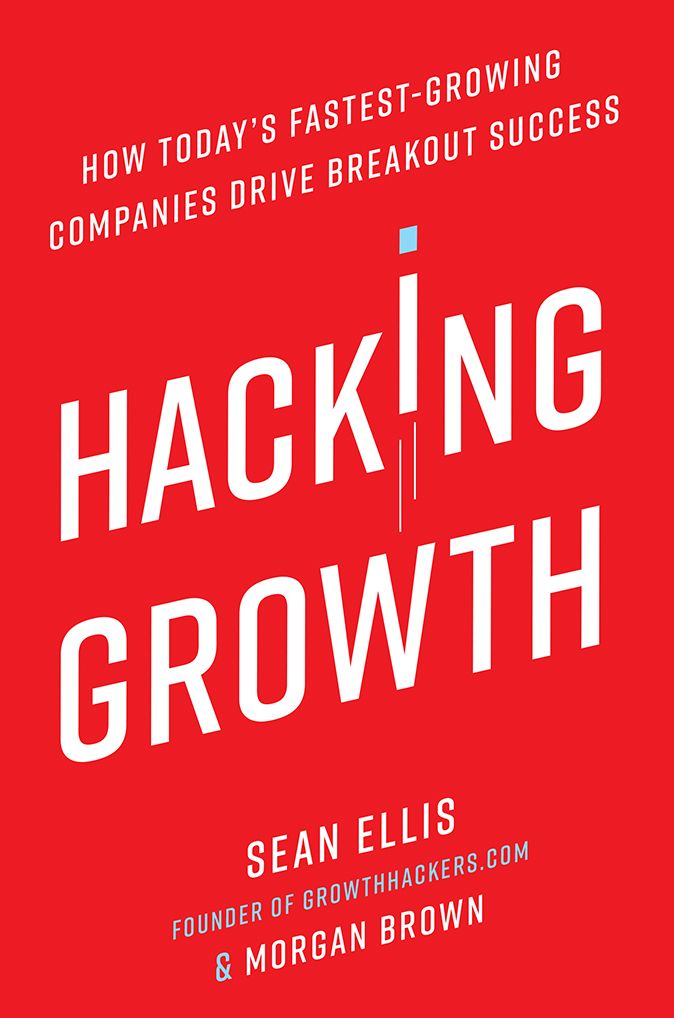
Hacking Growth Book Summary
How Today's Fastest-Growing Companies Drive Breakout Success
Book by Sean Ellis
Feeling Lazy?Read 1 Minute Summary
Summary
Hacking Growth reveals the revolutionary growth hacking techniques used by today's fastest-growing companies to drive breakout success - and shows you exactly how to implement them in your own organization.
1. The Method
The Power of Cross-Functional Growth Teams
Chapter 1 discusses the importance of building cross-functional growth teams to drive rapid experimentation and growth.
- Growth teams should include members from marketing, engineering, product, and data analysis. This breaks down organizational silos. The team focuses relentlessly on a singular goal - driving growth through rapid experimentation and analysis.
- Growth teams work best when they have strong executive sponsorship and authority to work across normal organizational boundaries.
- Two common growth team structures are the independent model reporting to a growth lead, and the functional model embedded in product teams. The right structure depends on the company.
Section: 1, Chapter: 1
A Good Plan Violently Executed Now is Better Than a Perfect Plan Tomorrow
"A good plan violently executed now is better than a perfect plan tomorrow."
This quote, cited by Facebook's Alex Schultz, underscores a key growth team principle - moving quickly to ramp up the tempo of experimentation is more important than having a flawless, thoroughly debated plan. Analysis paralysis and over-planning are the enemies of growth. Growth teams must act decisively and with urgency.
Section: 1, Chapter: 1
Dropbox Grew From 100k to 4M Users in 14 Months With No Marketing Spend
Dropbox is a classic example of growth hacking success. With help from interim growth lead Sean Ellis, Dropbox:
- Created a referral program giving existing users 250MB of extra space for referring a friend, and giving referred users 250MB too. This offered a highly relevant reward for a storage product.
- Experimented extensively with the referral flow, optimizing all elements over many iterations.
- Grew from 100,000 to 4M users in just 14 months with these growth tactics, all with no traditional marketing spend on advertising, PR or promotions.
This demonstrates the power of growth teams focusing on product-led, viral growth tactics that can massively scale while keeping acquisition costs low.
Section: 1, Chapter: 1
The Must-Have Product Prerequisite for Growth
Chapter 2 explains that before focusing on rapidly scaling growth, companies must first ensure they have achieved product-market fit and are delivering a "must-have" experience to users. Ways to assess:
- Conducting a user survey asking how disappointed users would be if they could no longer use your product. If over 40% say "very disappointed", that indicates the product is must-have.
- Analyzing user retention data to see if retention stabilizes over time, ideally showing increased retention the longer users stay with the product. Declining retention is a red flag.
Making your product a must-have comes before growth tactics. Otherwise you risk scaling up a product that ultimately fails to retain users.
Section: 1, Chapter: 2
Using Metrics to Determine the Aha Moment
To identify your product's core value and "aha moment" that turns users into devoted fans, analyze user behavior data to find:
- The tipping point number of actions that engaged users take vs casual ones (e.g. Following 30 people on Twitter, adding 7 friends in 10 days on Facebook)
- The common actions that retained users take but lost users don't
- The key product features or parts of the user experience that most engage your fans
Then focus your user experience on driving more users to that aha moment as quickly as possible. For example, when Facebook identified adding 7 friends in 10 days as a key tipping point, they redesigned their new user experience to focus people on adding friends upfront.
Section: 1, Chapter: 2
Experimentation Velocity Determines the Pace of Growth
Chapter 3 focuses on why the pace of experimentation is crucial to the pace of growth:
- The faster you run experiments, the more you learn about what works and what doesn't. More experiments = more insights.
- Most experiments will fail or show inconclusive results. Growth comes from many small wins compounded over time vs one big win.
- Early on, focus experiments on areas most core to your product vs incremental changes. Experiment boldly to maximize learning.
- Establish a weekly growth meeting rhythm to review results and determine the next most important experiments to run. Keep the growth team accountable.
Section: 1, Chapter: 3
How to Set Up Your Growth Idea Pipeline
To enable high velocity testing, create a growth idea pipeline that captures experiment ideas and follows these principles:
- Empower everyone on the growth team to submit ideas in a standard format: Idea name, description, hypothesis, and metrics to track.
- Use the ICE prioritization score (Impact, Confidence, Ease) to objectively rank and prioritize ideas. Rate each idea on a 1-10 scale for each.
- Each week, review top ideas and decide which to resource. Assign an owner to each chosen experiment.
- Run multiple experiments per week. More experiments = faster learning. But ensure each is well-constructed to give clear results.
- Track all experiments and share learnings broadly. Build a knowledge base of past tests anyone can access. Be sure to also track failed experiments!
Section: 1, Chapter: 3
The Four-Step Growth Hacking Cycle
Chapter 4 lays out the four key steps in the growth hacking process:
- Analyze: Review macro metrics, dive deep into user behavior data, and gather insights from customers via surveys/interviews to generate experiment ideas.
- Ideate: Encourage the team to brainstorm bold experiment ideas aimed at improving a North Star metric. Create an idea pipeline and rank using the ICE method.
- Prioritize: Each week, review top experiment ideas and prioritize based on impact, effort and company goals. Assign an owner to each.
- Test: Launch experiments quickly, ensuring each is constructed to give clear, statistically significant results. Track results obsessively.
Section: 1, Chapter: 4
From Idea to Experiment - How to Document Growth Tests
To keep experiments organized and surface key insights, document each test with the following details:
- Name: A concise label to refer to the test
- Description: What change is being made and who will see it (e.g. a 50/50 split test of two landing page headlines for new visitors)
- Hypothesis: The expected result and why (e.g. Changing the headline to emphasize key benefit X will increase signups by 10%)
- Metrics: The key metrics to track (signups, click-through rate, retention rate, etc.). Include a primary metric that determines success.
- Launch details: When it started/ended, sample size, anything that might affect results
- Results: The actual metric changes seen in the test. Note statistical significance.
- Conclusions: Insights gleaned and ideas for follow-up experiments to further optimize
Section: 1, Chapter: 4
2. The Growth Hacking Playbook
Related Content

Zero to One Book Summary
Peter Thiel
Zero to One is a contrarian and insightful guide to creating the future through building innovative companies that escape competition and push technology forward.
Zero to One is a contrarian and insightful guide to creating the future through building innovative companies that escape competition and push technology forward.
Entrepreneurship
Business
Management
Technology