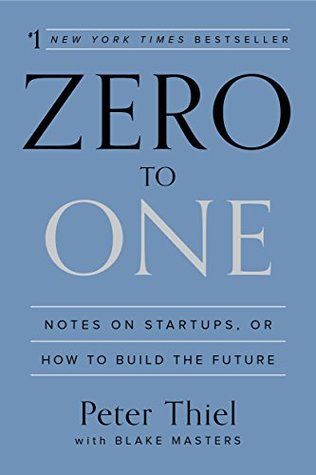
Zero to One Book Summary
Notes on Startups, or How to Build the Future
Book by Peter Thiel
Summary
Zero to One is a contrarian and insightful guide to creating the future through building innovative companies that escape competition and push technology forward.
The Future Is Unknown And Unknowable
The future is fundamentally unknown and unknowable. This opens up great opportunities, but requires thinking creatively rather than simply extrapolating from the past. Every moment happens only once, each company starts from unique circumstances, and the future is forged by discrete individual choices. Those who find value in unexpected places rather than just by following formulaic paths are best positioned to create the future.
Section: 1, Chapter: 1
Make Vertical, Zero To One Progress
Focus on making qualitative leaps in technology, business models, capabilities - going from zero to one. Don't just incrementally improve or copy what already exists (going from 1 to n). Examples of zero to one progress:
- Creating a new technology that is 10x better than alternatives
- Developing an innovative business model
- Building infrastructure or systems that unlock new possibilities
Test yourself - are you just making something marginally better, or creating something genuinely new and unique? Is your product, technology, or company just a marginal iteration on what exists, or is it categorically different and better?
Section: 1, Chapter: 1
Conventional Beliefs Only Appear Wrong In Retrospect
What is conventionally believed and accepted as truth is very hard to see past and question when you're immersed in it. Only with hindsight do previous conventional beliefs look arbitrary and wrong. Our educational system and social status games discourage contrarian thinking. Brilliant new ideas often seem wrong or misguided at first. Having the courage to pursue them anyway, in the face of skepticism, is extremely difficult but necessary for real innovation.
Section: 1, Chapter: 2
The Dot-Com Crash Taught Misguided Lessons
The dot-com crash in the early 2000s taught Silicon Valley four main lessons:
- Make incremental advances
- Stay lean and flexible
- Improve on the competition
- Focus on product, not sales
However, the opposite principles are probably more correct:
- It's better to risk boldness than triviality
- A bad plan is better than no plan
- Competitive markets destroy profits
- Sales matters just as much as product
The need for new technology is greater now than ever before. But we won't get it if everyone focuses on incremental improvements.
Section: 1, Chapter: 2
Be Bold And Seek To Create A Monopoly
Strive to create a monopoly business - one that is so good at what it does that no other firm can offer a close substitute. Avoid competition and aim to be a category of one. Some ways to build a monopoly:
- Proprietary technology - Be at least 10x better than the next best alternative. Create a product so much better it feels like it has no competition.
- Network effects - Build a product that becomes more useful as more people use it. This creates a barrier to entry.
- Economies of scale - Create a business with high fixed costs and low marginal costs, so you can scale efficiently.
- Branding - Build a strong brand that customers identify with and feel loyal to.
Section: 1, Chapter: 3
All Failed Companies Are The Same
The defining characteristic of a successful company is that it has carved out a unique and valuable market position. The differences between companies are what matters - the more different and unique a company is, the more likely it is to succeed and maintain a monopoly. Failed companies, in contrast, all look the same - they fail to escape competitive dynamics, struggle to differentiate themselves, and get beaten down by the forces of competition.
Section: 1, Chapter: 3
Monopoly Is The Condition Of Every Successful Business
"In the real world outside economic theory, every business is successful exactly to the extent that it does something others cannot. Monopoly is therefore not a pathology or an exception. Monopoly is the condition of every successful business."
Section: 1, Chapter: 3
Competition Is Overrated And Misunderstood
Don't glorify or romanticize competition. Avoid competing if possible, and seek to create and dominate new markets instead. Signs that you may be falling into competitive traps:
- Focusing on benchmarking against and emulating competitors
- Defining your market as the intersection of several overlapping existing markets (vs defining a new market)
- Emphasizing your similarity to competitors ("our product is just like X, but better in this way...")
- Obsessing over competitors' moves; Trying to undercut competitors on price instead of differentiating on value
Section: 1, Chapter: 4
Business Is Not Like War
Metaphors comparing business to war are misguided. In war, you have to compete over scarce territory or resources. In business, you want to avoid competition and seek uncontested market space. Battles between rivals cause both sides to focus on each other rather than on creating value for customers. Copycat competition on the same dimensions (price, features, etc) destroys industry profitability. Good businesses seek to escape competition and carve out their own turf rather than fighting rivals head-on.
Section: 1, Chapter: 4
Characteristics Of A Monopoly
Successful monopoly businesses usually have some combination of the following characteristics:
- Proprietary technology - A monopoly business has technology that is an order of magnitude better than its nearest substitute
- Network effects - The more people that use a product, the more valuable it becomes. This creates a high barrier to entry.
- Economies of scale - Fixed costs can be spread over an ever-larger customer base as the company grows, while variable costs shrink.
- Branding - A strong brand is a powerful way to claim a monopoly in customers' minds.
Section: 1, Chapter: 5
Related Content
Blue Ocean Strategy Book Summary
W. Chan Kim and Renee Mauborgne
Forget battling sharks in bloody red oceans. Blue Ocean Strategy shows you how to create your own uncontested market space, making the competition irrelevant and opening a sea of opportunities for profitable growth.
Forget battling sharks in bloody red oceans. Blue Ocean Strategy shows you how to create your own uncontested market space, making the competition irrelevant and opening a sea of opportunities for profitable growth.
Business
Strategy
Product Management
The Innovator's Dilemma Book Summary
Clayton M. Christensen
"The Innovator's Dilemma" unveils a paradoxical truth: successful companies are often perfectly positioned to fail. Established firms can become blindsided by disruptive technologies that reshape industries. This book offers a framework for navigating these disruptive threats, urging companies to embrace new market opportunities and transform themselves to thrive in the face of inevitable change.
"The Innovator's Dilemma" unveils a paradoxical truth: successful companies are often perfectly positioned to fail. Established firms can become blindsided by disruptive technologies that reshape industries. This book offers a framework for navigating these disruptive threats, urging companies to embrace new market opportunities and transform themselves to thrive in the face of inevitable change.
Business
Innovation
Management