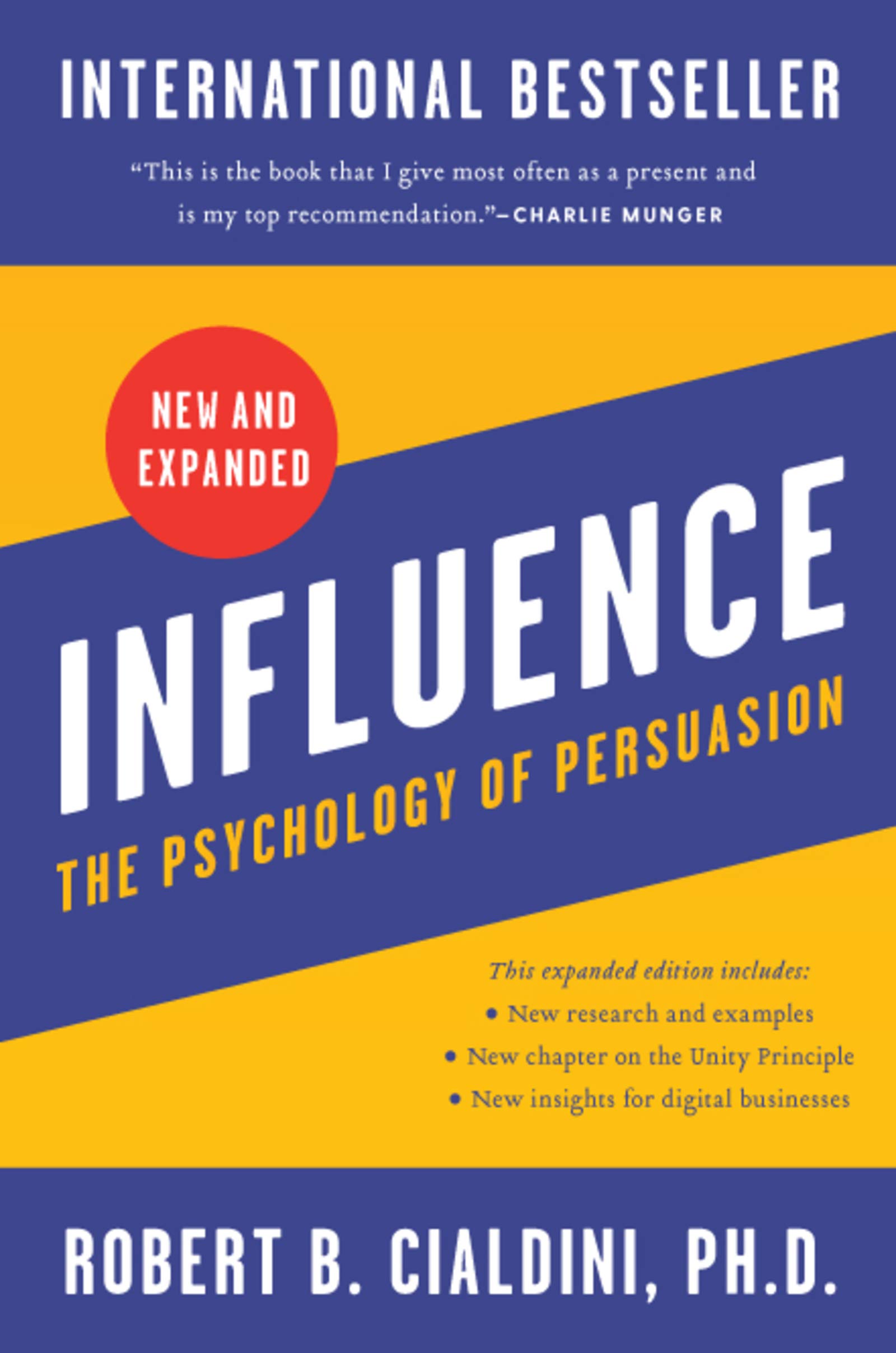
Influence Book Summary
The Psychology of Persuasion
Book by Robert Cialdini
Summary
Influence is the quintessential guide to the six universal principles of persuasion - reciprocation, commitment and consistency, social proof, authority, liking, and scarcity - that shape our decisions and behavior, often without our conscious awareness.
In his renowned book, Influence: The Psychology of Persuasion, Dr. Robert Cialdini presents a comprehensive analysis of the psychological forces that govern human compliance.
Cialdini identifies six fundamental principles of influence: reciprocation, the obligation to repay favors and gifts; commitment and consistency, our desire to align our actions with our stated beliefs and values; social proof, our tendency to follow the lead of similar others; liking, our acquiescence to those we know and like; authority, our deference to credible experts and leaders; and scarcity, our heightened desire for rare and dwindling resources. Cialdini explores each of these principles in depth, revealing their evolutionary roots, their cultural manifestations, and the ways in which they are leveraged by compliance professionals such as salespeople, marketers, and fundraisers.
Click, Whirr - Our Automatic Responses to Influence
Cialdini introduces the idea that humans, like animals, have automatic, instinctual responses to certain stimuli or "trigger features". He calls this "click, whirr" - when a trigger is activated, it "clicks" and then we automatically "whirr" into the corresponding behavior or action, without consciously thinking about it. Compliance professionals can exploit these automatic responses to influence us.
Section: 1, Chapter: 1
The Rule of Reciprocation - An Unwritten Social Contract
The rule of reciprocation states that we feel obliged to repay in kind what others have provided us. If someone does us a favor, we feel indebted to do something for them in return.
- This is a powerful rule that exists in all human societies
- It allows for unequal exchanges to happen, trusting the debt will be repaid
- It builds trust, community, and stable social structures for sharing resources
Section: 1, Chapter: 2
How a 'Free Gift' Exploits the Reciprocity Rule
The Hare Krishna society leveraged the reciprocity rule to get donations:
- In airports, they would give people a 'free gift' - a book or flower
- Though the gift was not requested, it still triggered a feeling of indebtedness
- When they then asked for a donation, people felt compelled to reciprocate
- Even those who didn't want the gift often made a donation just to relieve the sense of obligation Using unsolicited gifts is an effective way to exploit the automatic reciprocity response.
Section: 1, Chapter: 2
Use the Reciprocity Rule to Your Advantage
You can leverage the reciprocity rule in your favor:
- Proactively do favors and provide value for others
- They will feel a sense of indebtedness and want to repay you
- This makes them more likely to do what you request later
- But beware of those who purposely use this to manipulate - recognize when gifts have strings attached
Section: 1, Chapter: 2
Our Obsessive Desire to be Consistent
Cialdini introduces the consistency principle - our drive to be and appear consistent in our words, beliefs, attitudes and deeds.
- Inconsistency is generally viewed as an undesirable personality trait
- Being consistent is associated with logic, rationality, stability and honesty
- Once we make a choice or take a stand, we feel both interpersonal and intrapersonal pressure to act consistently with that declaration
- We like to justify our earlier behavior by making subsequent choices that fit with it
Section: 1, Chapter: 3
The Power of a Public Commitment
An experiment demonstrated how publicly committing to a stance leads to consistent future behavior:
- Researchers went door-to-door, asking people to place a large public service billboard on their front lawn
- Most refused this extreme request. But a subset had previously signed a petition supporting the cause - they were far more likely to comply
- Those who had publicly signed on to the initiative felt compelled to act consistently with that stance, even weeks later
- The more public the initial commitment, the more pressure to be consistently compliant later
Section: 1, Chapter: 3
Related Content
The Culture Code Book Summary
Daniel Coyle
The Culture Code reveals the secrets of highly successful groups, showing that the key to unleashing a team's full potential lies in creating a culture of safety, shared vulnerability, and purpose.
The Culture Code reveals the secrets of highly successful groups, showing that the key to unleashing a team's full potential lies in creating a culture of safety, shared vulnerability, and purpose.
Leadership
Management
Business