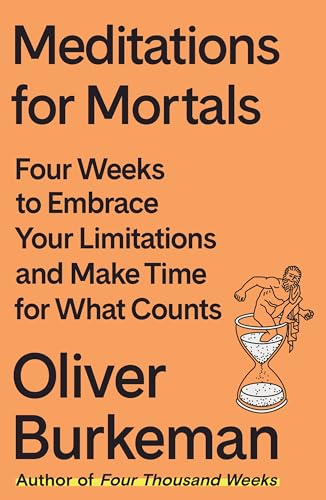
Meditations for Mortals Book Summary
Four Weeks to Embrace Your Limitations and Make Time for What Counts
Book by Oliver Burkeman
Summary
Addressing the fundamental questions about how to live, Meditations for Mortals offers a powerful new way to take action on what counts: a guiding philosophy of life Oliver Burkeman calls “imperfectionism.”
The Liberation Of Defeat
The most empowering step you can take is to grasp that life as a finite human is worse than you think. For example, the truth is that the incoming supply of things that feel like they genuinely need doing isn't merely large, but infinite.
This realization creates an important psychological shift - when you understand a struggle you'd been treating as very difficult is actually impossible. Something inside unclenches. An inner release comes from grasping how intractable our human limitations really are.
Facing the truth of your predicament frees you to accomplish more and enjoy yourself in the process, because you're no longer denying reality. You enter what writer Sasha Chapin calls "playing in the ruins" - accepting your limitations and getting on with life.
Section: 1, Chapter: 1
Kayaks And Superyachts
There are two approaches to life, represented by kayaks and superyachts:
The kayak: To be human is to occupy a little one-person kayak, borne along on the river of time. You're at the mercy of the current, able only to steer as best you can and react to whatever arises moment to moment.
The superyacht: Most of us prefer to feel like captains of superyachts, in control, programming our desired route, then watching it unfold from the comfort of a plush chair.
The desire for the superyacht experience leads us to create systems for self-improvement rather than simply doing meaningful things today. But the challenge is to recognize we're always in the kayak, never the superyacht - and to do something worthwhile anyway.
Section: 1, Chapter: 2
Just Do The Thing Once
To spend more time on what matters, stop focusing on becoming the kind of person who does that sort of thing. Instead, just do the thing - once, today or tomorrow at the latest.
Forgetting about the whole project of "becoming a meditator" and focusing solely on meditating for five minutes. Once. The same applies to writing, exercise, or any meaningful activity.
The irony is that just doing something once today is the only way you'll become the kind of person who does that sort of thing regularly. Otherwise, you're merely the kind of person who spends your life drawing up plans for how you're going to become a different kind of person later on.
Section: 1, Chapter: 2
You Are Free To Do Whatever You Like
You are free to do whatever you like. You need only face the consequences.
- Sheldon B. Kopp
Section: 1, Chapter: 3
Freedom In Limitations
The truth—though it often makes people indignant to hear it—is that it's almost never literally the case that you have to meet a work deadline, honor a commitment, or fulfill a family obligation. You're free to do whatever you like; you need only face the consequences.
Consequences aren't optional. Every choice comes with costs because at any instant, you can only pick one path and must deal with the repercussions of not picking others. Freedom isn't about escaping these costs—it's about realizing nothing stops you from doing anything, so long as you're willing to pay the price.
This perspective cuts agonizing choices down to a more manageable number while reminding us that many consequences don't justify the anxiety we invest in them.
Section: 1, Chapter: 3
Against Productivity Debt
Many people begin each morning in a kind of "productivity debt" which they must struggle to pay off throughout the day. This mindset means:
- You feel you haven't justified your existence until you've accomplished enough
- Success becomes a punishment, as each accomplishment sets a higher standard
- Your self-worth becomes tied to your output
The solution is to keep a "done list" instead of just a to-do list. Rather than measuring your accomplishments against all you could potentially do (an infinite standard), you compare what you've done to having done nothing at all – providing perspective and motivation.
Section: 1, Chapter: 4
Treating Your Reading Pile Like A River
To navigate information overload, treat your to-read pile like a river, not a bucket. Instead of seeing it as a container that gradually fills up and that you must empty, view it as a stream flowing past you.
From this stream, pick a few choice items without feeling guilty for letting all the others float by. The mere existence of something readable creates no obligation to read it.
Remember that consuming information is a present-moment activity - reading something interesting, moving, or amusing might be worth doing not just to improve your future self, but for the sake of that very half hour of being alive.
Section: 1, Chapter: 5
Focused Care In A Crisis-Filled World
In an age where you're asked to care about everything with maximum intensity, the most effective approach is to pick your battles and focus your concern more deeply.
Rather than having 50 million people care seriously about an issue for six hours, imagine distilling that concern into 3,000 people who make it a primary moral concern for a decade.
This means:
- Choose one or two issues to focus on deeply rather than taking on the emotional burden of dozens
- Don't feel bad about setting these boundaries - it allows you to fight your chosen battles more effectively
- Remember that living inside the news feels like being a good citizen but often paralyzes real action
Section: 1, Chapter: 6
You Can Only Cross Bridges When You Come To Them
We're hopelessly trapped in the present, confined to this temporal locality, unable even to peer over the fence into the future. This means we suffer from what psychologist Robert Saltzman calls "total vulnerability to events" - anything could happen at any moment.
Worry is our mind's attempt to picture every bridge we might have to cross, then figure out how to cross them. But this goal is doubly impossible. We can't think of every challenge we might face, and even if we could, the solace we crave would only come from knowing we'd made it safely over—which we can't know until we've actually crossed them.
The hidden gift in this reality? Your responsibility can only ever be to the next moment—just do "the next and most necessary thing" as best you can.
Section: 1, Chapter: 7
Decision-Hunting
Most decision-making advice treats decisions as things that just come along. But the life-enhancing route is to think of decisions not as things that come along, but as things to go hunting for.
In other words: operate on the assumption that somewhere, in the confusing morass of your work or life, lurks at least one decision you could make, right now, to get unstuck and get moving.
Making a decision is the defining act of the limit-embracing life because:
- You acknowledge you can only take one path among many alternatives
- You take ownership of your situation instead of postponing painful sacrifices
- You focus your energy on action rather than avoidance
Section: 2, Chapter: 8
Related Content
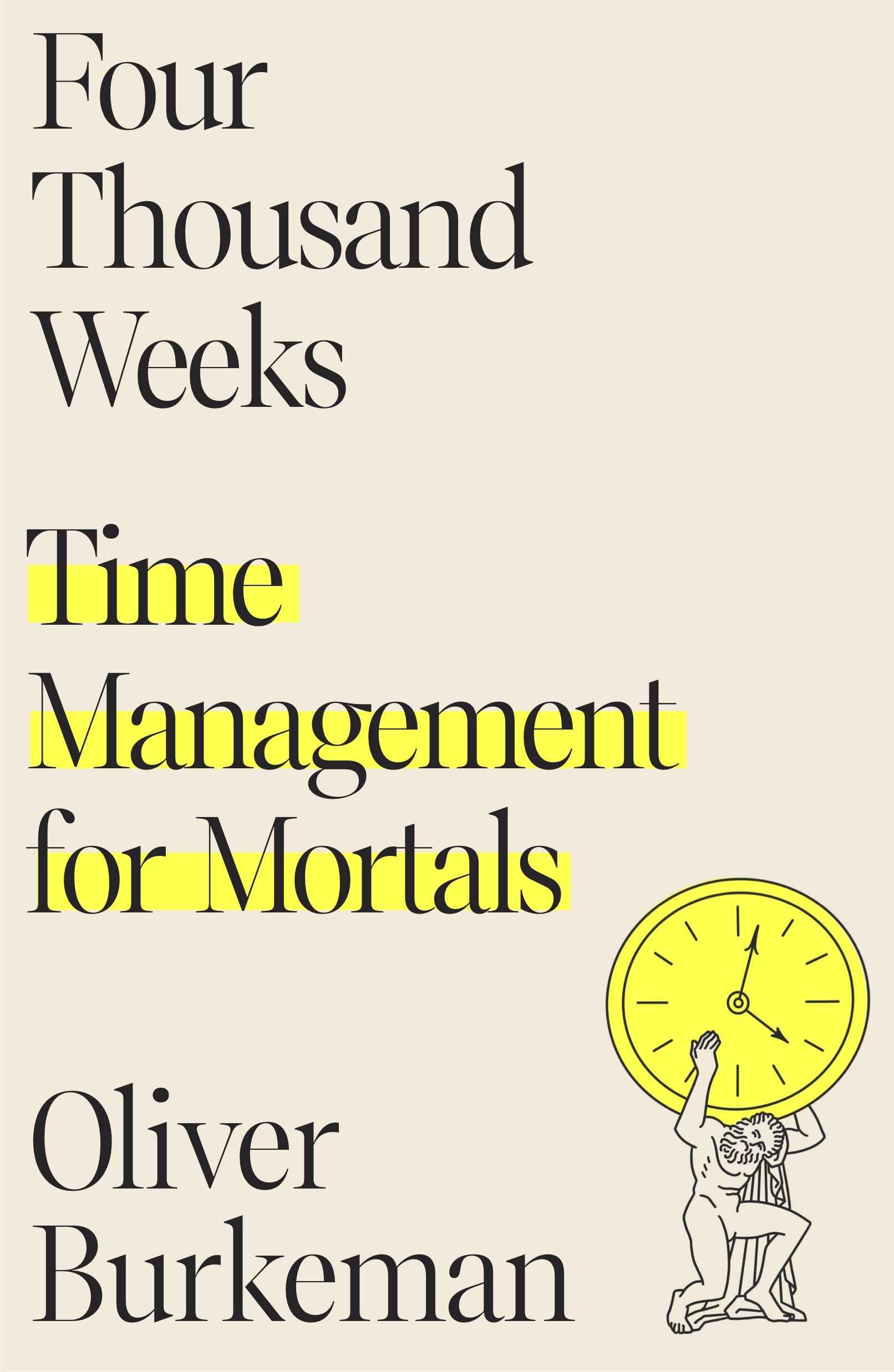
Four Thousand Weeks Book Summary
Oliver Burkeman
"Four Thousand Weeks" offers a radical perspective on time management, urging us to abandon the futile quest for control and embrace our finite existence. By accepting our limitations and making conscious choices, we can discover a more meaningful and fulfilling way to spend our brief time on this planet.
"Four Thousand Weeks" offers a radical perspective on time management, urging us to abandon the futile quest for control and embrace our finite existence. By accepting our limitations and making conscious choices, we can discover a more meaningful and fulfilling way to spend our brief time on this planet.
Philosophy
Personal Development