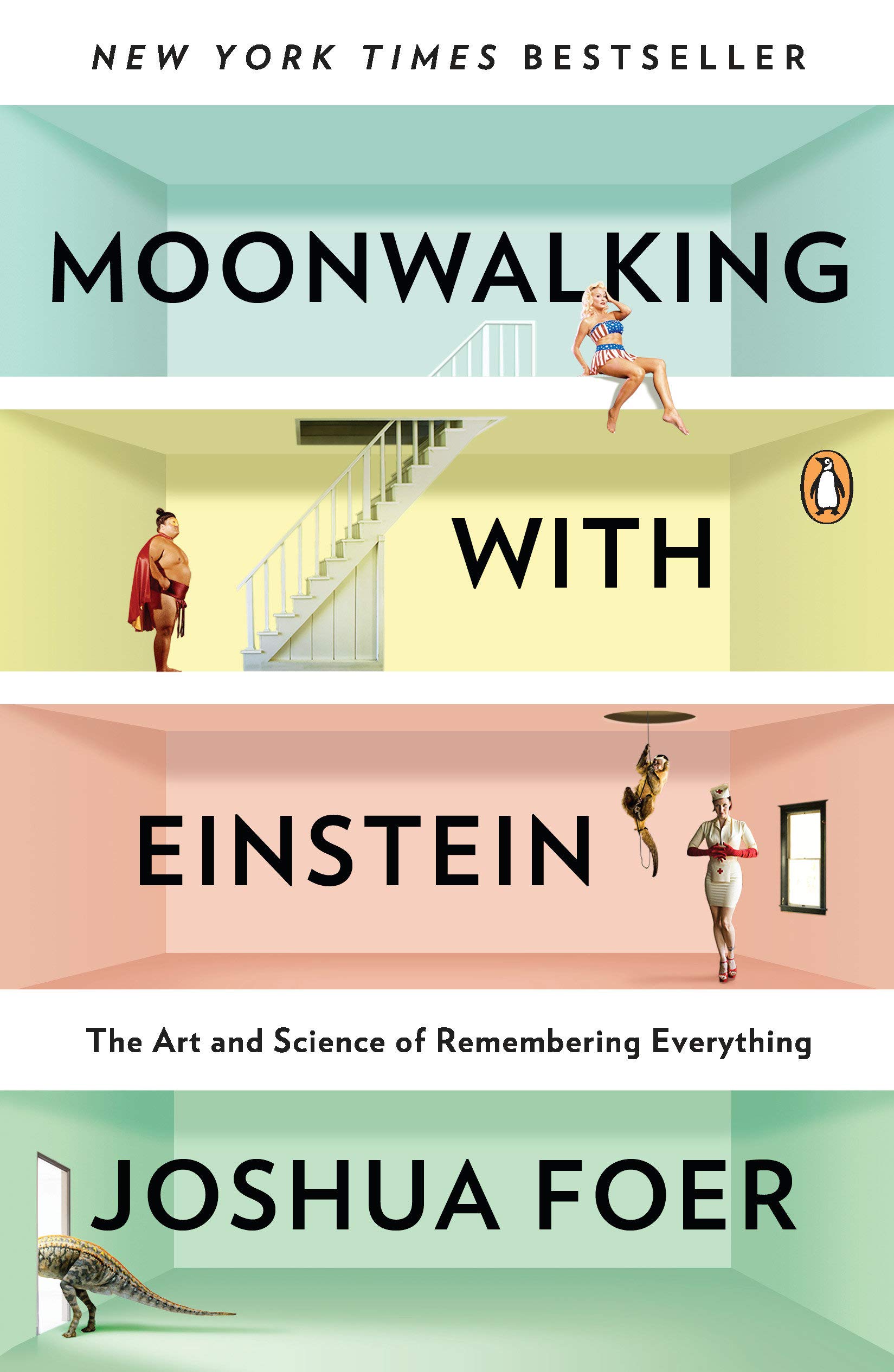
Moonwalking with Einstein Book Summary
The Art and Science of Remembering Everything
Book by Joshua Foer
Feeling Lazy?Read 1 Minute Summary
Summary
Joshua Foer chronicles his journey from covering the U.S. Memory Championship as a journalist to becoming a competitor and ultimately winning the event himself, all while exploring the history, science, and techniques of memory training and the untapped potential of the human mind.
The Smartest Man is Hard to Find
In the introduction, Joshua Foer attends the 2005 U.S. Memory Championship as a journalist and is amazed by the feats of memorization he witnesses. He gets the idea to spend a year training his own memory and write about the experience. Foer cites a quote that anyone could do what the mental athletes do, it's simply a matter of learning techniques.
Section: 1, Chapter: 1
The Man Who Remembered Too Much
Chapter 1 introduces the story of a Russian journalist named S who showed up at psychologist A.R. Luria's office in 1928 claiming to have an abnormally powerful memory. Luria studied S for 30 years and wrote a book about him, finding S's memory was virtually limitless. However, S was crippled by his inability to forget anything. His mind was constantly cluttered with trivial details and sensations.
While S's memory was seemingly sui generis, Foer suggests it may be possible for anyone to attain similar memorization abilities through training. He cites a study comparing the brains of mental athletes to a control group that found no neuroanatomical differences - only that the mental athletes were engaging different brain regions related to spatial memory and navigation. This suggests their skills were achieved through practice rather than innate ability.
Section: 1, Chapter: 1
The Expert's Expert
Chapter 2 introduces Anders Ericsson, a professor at Florida State University and the world's leading expert on expertise. Ericsson has spent decades studying expert performers, from mental athletes to chess grandmasters to virtuoso violinists, in order to understand how they achieve their incredible skills. His core finding is that expertise comes through a very specific type of practice he terms "deliberate practice" - focused, goal-directed training performed with full concentration and immediate feedback, consistently pushing past one's comfort zone. Innate talent is less important than the right kind of training.
Section: 1, Chapter: 2
The Most Forgetful Man in the World
In contrast to S's incredible memory, consider the story of EP, a man with one of the most severe cases of amnesia ever documented. After a bout with herpes simplex encephalitis, EP was left with extensive damage to his hippocampus and medial temporal lobes, wiping out his ability to form new long-term memories. Trapped in an eternal present, EP is a profound case study in the importance of memory to identity, relationships, and one's ability to function in the world.
Tying into EP's story, Foer makes the point that our sense of time and our very identities are structured by our memories of events. The more memories we create, the more "chronological landmarks" we build into our mental model of the past, helping us organize our experience. People with Alzheimer's and severe memory loss don't just lose their pasts - they lose their ability to imagine the future too.
This insight suggests an actionable lesson we can all apply: Be mindful about creating lots of memorable experiences in your life. Seek out new adventures, visit new places, learn new things.
Section: 1, Chapter: 3
The Memory Palace Technique
Foer lays out the basic technique for memorizing used by mental athletes: the "memory palace." Invented in ancient Greece, this powerful method exploits our brain's natural spatial memory abilities. To use it:
- Visualize a familiar physical space, like the layout of your house.
- Mentally place the items you want to memorize throughout the rooms, creating an associative link between each item and a specific location.
- To recall, simply retrace your steps through the memory palace. The distinctive items and images you placed will spring back to mind.
By tying information we want to remember to places and images, we take advantage of how the human brain evolved to work - not as a filing cabinet for abstract symbols, but as a way of navigating the world and remembering what's important. Even the most mundane facts can be made memorable with enough creativity in transforming them into strange, lewd, funny, or bizarre mental images and scenes.
Section: 1, Chapter: 4
Ancient Orators Used the Memory Palace
In the ancient world, before books were common, orators would use the method of loci to prepare for speeches. The Roman rhetorician Cicero was said to practice by memorizing the physical locations of his speeches, placing the topics he planned to discuss into the courtrooms, auditoriums, and amphitheaters where he would be speaking.
This allowed him to deliver long, complex addresses without notes, moving from point to point in his mind as he moved from place to place in the physical location. Using associative imagery allowed him to speak naturally and fluidly, without pausing to consciously recall the next set of facts from rote memory.
Section: 1, Chapter: 4
The Link Method
Another powerful technique is the "link method":
- Take the items to be memorized (like a series of numbers).
- Transform each one into an image.
- Create a scene or story linking the image.
- To recall, simply follow the chain of images.
For example, to memorize a shopping list with milk, eggs, and butter:
- Picture a giant milk carton.
- Imagine the milk carton opening, and a dozen eggs spilling out.
- The eggs crack open, and gallons of melted butter come pouring out.
By vividly linking images together, vast amounts of mundane data can be made unforgettable in creative ways, allowing mental athletes to perform staggering feats of memorization like reciting thousands of digits of pi.
Section: 1, Chapter: 4
Memory Training Transforms Thinking
While researching memory techniques, Foer discovered an unexpected benefit beyond just memorization skill: Forcing his brain to operate differently changed the very way he perceived and processed new information in his daily life.
As he practiced visualizing information spatially and associatively rather than just verbally and linearly, his whole way of thinking shifted. Poetry became richer and more evocative as he pictured the scenes described vividly in his mind. Conversations became more memorable as he automatically noted interesting imagery and analogies. Even his appreciation of art took on new dimensions as he immersed in the details of paintings and sculptures.
Memory training, he realized, doesn't just allow us to memorize facts - it can reshape our entire way of processing the world.
Section: 1, Chapter: 4
Related Content
Outliers Book Summary
Malcolm Gladwell
Outliers looks into the lives of exceptional individuals, uncovering the often-overlooked factors that contribute to their success. It challenges the notion of the "self-made" individual, highlighting the crucial role of opportunity, cultural legacies, and hidden advantages in shaping the path to achievement.
Outliers looks into the lives of exceptional individuals, uncovering the often-overlooked factors that contribute to their success. It challenges the notion of the "self-made" individual, highlighting the crucial role of opportunity, cultural legacies, and hidden advantages in shaping the path to achievement.
Psychology
Performance
Personal Development