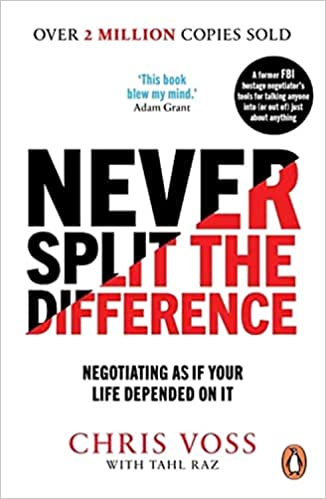
Never Split The Difference Book Summary
Negotiating as if Your Life Depended on It
Book by Chris Voss
Feeling Lazy?Read 1 Minute Summary
Summary
Never Split the Difference teaches that negotiation is not about logic and rationality, but about emotional intelligence, empathy, and the subtle art of getting into your counterpart's head to uncover their real motivations and desires.
The FBI's Lead International Kidnapping Negotiator
Chris Voss, the author, was the FBI's lead international kidnapping negotiator. He worked on over 150 international hostage cases during his 24-year career with the FBI. Through his experience negotiating with terrorists, bank robbers, and kidnappers, Voss developed a new approach to high-stakes negotiation based on emotional intelligence and empathy.
Section: 1, Chapter: 1
Negotiation Is Not Rational, It's Emotional
Humans are not rational beings, we are emotional, irrational beasts prone to cognitive biases. Negotiation is not about logic and intellect, it's about emotions and feelings.
To be a great negotiator, you have to get over your aversion to negotiating. Don't avoid conflict, learn to embrace it. Negotiation is really about getting what you want from others in a psychologically savvy way.
Successful negotiation involves getting your counterpart to do the work for you by triggering their own internal pressures and desires. The goal is to have them make your argument for you.
Section: 1, Chapter: 1
The FBI's Covert Negotiation Weapons
Over two decades of experience, the FBI Crisis Negotiation Unit developed a framework of proven negotiation tactics:
- Active Listening: Listen intently to your counterpart and make them feel understood
- Tactical Empathy: Recognize and vocalize your counterpart's perspective without necessarily agreeing
- Mirroring: Imitate your counterpart's speech patterns to build rapport
- Labeling: Put their feelings into words to show understanding and diffuse negativity
- Paraphrasing: Repeat back what they say in your own words
- Summarizing: Combine paraphrasing and labeling to reinforce key points
- Calibrated Questions: Gently say no by asking open-ended questions that start with "how" or "what"
Section: 1, Chapter: 1
Getting to "That's Right"
The sweetest two words in any negotiation are "That's right." When someone says "you're right" they are not really agreeing, just getting you to leave them alone.
But when they say "that's right", they feel truly understood and are open to being persuaded. Strive to reach "that's right" not "you're right." To get to "that's right", summarize and paraphrase their worldview back to them until they respond with "that's right." This creates breakthroughs.
Section: 1, Chapter: 1
Don't Go In With Assumptions
Good negotiators enter interactions with a mindset of discovery, looking to extract and observe as much information as possible. But most people enter with assumptions and arguments already in their head, which blinds them to what is really happening.
Hold multiple hypotheses and use the negotiation to test them. Don't treat your assumptions as gospel but as your negotiating counterpart's positions and arguments unfold before you.
Great negotiators question the assumptions that others accept on faith, and thus remain more emotionally open to all possibilities.
Section: 1, Chapter: 2
The Secret To Gaining The Upper Hand
"The goal is to identify what your counterparts actually need and get them feeling safe enough to talk about what they want. The latter will help you discover the former. Wants are easy to talk about, representing the aspiration of getting your way, and sustaining any illusion of control we have as we begin to negotiate; needs imply survival, the very minimum required to make us act, and so make us vulnerable."
Section: 1, Chapter: 2
Using Your Voice to Establish Rapport
There are 3 voice tones available to negotiators:
- The late-night FM DJ voice: Use selectively to make a point. Downward inflecting, calm and slow. Creates an aura of authority and trustworthiness without triggering defensiveness.
- The positive/playful voice: Should be your default. Voice of an easygoing, good-natured person. Relax and smile while talking.
- The direct or assertive voice: Used rarely. Will cause problems and pushback.
Section: 1, Chapter: 2
Mirroring
During a hostage negotiation, Voss asked the hostage taker "We chased your driver away?" mirroring the kidnappers own words back to him. This simple mirroring led the kidnapper to start "vomiting" information, admitting key details about his accomplice they didn't previously know about.
Section: 1, Chapter: 2
Don't Feel Their Pain, Label It
Tactical empathy is understanding the feelings and mindset of another in the moment and also hearing what is behind those feelings so you increase your influence in all the moments that follow. It's bringing our attention to both the emotional obstacles and the potential pathways to getting an agreement done. The steps are:
- Actively listen to their side
- Vocalize the underlying emotions you hear (labeling)
- Pause and let them talk more
- Repeat until they have vented all their emotions and feel understood
Section: 1, Chapter: 3
Labeling Emotions Diffuses Them
Labeling is a way of validating someone's emotion by acknowledging it verbally. Give their emotion a name and you show you identify with how they feel.
The key is to label in a neutral tone, staying calm yourself. Simple phrases like "It seems like..." or "It sounds like..." work well. The magic of labeling emotions is it diffuses them. When people feel understood, their defensive walls come down and they are more open to influence.
Labeling negative emotions helps to de-escalate conflicts, while positively affirming your counterpart's worldview.
Section: 1, Chapter: 3
"No" Means Many Things
Pushing hard for "yes" doesn't actually get a negotiator any closer to a win, it just angers the other side. No one likes feeling persuaded or pushed around."
No" is not rejection, it often means things like: I am not yet ready to agree; You are making me feel uncomfortable; I do not understand; I don't think I can afford it; I want something else; I need more information; or I want to talk it over with someone else.
Great negotiators seek "No" because they know that's often when the real negotiation begins. "No" provides a great opportunity for both parties to clarify what they don't want, and ultimately work together to craft a solution.
Section: 1, Chapter: 4
Related Content
Super Communicators Book Summary
Charles Duhigg
Who and what are supercommunicators? They're the people who can steer a conversation to a successful conclusion. They are able to talk about difficult topics without giving offence. They're brilliant facilitators and decision-guiders. How do they do it?
Who and what are supercommunicators? They're the people who can steer a conversation to a successful conclusion. They are able to talk about difficult topics without giving offence. They're brilliant facilitators and decision-guiders. How do they do it?
Self-Help
Psychology
Leadership
Business
Communication