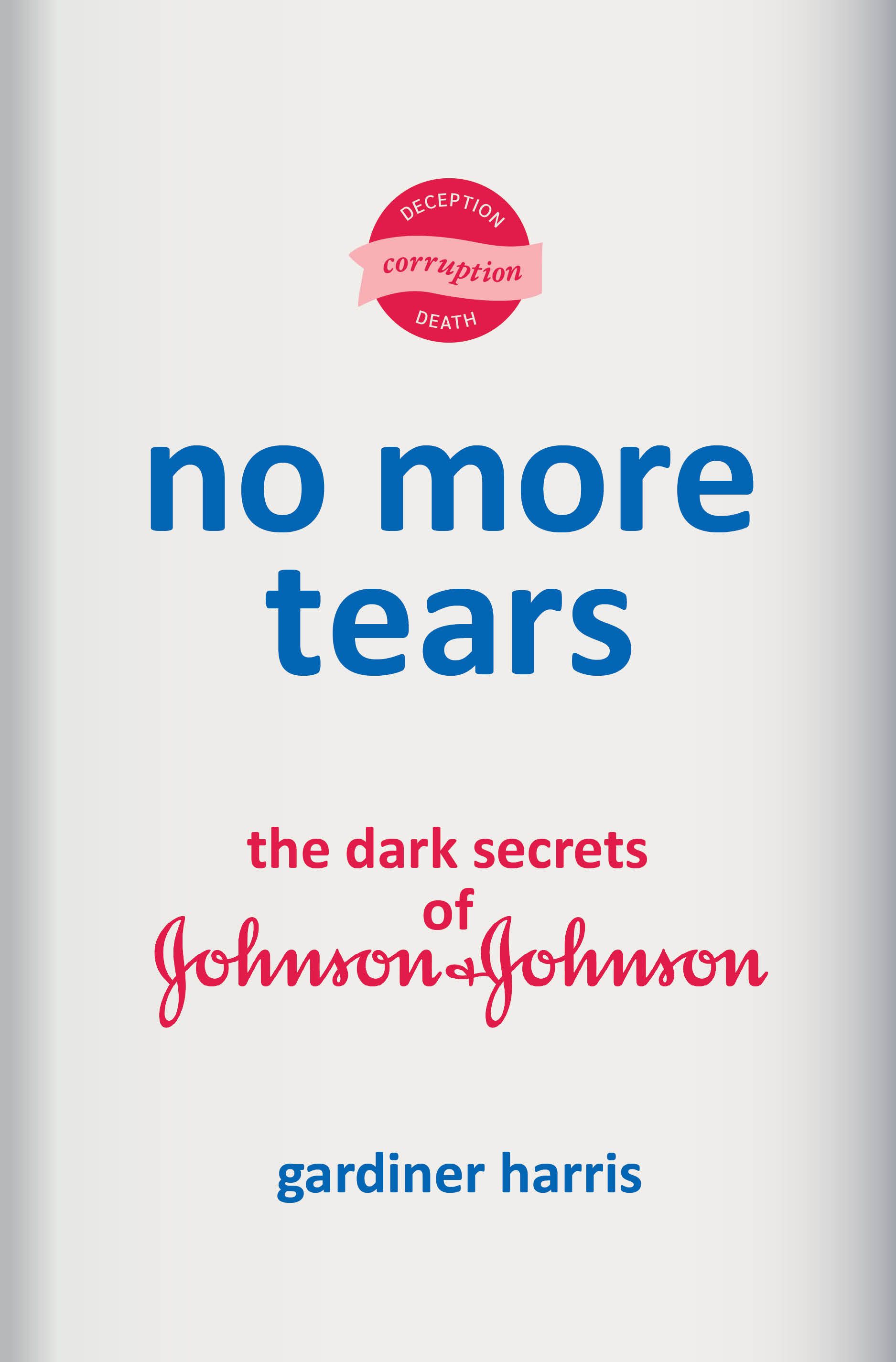
No More Tears - Book Summary
The Dark Secrets of Johnson & Johnson
Book by Gardiner Harris
Summary
Behind the trusted baby powder and beloved Tylenol lies one of the most shocking corporate deceptions in American history—how Johnson & Johnson knowingly sold dangerous products for decades while building a reputation as the most ethical company in healthcare.
Trust Is Our Product
Johnson & Johnson's most powerful branding weapon isn't advertising or marketing—it's a distinctive fragrance with over two hundred ingredients from around the world. The complex floral scent combines vanilla, jasmine, lilac, rose, musk, and citrus to create the most recognized fragrance globally. This scent imprints itself on infants before birth and throughout childhood, creating what J&J calls 'the Golden Egg'—an emotional bond between mothers, babies, and the J&J brand.
This emotional programming operates at the deepest level of human psychology, feeding directly into the brain's limbic system. Unlike competitors who achieve only 'rational trust,' Johnson & Johnson uniquely possesses 'real emotional trust' that consumers will forgive missteps and brand crises. The investment in this psychological manipulation pays enormous dividends—creating a protective halo around all J&J products for life.
Section: 1, Chapter: 1
The Myth Of FDA Protection
J&J's most powerful defense isn't legal—it's mythological. The company successfully portrays the FDA as a 'tough cop' that protects Americans from dangerous drugs. This myth serves multiple purposes:
- Reassures sales reps their activities must be legal ('the FDA wouldn't allow it')
- Convinces doctors that FDA approval equals safety
- Provides legal immunity in many states
- Makes Americans willing to try new drugs faster than other countries
In reality, the FDA is industry-captured, understaffed, and reactive. Most enforcement comes from whistleblowers, not agency action.
Section: 1, Chapter: 1
The Quintessential American Story
CNBC's Tyler Mathisen called J&J 'quintessentially American'—and he was right. The company's story mirrors American healthcare's transformation from best to worst, protected by myths and money.
J&J represents everything wrong with American capitalism: regulatory capture, institutional corruption, and the prioritization of profits over people. Despite causing potentially millions of deaths through its prescription drugs, the company maintained its reputation through massive PR campaigns and strategic donations. Its ability to avoid accountability while being celebrated as ethical demonstrates the fundamental corruption of American systems.
Section: 1, Chapter: 1
Three Brothers Go To New Brunswick
The Johnson & Johnson story began when Robert Wood Johnson, sent away from Pennsylvania to avoid Civil War service, learned the mysterious art of medicinal plasters in New York. He partnered with George Seabury in 1873, then struck out with his brothers to found Johnson & Johnson in 1887.
Their breakthrough came through relentless innovation in rubber-based plasters that could both stick and keep. Combined with early adoption of antiseptic practices inspired by Joseph Lister, the company built a global empire of sterile medical supplies. By 1911, J&J produced 90% of the world's sterile cotton, gauze, and bandages.
Section: 1, Chapter: 2
The Mineral Twins That Changed Everything
Talc and asbestos are geological twins—chemically similar minerals that often form together in the earth. The key danger lies in their proximity: talc deposits are frequently sandwiched between or ribboned with asbestos veins, making complete separation impossible.
When J&J bought Vermont talc mines in 1964, they positioned themselves just yards from asbestos mines. The company discovered their talc contained 'less than 1% to about 3% of contaminants'—mostly asbestos. This contamination would haunt the company for decades, as even microscopic asbestos fibers can cause cancer decades after exposure.
Section: 2, Chapter: 3
How The FDA Became Powerless
The FDA was born toothless in 1906, able only to verify ingredient lists on patent medicines. It took the horrific deaths of 73 people from poisoned Elixir Sulfanilamide in 1937—including six-year-old Joan Nidiffer—to give the agency power to test drug safety. The thalidomide crisis then mandated efficacy testing.
But cosmetics like Johnson's Baby Powder fell into a regulatory black hole. Despite being used by millions daily, cosmetic products needed no FDA approval and the agency had minimal resources to study them. As one official noted: 'Nobody dies from cosmetics.' This blind spot would prove catastrophic.
Section: 2, Chapter: 5
Manufacturing False Safety Standards
When facing potential regulation, J&J didn't fight the FDA—it captured the standard-setting process. The industry created the J4-1 testing method, designed to look sophisticated while being incapable of detecting asbestos contamination.
The method was like 'using a bathroom scale to weigh a pin.' Labs tested with J4-1 failed to detect even deliberately spiked samples containing asbestos. Four labs missed all fourteen spiked samples; others caught only three. Despite these obvious failures, the industry adopted J4-1 unchanged, giving companies a scientific-sounding way to declare products 'asbestos-free' while knowing they contained the deadly mineral.
Section: 2, Chapter: 6
The Power Of Institutional Pressure
When Harvard's Dr. Daniel Cramer published evidence linking talcum powder to ovarian cancer, J&J deployed its most effective weapon: institutional capture. Company executives flew to Boston and pressured Dr. Thomas Chalmers, president of Mount Sinai Medical School, to issue a public retraction of his own faculty's research.
Chalmer's initial defense of the research was stripped away line by line until the final statement contradicted the science. This wasn't just about one study—it was about demonstrating that even elite medical institutions would bend to corporate pressure. The tactic worked so well that it trained a generation of journalists to be skeptical of any claims about baby powder contamination.
Section: 2, Chapter: 7
Secrecy As Corporate Strategy
When a worker died from mesothelioma linked to J&J's former talc mine, the resulting legal discovery threatened to expose decades of cover-ups. J&J's response revealed its sophisticated approach to damage control through secrecy:
- Document purges to destroy evidence
- False affidavits swearing asbestos was never found
- Threatening plaintiffs' attorneys with sanctions
- Creating fake records to replace real ones
This pattern—deny, destroy, and threaten—became J&J's standard playbook for managing scandals across all its product lines for decades.
Section: 2, Chapter: 8
The Texas Two-Step And Avoiding Justice
When Baby Powder lawsuits threatened real accountability, J&J pioneered a legal maneuver called the 'Texas Two-Step.' The company:
- Transferred all Baby Powder liabilities to a subsidiary (LTL Management)
- Put $2 billion in a trust fund for litigation costs
- Declared the subsidiary bankrupt despite J&J's $400+ billion market cap
This allowed the company to cap damages and eliminate punitive awards from outraged juries. Though courts eventually rejected this scheme, it demonstrated J&J's willingness to push legal boundaries just as aggressively as it had pushed medical and ethical ones.
Section: 2, Chapter: 9
Sacred Cows Don't Die Easy
When the truth about Johnson's Baby Powder finally emerged in court, the evidence was overwhelming. Attorney Mark Lanier presented a devastating case: J&J knew for decades that Baby Powder contained asbestos, hid this from regulators, and continued selling while thousands of women developed cancer.
The jury awarded $2.5 billion in punitive damages—one of the largest civil judgments in history. Even after appeals reduced it to $2.1 billion, the Supreme Court upheld the verdict. J&J transferred the money within a day, but the company's 'sacred cow' was finally dead. Baby Powder sales were discontinued globally by 2023.
Section: 2, Chapter: 9
Manufacturing A Poisoning Myth
The 1982 Tylenol poisoning case created the most powerful corporate myth in American business history. But the accepted narrative has critical flaws: Tylenol had been tampered with hundreds of times before. The prime suspect—Roger Arnold—worked for J&J's distribution partner and had access to wholesale Tylenol boxes found scattered in a parking lot before the first death.
The FBI ignored these clues, focusing instead on a con man who sent an extortion letter. Arnold later murdered another man, validating investigators who believed he was the Tylenol killer. If true, J&J wasn't an innocent victim but a company whose compromised distribution system enabled mass murder.
Section: 3, Chapter: 10
When The FDA Goes Missing
During the Tylenol crisis, the FDA immediately absolved J&J of responsibility and surrendered its investigative role to the company itself. This wasn't objectivity—it was capture.
The corrupt commissioner Arthur Hayes took illegal payments from drugmakers while in office. He used the crisis to create a 'love fest' with J&J, issuing statements designed to shield the company from liability. The agency even officially dismissed the possibility that contamination occurred in J&J's distribution system—despite evidence pointing exactly there.
Hayes retired in disgrace but spent his remaining years working for a PR firm owned by a former J&J executive.
Section: 3, Chapter: 12
The Cost Of Doing Business
When asked about continuing to sell infant Tylenol despite babies dying from dosing mix-ups, McNeil's medical director revealed the company's calculation:
'Rather than pull the products off the shelf, that's sort of the cost of doing business?'
'McNeil felt that the benefit... was appropriate to keep it in the marketplace, yes.'
This became J&J's standard approach: factor potential criminal penalties into business costs and continue selling deadly products because the profits exceeded any punishment. Between 2010-2021, J&J spent $25 billion on litigation—a small price for avoiding real accountability.
Section: 3, Chapter: 13
The Deadliest Over-The-Counter Drug
Tylenol kills at least 150 Americans annually and hospitalizes 30,000—more than all other over-the-counter pain relievers combined. The drug's safety margin is uniquely narrow: the maximum daily dose is also the maximum safe dose.
Unlike aspirin or ibuprofen, acetaminophen provides no warning signs before liver failure strikes. Victims often mistake early symptoms for the flu and take more Tylenol, sealing their fate. The antidote only works within eight hours, but accidental poisoning victims rarely realize they're in danger until it's too late.
Key insight: Despite these risks, the FDA requires stronger warnings on prescription acetaminophen (325mg) than over-the-counter Extra Strength Tylenol (500mg).
Section: 3, Chapter: 13