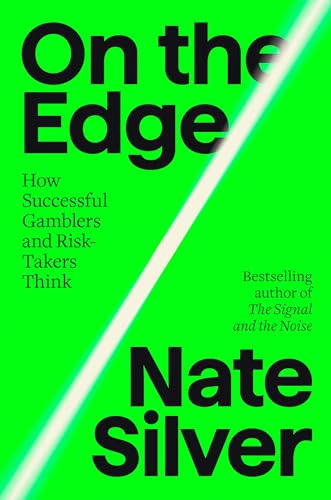
On The Edge Book Summary
The Art of Risking Everything
Book by Nate Silver
Summary
"On the Edge" takes readers on a captivating journey through the high-stakes world of poker, sports betting, and risk-taking, revealing the counterintuitive strategies and mental habits that allow gamblers and daredevils to thrive in the face of daunting odds.
Poker Solvers Revolutionize The Game
The advent of computer solvers has revolutionized the game of poker. These AI-aided programs, developed by pioneers like Piotr Lopusiewicz, find the game theory optimal (GTO) solution for poker by running through billions of iterations. They reveal that optimal play often involves frequent randomization and mixed strategies to remain unexploitable. As a result, modern poker players devote hundreds of hours to studying solver outputs, bringing game theory into practice at an unprecedented level. While humans still maintain an edge through psychological reads and exploitative play, the technical gap between top players and computers is rapidly shrinking.
Section: 1, Chapter: 1
The Promise of Game Theory
"Poker has been around for roughly two centuries, but the vast majority of poker hands ever played by humans—probably at least 95 percent if not as much as 99 percent—have been played in the past twenty or twenty-five years."
Section: 1, Chapter: 1
Poker Players Apply Game Theory At An Unprecedented Level
Serious poker players can gain an edge by:
- Devoting significant study time to poker solver outputs to internalize game theory optimal play
- Employing mixed strategies and balanced ranges to avoid being exploited by observant opponents
- Understanding the tradeoffs between GTO and exploitative play styles based on villain tendencies
- Utilizing randomization techniques like choosing bet sizes based on the second hand of the tournament clock
- Knowing when to deviate from solver strategies to capitalize on reads and psychological factors
Section: 1, Chapter: 1
Strategic Empathy Is Key To Success In Poker
One of the most important skills for top poker players is strategic empathy - the ability to put yourself in your opponent's shoes and understand how they perceive the game state. By paying attention to subtle physical tells, betting patterns, and emotional states, elite players like Vanessa Selbst and Maria Ho gain an edge by narrowing their opponent's range and finding exploitative plays. However, this is a skill that needs to be carefully honed and applied, as making hero calls or huge bluffs based on a hunch can be disastrous without hard evidence to support a read.
Section: 1, Chapter: 2
Poker Is A Game of Incomplete Information
When making a big decision in poker, it's essential to:
- Pay attention to your opponent's physical tells and emotional states while not staring too obviously
- Consider the story your opponent is telling with their betting actions and see if it adds up
- Rely on your experiential database of poker hands to identify similar patterns and outcomes
- Give villains credit for understanding basic strategic considerations and don't assume they're making illogical plays without strong evidence
- Make peace with the fact that you'll never have complete certainty and sometimes the mathematically correct play will lose to an improbable bluff
By honing your perception skills while embracing the inherent ambiguity of poker, you'll be able to make more accurate decisions under pressure.
Section: 1, Chapter: 2
The Physical Challenges Of Playing For High Stakes
Playing poker for significant amounts of money relative to your bankroll creates an unmistakable physical response, even for seasoned professionals. Sweaty palms, pounding heartbeats, and trembling hands are common symptoms of the adrenaline rush brought on by high-pressure situations.
According to trader turned neuroscientist John Coates, author of The Hour Between Dog and Wolf, embracing this stress response is key for performing your best under pressure. Top poker players, traders, and athletes all show heightened physical responses to risk, giving them an extra gear to make perceptive choices in pivotal moments.
Section: 1, Chapter: 2
Casinos Use Data To Optimize Profits And Player Experience
Modern casinos are increasingly using data analytics and machine learning to model player behavior and optimize every aspect of their gaming floors. Pioneered by Gary Loveman, former CEO of Caesars Entertainment, casinos now employ teams of MIT-trained mathematicians and data scientists to determine everything from the optimal slot machine hold percentage to the personalized comps offered to loyal high rollers.
By tracking player activity through loyalty cards, mining behavioral data, and running experiments, mega-resorts can create a perfectly tuned ecosystem that maximizes both player satisfaction and casino winnings.
Section: 1, Chapter: 3
The Three Tiers Of The Casino Business
The casino industry can be divided into three distinct market segments:
- High-end luxury resorts: Upscale properties like the Bellagio and Wynn cater to an affluent clientele with lavish amenities, Michelin-starred restaurants, and designer shopping. Gambling is just one component of a complete entertainment experience.
- Mass market corporate casinos: Companies like MGM Resorts and Caesars Entertainment operate a broad portfolio of properties that appeal to a wide spectrum of tourists and convention-goers. Casinos use tiered loyalty programs to segment customers and offer personalized promotions.
- Locals market and slot parlors: These bare-bones operations cater to a working class clientele with minimal amenities beyond the gaming floor. Slot machines and video poker are the primary focus, and casino design principles create a maze-like environment to keep players glued to their games.
Section: 1, Chapter: 3
Advantage Players Find Edges In A Sea Of Bad Bets
While the odds are stacked against the typical casino gambler, a rare breed of advantage player seeks out profitable opportunities by:
- Identifying promotions and game variants with reduced house edges
- Pouncing on pricing mistakes, such as progressive jackpots that have reached a positive expected value threshold
- Playing unbeatable games like poker where an edge can be gained through skill
- Taking advantage of casino host incentives and loss rebates that mitigate downside risk
- Developing data-driven models for advantage play in table games and sports betting
Section: 1, Chapter: 3
Razor Thin Margins Of Professional Sports Betting
Professional sports bettors operate in an extremely efficient market, often grinding out an edge of just 2-3% on the massive amounts of money they bet. With such slim margins for error, getting money down becomes as important as handicapping games profitably.
Bettors must navigate betting limits, wager timing, market-making sportsbooks, and closing line value to extract as much expected value from their edges as possible. This unforgiving calculus has turned sports betting into a high-stakes cat-and-mouse game between top bettors looking for weaknesses in the betting market and sportsbooks looking to encourage square money while limiting their sharpest customers.
Section: 1, Chapter: 4
Related Content
Algorithms To Live By Book Summary
Brian Christian
Algorithms to Live By reveals how computer algorithms can solve many of life's most vexing human problems, from finding a spouse to folding laundry, by providing a blueprint for optimizing everyday decisions through the lens of computer science.
Algorithms to Live By reveals how computer algorithms can solve many of life's most vexing human problems, from finding a spouse to folding laundry, by providing a blueprint for optimizing everyday decisions through the lens of computer science.
Computer Science
Decision Making
The Signal and the Noise Book Summary
Nate Silver
In The Signal and the Noise, Nate Silver explores the art and science of prediction, explaining what separates good forecasters from bad ones and how we can all improve our understanding of an uncertain world.
In The Signal and the Noise, Nate Silver explores the art and science of prediction, explaining what separates good forecasters from bad ones and how we can all improve our understanding of an uncertain world.
Prediction
Decision Making
Economics