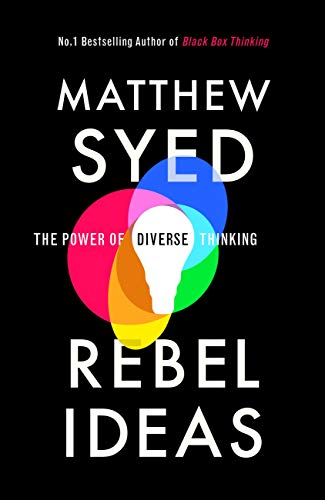
Rebel Ideas Book Summary
The Power of Diverse Thinking
Book by Matthew Syed
Summary
Matthew Syed reveals the vital ingredient missing from our understanding of success: cognitive diversity. Rebel Ideas shows how bringing together different insights, perspectives and thinking styles turbocharges creativity, problem-solving and decision-making, to improve performance in today's complex world.
The CIA's Blindspot Before 9/11
In the years before 9/11, the CIA suffered from a lack of diversity that left them unable to detect warning signs about the impending terrorist attack. The agency was overwhelmingly staffed by white, male, Protestant Americans who struggled to understand the significance of intelligence about Osama bin Laden and Al-Qaeda. As an insider noted, "the CIA couldn't perceive the danger. There was a black hole in their perspective."
Section: 1, Chapter: 1
Homogeneity Breeds Collective Blindness
Homogenous groups, even when composed of smart individuals, often become collectively blind. They tend to share the same assumptions and blindspots. Homophily, the tendency of like to associate with like, acts as an invisible force pulling groups towards conformity of thought. Diverse groups that contain different perspectives are less likely to fall prey to collective blindness.
Section: 1, Chapter: 1
The Power Of Diverse Perspectives
"If two people have perspectives that are incomplete, joining them together can yield more insight, not less. They are both wrong, so to speak. They both miss something. But they are wrong in different directions. This means that their shared picture is richer and more accurate."
Section: 1, Chapter: 1
Welcome Diverse Views
To counteract our tendency towards homophily and reap the benefits of diversity, we must actively seek out people with different backgrounds and perspectives from our own. When assembling a team or group to tackle a problem, consider the range of cognitive diversity, not just expertise. Intentionally engage with those who see things differently, even if it feels uncomfortable at first. Over time, it will expand your own thinking.
Section: 1, Chapter: 1
Why Diverse Teams Beat Homogenous Ones
Wise groups express different properties than homogenous ones:
- They contain people with perspectives that challenge, augment, diverge and cross-pollinate, not parrot the same views
- Each person contributes useful but partial information from their region of the "problem space"
- Their collective intelligence emerges from the interaction of their diverse views In contrast, homogenous groups become echo chambers that reinforce shared assumptions. Even when composed of smart people, they collectively underperform.
Section: 1, Chapter: 2
How Diversity Powers Prediction
A study by psychologist Jack Soll found that the average prediction of six diverse economic forecasters was 15% more accurate than even the top individual forecaster. The key was that each economist used different mental models which, when aggregated, filled in each other's blindspots. Homogenous teams of "best" forecasters who all thought alike performed worse than diverse teams with different perspectives.
Section: 1, Chapter: 2
Seek Germane Cognitive Diversity
When assembling a team, aim for germane cognitive diversity - a range of perspectives and thinking styles specifically relevant to the problem at hand. Diversity of backgrounds is beneficial insofar as it translates into diversity of insights. Random diversity for its own sake is less impactful than curated diversity aligned to the team's objectives. Focus on the sweet spot of diverse views that can meaningfully cross-pollinate.
Section: 1, Chapter: 2
Dominance Dynamics Undermine Performance
Dominance hierarchies are a pervasive feature of human groups. While they can enable smooth coordination, they often stifle the upward flow of ideas and information. Subordinates self-censor in the presence of dominant leaders. What feels like cohesive teamwork may in fact be an echo chamber that amplifies blindspots. Dominance is appropriate for executing plans but counterproductive for making them.
During the 1996 Mount Everest disaster, the steep authority gradient between guides and clients suppressed vital information flow that could have averted tragedy. Clients noticed troubling signs, like deteriorating weather, but didn't feel empowered to speak up forcefully to their leaders. Guides failed to elicit input and concerns from the group. The result was critical decisions being made without the full picture, leading step-by-step to catastrophe.
Section: 1, Chapter: 3
Related Content
Range Book Summary
David Epstein
"Range" challenges the conventional wisdom that early specialization is the key to success. Instead, Epstein argues that in our increasingly complex and unpredictable world, it is those with broad experience and diverse skills who are best equipped to thrive.
"Range" challenges the conventional wisdom that early specialization is the key to success. Instead, Epstein argues that in our increasingly complex and unpredictable world, it is those with broad experience and diverse skills who are best equipped to thrive.
Personal Development
Learning
Psychology