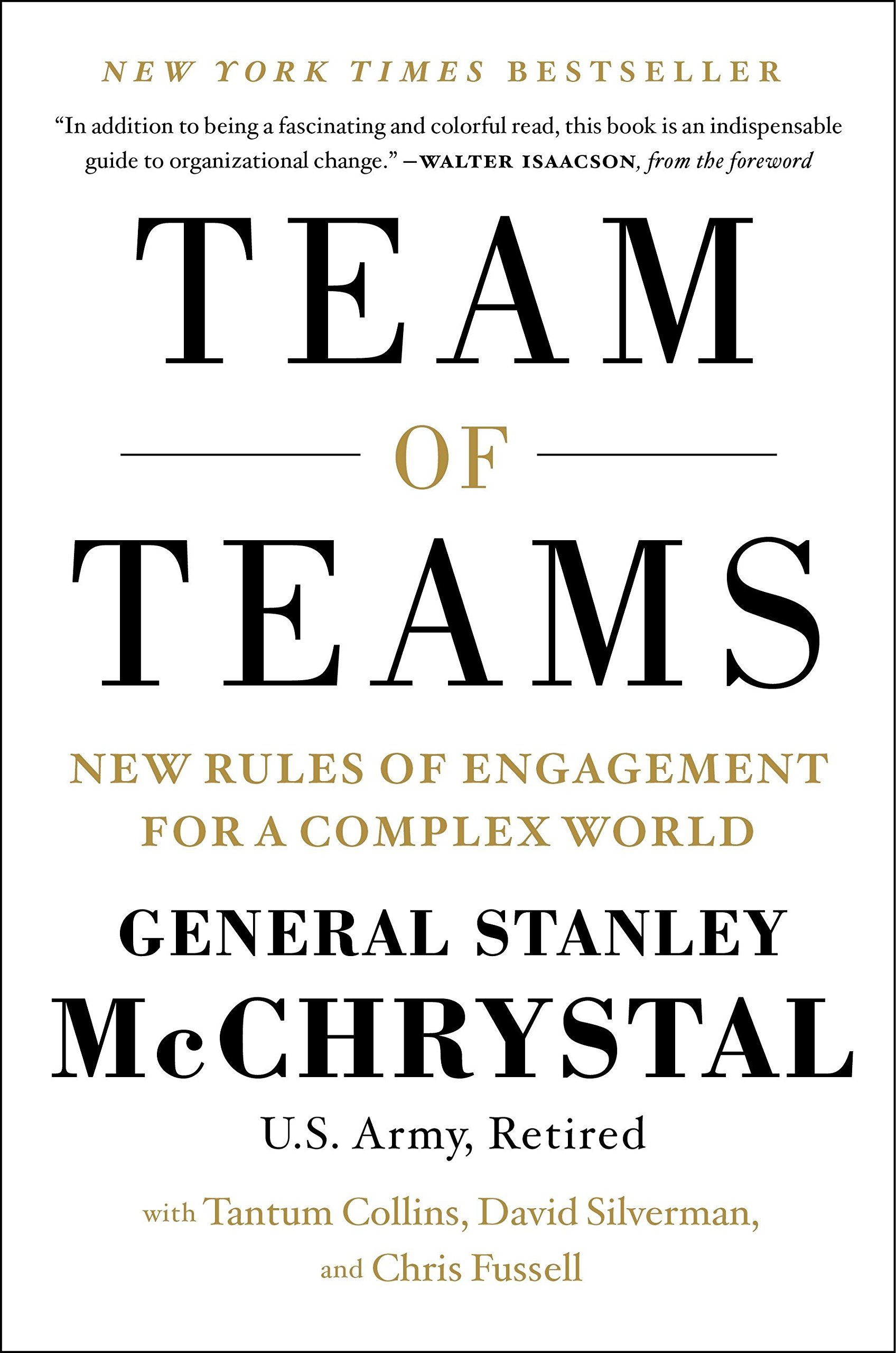
Team of Teams Book Summary
New Rules of Engagement for a Complex World
Book by Stanley McChrystal
Summary
In Team of Teams, General Stanley McChrystal shares powerful lessons on how organizations can adapt and succeed in complex, rapidly changing environments by breaking down silos, empowering teams, and fostering a culture of trust, transparency, and decentralized decision-making.
The Unstoppable Rise of Al Qaeda in Iraq
In 2004, the U.S. military's Joint Special Operations Task Force was struggling against Al Qaeda in Iraq (AQI) despite having more resources, better training, and advanced technology. AQI proved to be a resilient and adaptable foe, able to survive leadership losses and quickly regenerate. Led by Abu Musab al-Zarqawi, AQI engineered a campaign of brutal violence, bombing civilian targets and igniting a sectarian civil war in Iraq. The author, as commander of the Task Force, realized that AQI was a fundamentally different kind of enemy and the U.S. forces would have to adapt to have any hope of victory.
Section: 1, Chapter: 1
Realization That Organizational Change Was Needed
The author and Task Force leadership realized that to defeat an agile, networked enemy like AQI, they would have to drastically change their own organization. Efficiency alone was no longer enough - they needed adaptability. Some key insights:
- The Task Force's existing structure was too rigid and siloed to keep up with the speed of events in Iraq
- Information sharing and collaboration between different units was poor
- Authority was too centralized, inhibiting fast decision making by frontline troops
- The Task Force would need to transform into a flatter, faster, more integrated "team of teams" to win
Section: 1, Chapter: 1
The Enduring Legacy of Frederick Winslow Taylor's Scientific Management
Frederick Winslow Taylor pioneered the concept of "scientific management" in the early 20th century, seeking to optimize industrial efficiency through time-motion studies, process optimization, and centralized planning. His reductionist approach of breaking work down into specialized, repetitive tasks boosted productivity tremendously and left an enduring mark on management thinking across business, government and the military. However, the rigidity and top-down control inherent in "Taylorism" has limitations in environments with greater complexity and unpredictability.
Section: 1, Chapter: 2
Match Organizational Structure to the Environment
Taylorist management and rigid organizational structures work well when tasks and environments are predictable. But in fast-changing, complex environments, adaptability is key. Leaders must recognize when old models no longer fit and be willing to drastically change organizational structures, trading some efficiency for agility. Just as the industrial revolution demanded a management revolution, the information revolution demands new ways of organizing.
Section: 1, Chapter: 2
The Difference Between Complicated and Complex Systems
Understanding the difference between complicated and complex systems is key to managing in the modern world:
Complicated systems:
- Are rule-bound with predictable cause-and-effect relationships
- Consist of many parts, but connections between parts are fixed and straightforward
- Respond in expected ways to change - Optimal solutions can be planned in advance Examples: an assembly line, a Swiss watch
Complex systems:
- Consist of many interdependent parts with unpredictable, nonlinear relationships
- Produce emergent behaviors and effects that cannot be predicted just by looking at individual components
- Defy attempts to "solve" with reductionist planning and control Examples: the weather, a rainforest ecosystem, the global economy
Section: 1, Chapter: 3
The Mistake of Treating Complex Problems as Complicated Ones
Many intractable modern challenges arise from failing to distinguish between the merely complicated and the genuinely complex. Complicated problems can be hard, but with enough data and planning they can be "solved." Complex problems, by contrast, have no permanent solutions - only better or worse responses. Common mistakes:
- Seeking perfect, stable solutions rather than dynamic adaptations
- Excessive faith in more data leading to prediction and control
- Reductionist "divide and optimize" approaches that generate unintended consequences
- Expecting things to add up in a linear way rather than combining in unexpected ways
Instead, leaders must embrace uncertainty, focus on resilience and adaptability, and take an experimental, iterative approach.
Section: 1, Chapter: 3
From Clockwork to Complexity in Modern Warfare
In Iraq, the U.S. military confronted an environment that was not just complicated, but complex. A complicated environment, like the battlefields of the World Wars, still had a basic, underlying clockwork logic. But by 2004, the speed and interdependence enabled by new technologies had pushed things over the edge into complexity. Small events could spiral outward with disproportionate impacts. Insurgent tactics and civilian reactions seemed to shift constantly in unpredictable ways. Cause and effect were no longer straightforward. Precision plans quickly became irrelevant. The U.S. Task Force realized that rather than just doing complicated operations more efficiently, it would have to fundamentally transform to become an adaptable, complex system itself.
Section: 1, Chapter: 3
Adaptability Trumps Efficiency in Complex Environments
In complex environments, adaptability often matters more than raw efficiency in achieving goals. The author compares the U.S. military's struggles in Iraq to the experience of the Dutch fighting floods - in both cases, focusing only on efficiently executing existing plans proved less effective than building in resilience and flexibility to respond to changing circumstances. Being able to sense and adapt to change, even if it means sacrificing some efficiency, is key to success in a complex world.
Section: 1, Chapter: 4
Efficiency Versus Adaptability in Organizations
Many organizations pursue efficiency, trying to execute known processes as well as possible. But when the environment is uncertain, the ability to adapt is more important.
Efficiency:
- Doing things optimally based on predefined criteria
- Relies on prediction and planning; vulnerable to the unexpected
- Well-suited for complicated, knowable environments
Adaptability:
- Able to change to meet new circumstances
- Continuously evolves based on new information; tolerates the unexpected
- Needed in complex, unknowable environments
The key is matching the organizational approach to the environment. Too often, organizations default to chasing efficiency even when adaptability is needed.
Section: 1, Chapter: 4
Related Content

The Culture Code Book Summary
Daniel Coyle
The Culture Code reveals the secrets of highly successful groups, showing that the key to unleashing a team's full potential lies in creating a culture of safety, shared vulnerability, and purpose.
The Culture Code reveals the secrets of highly successful groups, showing that the key to unleashing a team's full potential lies in creating a culture of safety, shared vulnerability, and purpose.
Leadership
Management
Business