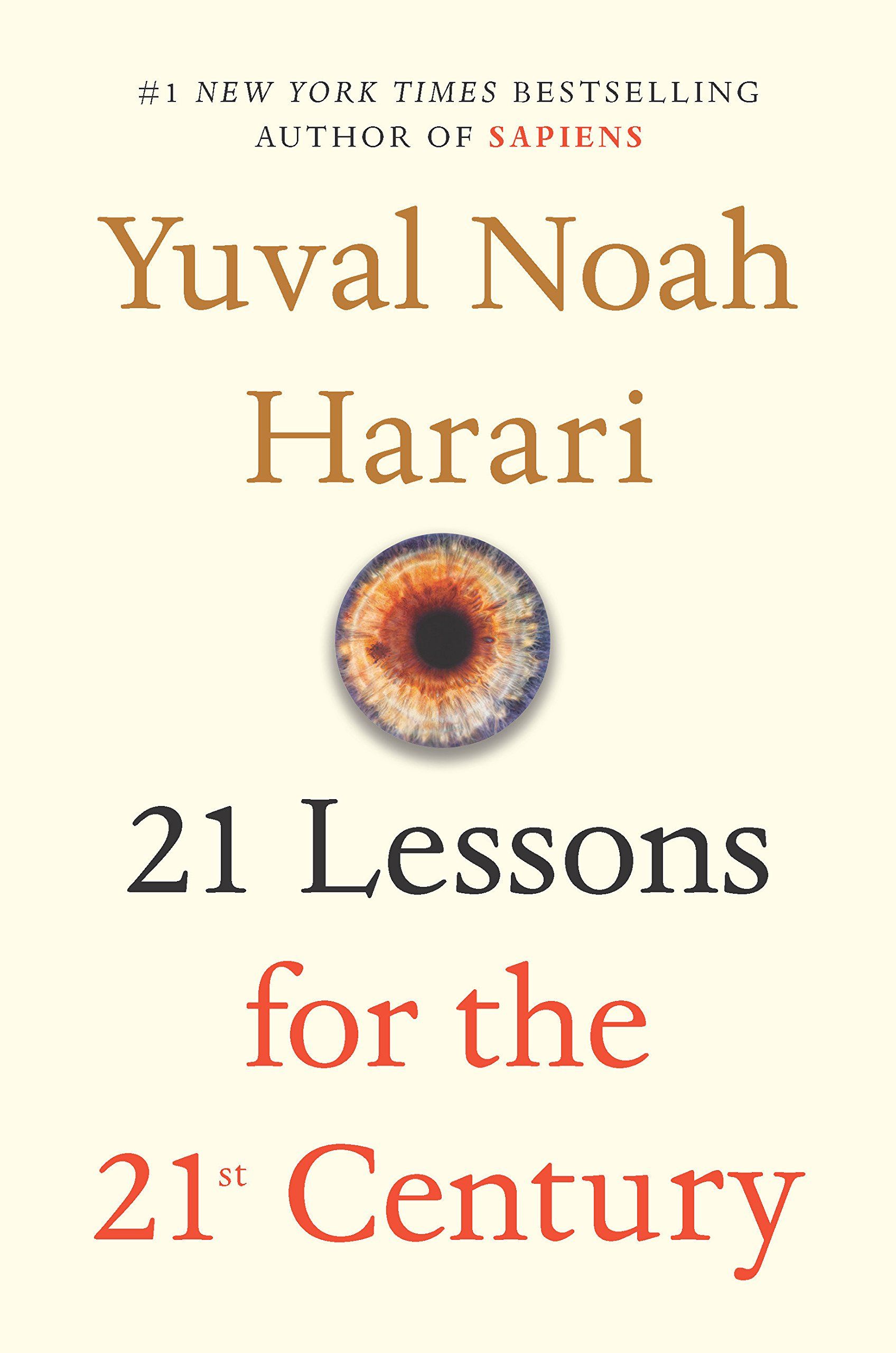
21 Lessons for the 21st Century Book Summary
Book by Yuval Noah Harari
Summary
In "21 Lessons for the 21st Century", Yuval Noah Harari explores the most pressing challenges and opportunities of our time, offering insights on how to navigate a rapidly changing world shaped by technological disruption, political upheaval, and existential uncertainty.
1. The Technological Challenge
The End Of History Has Been Postponed
The liberal story that dominated global politics in recent decades is under threat. According to this story, humankind was moving towards a single global society of free markets and democratic politics. Many expected the world to converge around liberal values after the end of the Cold War. However, nationalism, religion and culture are now returning to divide humans into hostile camps. Economic inequality is rising. Instead of a single global society, the world is fracturing.
Section: 1, Chapter: 1
Step Back And See The Bigger Picture
When you feel anxious about current events, take a step back and consider the broader arc of history. While the liberal world order seems to be in crisis, this is not the first time liberalism has faced serious challenges. After the First World War, fascism and communism threatened to wipe out liberal democracy. Then in the 1960s and 1970s, social unrest and economic stagnation made it seem liberalism was doomed again. Yet liberalism not only survived these crises but emerged stronger than before by adopting ideas from its critics. So while the current crisis of liberalism is real, keep in mind that history is not over and new ideas and systems can still emerge.
Section: 1, Chapter: 1
Humans Lose Their Economic Value
As artificial intelligence advances, machines may soon be able to outperform humans at most cognitive tasks. Robots and 3D printers could produce most of the products and services that people need. If this happens, the majority of humans may lose their economic value. The economy wouldn't need their labor or purchasing power anymore. A small elite may own the all-powerful algorithms and robot factories, making unprecedented profits. But the masses may become an economically irrelevant "useless class." Inequality could skyrocket to previously unthinkable levels.
Section: 1, Chapter: 2
What To Do If Job Losses Outstrip Job Creation
"So what should we do? Should we adopt the liberal dogma and trust the aggregate of individual voters and customers? Or perhaps we should reject the individualist approach, and like many previous cultures in history empower communities to make sense of the world together? Such a solution, however, only takes us from the frying pan of individual ignorance into the fire of biased groupthink...
Providing people with more and better information is unlikely to improve matters. Scientists hope to dispel wrong views by better science education, and pundits hope to sway public opinion on issues such as Obamacare or global warming by presenting the public with accurate facts and expert reports. Such hopes are grounded in a misunderstanding of how humans actually think."
Section: 1, Chapter: 4
Universal Basic Income As A Solution
One proposed solution to the threat of mass unemployment caused by automation is universal basic income (UBI):
- The government would tax a portion of the immense wealth generated by artificial intelligence and use it to provide all citizens with a guaranteed livable income, regardless of whether they work or not.
- This could help prevent mass joblessness from leading to total economic and social collapse. Even if most people lost their jobs to machines, they would still have enough income to meet their basic needs and consume products and services.
- UBI could be combined with universal free education, enabling the unemployed to gain new skills for the remaining human jobs. It could also be supplemented with socially useful make-work or jobs focused on human interaction.
- However, UBI may not give unemployed people a sense of meaning and social status previously provided by jobs. Societies may need to radically change how they view work, leisure and the purpose of life as automation progresses.
Section: 1, Chapter: 4
2. The Political Challenge
Communities Empower Us, But Also Restrict Us
Humans have bodies, and throughout history we have depended on physical communities for our survival and wellbeing.
- Communities provide us with meaning, support, and a sense of belonging. They are crucial for our physical and mental health.
- However, communities also restrict our freedom, pressuring us to conform to social norms and traditions. They can be stifling and oppressive, especially to minorities and outliers.
In the 21st century, many of our physical interactions and dependencies are being replaced by virtual ones. More and more of life is moving onto cyberspace and online networks. This is liberating in many ways, but may leave our bodies and local communities neglected, making us feel unmoored and alienated.
Section: 2, Chapter: 5
"There Is Just One Civilization In The World"
"In recent generations the few remaining civilizations have been blending into a single global civilization. Political, ethnic, cultural and economic divisions endure, but they do not undermine the fundamental unity. If we take a long-term perspective of centuries and millennia, it becomes obvious that there is just one civilization in the world: global human civilization."
Section: 2, Chapter: 6
Environmental Problems Require Global Collaboration
Consider the problem of vehicle emissions and air pollution:
- The exhaust from a car in Mexico can impact air quality in Canada. The CO2 emitted by planes over the Pacific contributes to climate change in Africa. Pollutants don't stay within national borders.
- Air pollution kills millions worldwide each year and is a major contributor to respiratory disease, cancer, acid rain, and climate change. Addressing it is one of the biggest public health and ecological challenges we face.
- No nation can regulate all the world's vehicles and industries by itself. Even if the US passes strict emissions standards, those efforts will be undermined if China keeps polluting.
That's why countries have negotiated international agreements like the Kyoto Protocol and Paris Agreement, trying to coordinate emission cuts. In our interconnected world, countries are realizing that cooperating is often essential to serving their national interests.
Section: 2, Chapter: 7
How Science Replaced Religion
For most of history, religion was seen as the ultimate source of authority, values and knowledge. However, the scientific revolution radically undermined religion's monopoly:
- Science offered far more convincing and useful explanations for natural phenomena based on observation and logic, not faith. Lightning was proven to be an electrical phenomenon, not the wrath of Zeus.
- Technology derived from science became indispensable for modern societies to function. It was impossible to reject physics while accepting radios, impossible to reject biology while accepting vaccines and impossible to reject chemistry while accepting fertilizer.
- Philosophers argued that values and morals too should be defined by reason and evidence, not religious dogma. Influential thinkers like John Locke derived human rights from logical arguments, not divine fiat.
Today, the place of religion has been largely replaced by science, in terms of defining what is objectively real, and by secular humanism, in terms of defining what is ethical and meaningful.
Section: 2, Chapter: 8
The Paradox Of Multicultural Tolerance
How should a multicultural society deal with intolerant subcultures in its midst? It's a hard dilemma with no easy answers. Consider:
- A tolerant society that accepts diversity will inevitably include some intolerant groups that reject diversity, like religious fundamentalists who oppose gay rights or immigrants who refuse to integrate.
- If a society is too tolerant of intolerance, it risks letting hateful groups undermine its core values and institutions. But if a society is too intolerant of intolerant groups, it becomes a bit intolerant itself.
There's no clear solution, but here are some principles to consider:
- Insist that all groups, no matter how traditional, respect the fundamental human rights of their members.
- When groups express bigoted views, counter them openly with arguments and data, don't just ban the expression. Outlawing ideas risks letting them fester underground.
- Focus on integrating the younger generation of minorities through mixed schools and neighborhoods.
Section: 2, Chapter: 9
3. Despair and Hope
4. Truth
5. Resilience
Related Content
Range Book Summary
David Epstein
"Range" challenges the conventional wisdom that early specialization is the key to success. Instead, Epstein argues that in our increasingly complex and unpredictable world, it is those with broad experience and diverse skills who are best equipped to thrive.
"Range" challenges the conventional wisdom that early specialization is the key to success. Instead, Epstein argues that in our increasingly complex and unpredictable world, it is those with broad experience and diverse skills who are best equipped to thrive.
Personal Development
Learning
Psychology