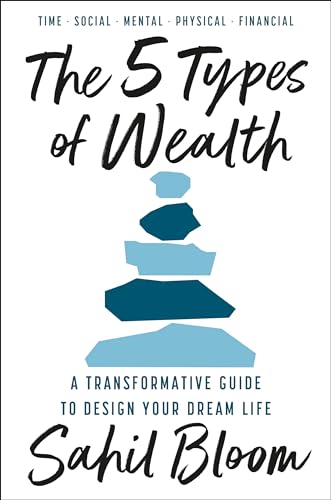
The 5 Types of Wealth Book Summary
A Transformative Guide to Design Your Dream Life
Book by Sahil Bloom
Summary
After three years of research, personal experimentation, and thousands of interviews across the globe, Sahil Bloom has created a groundbreaking blueprint to build your life around five types of wealth: Time Wealth, Social Wealth, Mental Wealth, Physical Wealth, and Financial Wealth.
You're Going To See Your Parents Fifteen More Times Before They Die
> You're going to see your parents fifteen more times before they die.
- Friend of Sahil Bloom
Section: 0, Chapter: 0
The Arrival Fallacy
The arrival fallacy is the false assumption that reaching some achievement or goal will create durable feelings of satisfaction and contentment in our lives. We incorrectly assume that we will finally experience the sensation of having arrived when we reach whatever we have propped up as our destination.
Section: 0, Chapter: 0
The Five Types of Wealth
The five types of wealth represent a new scoreboard for measuring a successful life:
1. Time Wealth : The freedom to choose how to spend your time, with whom, where, and when to trade it
2. Social Wealth : Connection to others - the depth of meaningful relationships and breadth of your network
3. Mental Wealth : Connection to purpose and meaning, the pursuit of growth, and space for thinking
4. Physical Wealth : Your health, fitness, and vitality - built through movement, nutrition, and recovery
5. Financial Wealth : Assets minus liabilities, including your expectations of what you need
Section: 0, Chapter: 2
The Life Razor: Your Decision-Making Heuristic
Your Life Razor is a single statement that defines your presence in the current season of life - a powerful decision-making heuristic with three core characteristics:
1. Controllable : It should be within your direct control
2. Ripple-creating : It should have positive second-order effects in other areas of life
3. Identity-defining : It should indicate the type of person you are
Example: "I will coach my son's sports teams" shows commitment to family, creates ripples in relationships, and defines identity as a present parent. When facing decisions, ask: "What would the type of person who coaches his son's sports teams do?"
Section: 0, Chapter: 4
Never Miss A Tuesday Dinner
For over thirty years, Netflix co-founder Marc Randolph maintained a non-negotiable weekly ritual: every Tuesday at 5 PM, he would leave work to spend the evening with his wife. Despite building one of the most transformative companies in history, this commitment was absolute.
"Nothing got in the way of that," Randolph explained. "If you had something to say to me on Tuesday afternoon at 4:55, you had better say it on the way to the parking lot."
This simple ritual wasn't just about dinner - it was about symbolism and signaling priorities. It showed his wife, children, and employees what truly mattered to him. It created positive ripple effects throughout his world, strengthening his marriage, providing security to his children, and encouraging employees to set their own boundaries.
Section: 0, Chapter: 4
Running Faster to Stay in Place
In Lewis Carroll's "Through the Looking-Glass," Alice finds herself running with the Red Queen but making no progress. When she questions this, the Queen explains: "Here, you see, it takes all the running you can do, to keep in the same place. If you want to get somewhere else, you must run at least twice as fast!"
This Red Queen Effect perfectly describes our modern relationship with time. Despite having more time-saving technology than ever, we feel constantly behind. We're victims of attention residue - the cognitive cost of switching between tasks - and scattered focus from endless digital distractions.
The solution isn't to run faster, but to run smarter by identifying high-leverage moments and directing concentrated attention to them.
Section: 1, Chapter: 7
The Three Pillars of Time Wealth
Time Wealth is built on three progressing pillars:
1. Awareness : Understanding the finite, impermanent nature of time. Recognize yourself as a "time billionaire" with billions of seconds remaining, but grasp that this fortune diminishes daily.
2. Attention : The ability to direct your focus to what matters and ignore the rest. Like a magnifying glass concentrates sunlight, concentrated attention creates asymmetric outputs - breaking the fixed 1:1 relationship between inputs and results.
3. Control : The freedom to own your time and choose how to spend it. This is the ultimate goal - becoming a time maker rather than a time taker.
Section: 1, Chapter: 8
The Eisenhower Matrix: Managing Priorities
Use the Eisenhower Matrix to differentiate between urgent and important tasks:
- **Important and urgent**: Do these tasks NOW
- **Important but not urgent**: SCHEDULE time for these compounding activities
- **Not important but urgent**: DELEGATE these tasks
- **Not important and not urgent**: DELETE these time-wasting activities
Your goals with this matrix:
- Manage the important tasks so they rarely become urgent
- Spend most of your time on important, non-urgent tasks
- Minimize time spent in the bottom half of the matrix
Section: 1, Chapter: 9
The Time Wealth Hard Reset
Calculate how many times you'll see your loved ones before the end of their lives through this simple exercise:
- Write down the name of a friend or family member you love deeply but don't see enough
- Approximate how many times per year you see that person
- Subtract the older person's age from 80 (their estimated remaining years)
- Multiply the number of times you see them per year by their remaining years
This terrifyingly simple math creates a powerful awareness that can spark new priorities. When the author realized he would only see his 65-year-old father about 15 more times before he died, it prompted him to move across the country to be closer to family.
Section: 1, Chapter: 9
The Four Types of Professional Time
There are four types of professional time that you should balance:
1. Management Time : Meetings, calls, presentations, email, team management
2. Creation Time : Writing, coding, building, preparing - where new progress is found
3. Consumption Time : Reading, listening, studying - where new ideas are planted
4. Ideation Time : Brainstorming, journaling, walking, self-reflecting - where ideas are cultivated
Most people spend too much time in Management and neglect the others, especially Consumption and Ideation. Track your time for a week to identify imbalances, then work toward batching Management Time to create space for Creation, Consumption, and Ideation.
Section: 1, Chapter: 9
Parkinson's Law: How to Eliminate Time Waste
Parkinson's Law states that work expands to fill the time allotted for its completion. Use this principle to be more efficient:
- Set shorter time blocks for low-importance tasks
- Batch-process email in 1-3 constrained windows each day
- Shorten standard meetings to 25 minutes
- Work on big projects in 1-3 hour focus blocks
- Batch dreaded personal tasks (cleaning, laundry) into short sprints
When you establish long fixed hours, you find unproductive ways to fill them. Instead, work like a lion: sprint, rest, repeat. The artificial pressure of time constraints makes you focus on what's truly important.
Section: 1, Chapter: 9
Sitting In The Front Row
Close your eyes and take three deep breaths. Imagine you're dead. You're at your funeral. People are walking in, crying, hugging each other. Everyone sits down. Who is sitting in the front row? Imagine their faces. These people—your Front-Row People—are the ones who truly matter.
Section: 2, Chapter: 11
Harvard's 85-Year Study on Happiness
In 1938, two research teams began tracking the lives of 724 men from different backgrounds. The Harvard Study of Adult Development continues today, making it the longest-running study on happiness and health ever conducted.
After 85+ years of data, the study's most important finding is stunningly simple: relationships are everything. Strong, healthy relationships are the best predictor of life satisfaction, far outpacing social class, wealth, fame, IQ, and genetics.
Even more remarkably, relationship satisfaction at age 50 was the single greatest predictor of physical health at age 80. Conversely, loneliness was found to be worse for health than regular tobacco or alcohol use.
As the study's director Robert Waldinger concluded: "Taking care of your body is important, but tending to your relationships is a form of self-care too."
Section: 2, Chapter: 12
Related Content
Think and Grow Rich Book Summary
Napoleon Hill
"Think and Grow Rich" is a transformative guide that reveals how harnessing the power of thought, desire, and persistence can turn your dreams into reality, offering practical strategies to overcome mental barriers and achieve lasting success and wealth.
"Think and Grow Rich" is a transformative guide that reveals how harnessing the power of thought, desire, and persistence can turn your dreams into reality, offering practical strategies to overcome mental barriers and achieve lasting success and wealth.
Personal Development
Money
Die With Zero Book Summary
Bill Perkins
Die with Zero is an unconventional guide that challenges traditional notions of saving and spending, urging readers to maximize their life experiences by investing in memories and relationships while they still have the time and health to fully enjoy them.
Die with Zero is an unconventional guide that challenges traditional notions of saving and spending, urging readers to maximize their life experiences by investing in memories and relationships while they still have the time and health to fully enjoy them.
Life
Meaning
Money