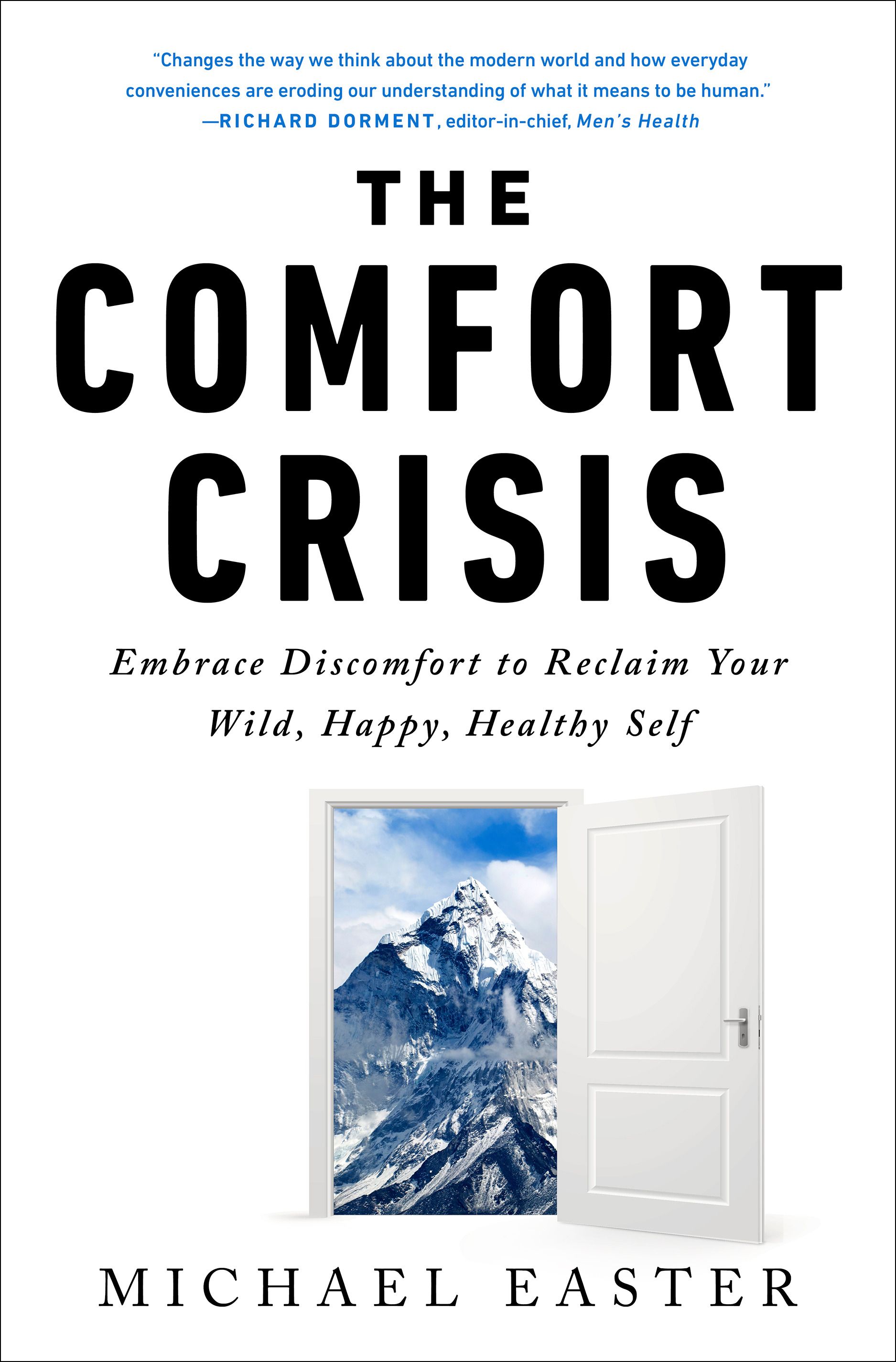
The Comfort Crisis Book Summary
Embrace Discomfort To Reclaim Your Wild, Happy, Healthy Self
Book by Michael Easter
Summary
In "The Comfort Crisis," Michael Easter investigates how our modern culture of constant comfort may be making us less resilient, more prone to illness, and robbing us of the very experiences that make us feel most alive.
The Problem With Comfort
"Most people today rarely step outside their comfort zones. We are living progressively sheltered, sterile, temperature-controlled, overfed, underchallenged, safety-netted lives."
Section: 1, Chapter: 1
Prevalence Induced Concept Change
The author describes a psychology study where participants had to judge faces as either threatening or not threatening. As threatening faces became rarer, participants began perceiving neutral faces as threatening.
This "prevalence-induced concept change" or "problem creep" explains how when we experience fewer problems, we don't become more satisfied - we just lower our threshold for what we consider a problem. So even clearly black-and-white situations become gray, making us question our judgment. This has implications for how comfort creep affects us.
Section: 1, Chapter: 1
Comfort No Longer Moves Happiness
"Comforts and conveniences are great. But they haven't always moved the ball downfield in our most important metric: happy, healthful years."
Section: 1, Chapter: 3
Too Much Comfort Is Now Harming Us
For 99.996% of human history, our species lived with constant discomfort - too hot, cold, hungry, exposed to the elements, dealing with predators, injuries and diseases. Seeking comfort helped us survive. But in the last 0.004% of our history, we've suddenly been living with constant comfort thanks to modern innovations. Yet our brains are still wired for an uncomfortable world. So while comforts have allowed us to thrive, being overly comfortable is now linked with chronic diseases, mental health issues, lack of meaning, and fragility.
- Early humans lived intimately with discomfort to survive
- Comfort-seeking drove us to find food, build shelter, avoid risks
- But 99.996% of human history was pre-modern comforts
- In last 100 years, we now live with climate control, abundant food, sanitation, medicine
- Comfort creep means yesterday's comfort is today's discomfort
Section: 1, Chapter: 3
How "Problem Creep" Makes Solving One Issue Lead To Finding More
Psychologist David Levari conducted studies showing that when problems become rarer, we expand our definition of a "problem" to still find new ones. In one study, as threatening faces became less frequent, participants started deeming neutral faces as threatening. In another, as unethical research proposals became fewer, ambiguous proposals started seeming unethical.
This "prevalence-induced concept change" or "problem creep" happens unconsciously. As we experience fewer problems, we don't become more satisfied - we just move the goalposts. What used to be acceptable is now problematic. The same goes for comfort - as we get used to new comforts, our old comforts become unacceptable. Stairs were once a marvel, but now we need escalators. The problem creep phenomenon means solving issues doesn't necessarily make us happier, we just find new "problems."
Section: 1, Chapter: 4
Facing Challenges With A 50/50 Shot At Success Can Expand Your Limits
Sports scientist Marcus Elliott pioneered "misogi" challenges - grueling feats slightly beyond your limits, with two rules: "Make it really hard" and "don't die." You should have about a 50% chance of completing it. Repeatedly surfing your edge and sometimes failing shows you're capable of far more than you imagined. Examples of misogis Elliott and others have done:
- Moving an 85-pound rock underwater for 5km
- Stand-up paddleboarding 25 miles across the ocean
- Running the 46-mile rim-to-rim-to-rim route in the Grand Canyon
Neurological studies confirm that facing adversity with a high chance of failure activates a "toughening" effect - expanding your internal resources to handle new challenges with confidence.
Section: 1, Chapter: 6
Why Cities Make Us Lonely
Despite most modern people living in dense urban areas surrounded by other humans, nearly half of Americans report feeling lonely in what is being called a "loneliness epidemic." This is likely because cities violate our evolutionary preference for living in groups of around 150 people (Dunbar's Number) - the optimal community size that allowed us to thrive for most of human history.
But today a single city block can have thousands of people; human brains uneasy with population density that's too high. A lack of connection to people and place in cities breeds unhappiness
Rural, nature-connected people often report more life satisfaction In contrast, time in nature allows us to reset and experience the kind of intimate connections, sense of belonging, and timeless rhythms we evolved with.
Section: 1, Chapter: 8
Related Content
Scarcity Brain Book Summary
Michael Easter
In a world of abundance, our ancient scarcity-wired brains keep us trapped in self-defeating loops of "more" - but by recognizing these patterns and deliberately choosing "enough," we can find deeper fulfillment.
In a world of abundance, our ancient scarcity-wired brains keep us trapped in self-defeating loops of "more" - but by recognizing these patterns and deliberately choosing "enough," we can find deeper fulfillment.
Personal Development
Psychology
Habits
Human Behavior