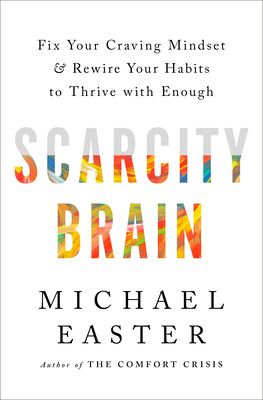
Scarcity Brain Book Summary
Fix Your Craving Mindset and Rewire Your Habits to Thrive with Enough
Book by Michael Easter
Feeling Lazy?Read 1 Minute Summary
Summary
In a world of abundance, our ancient scarcity-wired brains keep us trapped in self-defeating loops of "more" - but by recognizing these patterns and deliberately choosing "enough," we can find deeper fulfillment.
The Scarcity Loop: A Powerful Behavior Pattern
The scarcity loop is a three-part system that powerfully drives behavior:
- Opportunity - An opportunity to get something of value that improves our life, but with risk of not getting it.
- Unpredictable Rewards - Not knowing when or how much of the reward we'll get, which excites the dopamine system and makes us crave it more.
- Quick Repeatability - The behavior can be repeated quickly in rapid succession, compelling more action.
The scarcity loop evolved to help our ancestors persist in finding scarce food and resources. But now it's being used in slot machines, social media, shopping, and more to drive counterproductive habits.
Section: 1, Chapter: 1
Si Redd Revolutionizes Slot Machines
In the 1970s, slot machines were unpopular - over 97% of plays lost, so people quickly stopped playing. But slot machine designer Si Redd used screens to allow multiple betting lines (increasing win frequency to 45%) and near misses (encouraging replay).
He also added exciting sounds/graphics and a Spin button for faster play. This optimized the scarcity loop in slot machines - providing opportunity, unpredictable rewards, and quick repeatability. Redd's machines were a hit, expanding to most casino floors and increasing revenues tenfold. His insights shaped the modern slot machine industry.
Section: 1, Chapter: 1
The Scarcity Loop Is Embedded In Many Modern Technologies
The scarcity loop is now used in many digital products and services to influence behavior, including:
- Social media: Posting/scrolling for unpredictable likes, comments, shares
- Email: Checking for variable rewards of good/bad/neutral messages
- Online shopping: Searching for deals, gambling on quality of purchase
- Mobile gaming: Playing for unpredictable in-game rewards and progress
- Dating apps: Swiping for the uncertain reward of matches
- Gig economy apps: Incentivizing workers with unpredictable payouts
Section: 1, Chapter: 1
Laboratory Pigeons Reveal The Power Of The Scarcity Loop
Experiments by psychologist Thomas Zentall show that pigeons will consistently choose a "gambling" game that provides less food overall, mimicking the human slots players Si Redd observed.
When pigeons can choose between:
- A "sure thing" game providing a medium food reward 50% of the time, or
- A "gambling" game with a larger food reward only 20% of the time
An overwhelming 96.9% of pigeons prefer the "gambling" game, even though it provides less food! The larger unpredictable reward taps into an instinctual attraction to variable payouts. This behavior is seen across many animals.
Section: 1, Chapter: 2
Dopamine Drives Pursuit Of Unpredictable Rewards
Dopamine has long been misunderstood as the "pleasure chemical." In reality, dopamine release motivates us to pursue rewards, especially when they are unpredictable.
When an outcome is unsure, our dopamine levels spike - causing intense focus, craving and anticipation as we await the result. This happens when waiting to see if we got likes on a post, matches on a dating app, a gambling payout, and so on.
Dopamine evolved to make us "obsessive" about persisting for unpredictable payoffs related to survival. Today, the neurochemical still pushes us to keep checking, scrolling, swiping and pulling the metaphorical slot handle - even when the reward is trivial or counterproductive.
Section: 1, Chapter: 2
The Scarcity Loop Is A Key Cause Of Addiction
For someone struggling with substance abuse, just the possibility of getting their drug of choice puts them in a powerful scarcity loop. Obtaining the drug comes with a moment of suspense - will they find it this time? How pure will it be? That uncertainty is exciting, making the high more intense and the behavior more likely to be repeated.
If you or someone you know has an addiction, look for ways to:
- Reduce access to the substance
- Make consumption more predictable and less exciting
- Satisfy the underlying need the drug fulfilled in a healthier way
Section: 1, Chapter: 2
The Internet Overloads Us With Information While Limiting Real
Today, the internet provides an endless flood of novel information - accessible with minimal effort and no real danger.
However, this easy access to data doesn't necessarily lead to true understanding. Skimming headlines and posts designed to hijack our attention often leaves us more anxious and fragmented.
To use the internet mindfully and aid real comprehension:
- Limit reflexive clicking on clickbait that provides surface-level "information rewards"
- Aim to engage with primary sources (research, in-depth journalism) vs hot takes
- When you have a hunch you've been misled by an oversimplified take, challenge it by researching alternative viewpoints
Section: 1, Chapter: 3
NASA Astronaut Reflects On The Overview Effect And Its Implications
"After my first mission on the station, I would have said that you can't see the stars very well from the space station, because we have too many lights on inside...But then I started coming up here a half hour before everyone else would wake up. And I'd shut off the lights and just sit with my eyes open and sort of meditate, not trying to think about much, but rather just trying to soak it in...Space actually isn't the inky black that I described to people after my first mission. It seemed to me that the stars we normally see as individual stars weren't really that way. I could start picking up the faint stars super far away. There were so many of them that it seemed more like shades of gray and white and black. It was more of a texture, a net. And that changed how I think about perception, the limits of human knowledge, and how we have so much more to explore."
Section: 1, Chapter: 3
Humans Naturally Add Rather Than Subtract To Solve Problems
When an engineer was bested by his 3-year-old son in a bridge-building challenge, he realized humans overlook subtraction as a problem-solving strategy. The father tried to fix a lopsided bridge by adding more blocks to the short column. His preschooler intuitively removed blocks from the taller column instead.
Experiments show that even when subtraction is the best solution, people default to adding. We tend to add more:
- Lego blocks to stabilize a structure
- Features to a mini-golf hole or product
- Words to an essay
- Items to a travel itinerary
- Even when instructed to improve the situation with "as few moves as possible"!
Section: 1, Chapter: 4
The Tsimane Tribe Enjoys Shockingly Healthy Hearts Through Simplicity
The Tsimane tribe of the Bolivian Amazon has the lowest rates of heart disease ever measured - an astounding 5 times lower than Americans'.
A whopping 90% of tribe members aged 40-94 had completely clean arteries. In contrast, nearly 50% of Americans have some coronary artery disease by age 40-50.
The Tsimane secret? A diet based on:
- Unprocessed carbohydrates (70% of calories)
- Lean animal protein and fish (25%)
- Fruits and vegetables (5%)
Section: 1, Chapter: 5
Related Content
Stumbling on Happiness Book Summary
Daniel Gilbert
Harvard psychologist Daniel Gilbert takes readers on a whirlwind tour of the human brain, exploring how our unique ability to imagine the future often leads us astray in predicting what will make us happy. Gilbert argues that the futures we envision are often distorted by our current emotions, our flawed memories, and our psychological blind spots - but recognizing these limitations, we can learn to more accurately forecast our feelings and maximize our well-being.
Harvard psychologist Daniel Gilbert takes readers on a whirlwind tour of the human brain, exploring how our unique ability to imagine the future often leads us astray in predicting what will make us happy. Gilbert argues that the futures we envision are often distorted by our current emotions, our flawed memories, and our psychological blind spots - but recognizing these limitations, we can learn to more accurately forecast our feelings and maximize our well-being.
Happiness
Psychology
The Courage to Be Disliked
Ichiro Kishimi and Fumitake Koga
Through an illuminating dialogue, "The Courage to Be Disliked" reveals how Adlerian psychology empowers us to overcome the past, embrace our authentic selves, and find genuine happiness by courageously living in the present and contributing to others.
Through an illuminating dialogue, "The Courage to Be Disliked" reveals how Adlerian psychology empowers us to overcome the past, embrace our authentic selves, and find genuine happiness by courageously living in the present and contributing to others.
Personal Development
Happiness
Psychology