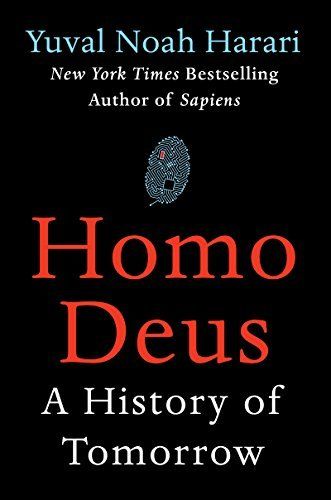
Homo Deus Book Summary
A History of Tomorrow
Book by Yuval Noah Harari
Summary
Homo Deus explores the future of humanity in a world where the old challenges of famine, plague, and war have been largely conquered, and new godlike technologies of artificial intelligence and bioengineering are on the horizon, forcing us to confront fundamental questions about the nature of consciousness, free will, and what it means to be human in an age of algorithms.
1. Homo Sapiens Conquers the World
A New Human Agenda
In the 21st century, humankind is likely to make a serious attempt to gain happiness, immortality, and god-like powers.
We are now at a point where we need to set a new agenda for ourselves. Having reduced mortality from starvation, disease, and violence, our next targets are likely to be extending life span, prolonging youth, and enhancing our cognitive and physical abilities. Science and technology will play a crucial role in achieving these goals.
This journey towards divinity may actually end up making us less humane. The more god-like we aspire to be, the less we may value mortal concerns. Life and death, happiness and suffering, may all become trivial matters for upgraded humans. There could emerge a new superhuman elite, far removed from the concerns and values of today.
Section: 1, Chapter: 1
"Is Sugar More Dangerous Than Gunpowder?"
"In 2012 about 56 million people died throughout the world; 620,000 of them died due to human violence (war killed 120,000 people, and crime killed another 500,000). In contrast, 800,000 committed suicide, and 1.5 million died of diabetes. Sugar is now more dangerous than gunpowder."
Section: 1, Chapter: 1
The Rise And Fall Of Infectious Diseases
For thousands of years, epidemics were the most important cause of human mortality. The Black Death, which began in the 1330s, killed between 75 million and 200 million people - more than a quarter of the population of Eurasia. In England, 4 out of 10 people died. In the city of Florence, it was 1 out of 2.
However, in the last few decades, we have managed to rein in this threat. Though infectious diseases still kill millions every year, they are no longer the leading cause of death globally. This is a result of improved hygiene, better nutrition, new medicines, and most importantly - a scientific understanding of diseases. As our scientific knowledge grows, we can expect to reduce the impact of infectious diseases even further.
Section: 1, Chapter: 1
The Decline Of Violence
Another major threat that humans have faced throughout history is violence. However, in recent decades, war and violence have been on the decline. Despite conflicts in places like Syria and Iraq, we are living in the most peaceful era in human history. More people die today from suicide or car accidents than from war and violent crime combined.
Several factors have contributed to this decline:
- The development of nuclear weapons has made war between superpowers unthinkable
- Global trade has made war less profitable
- The rise of democracy and international organizations has provided alternatives to violence
- Changing norms and values have made violence less acceptable
Section: 1, Chapter: 1
The Ape That Conquered The World
Homo sapiens - our species - has had an extraordinary impact on the world. Starting from humble origins in East Africa, we have spread to every continent, reshaped ecosystems, and domesticated other species.
This journey began around 70,000 years ago with the Cognitive Revolution. It saw the emergence of new ways of thinking and communicating, including the ability to create and believe in imagined realities. This allowed large numbers of strangers to cooperate effectively.
The next major milestone was the Agricultural Revolution, which began around 12,000 years ago. By domesticating plants and animals, we were able to greatly increase the amount of food available. This allowed human populations to grow exponentially and laid the foundation for the rise of cities, kingdoms, and empires.
Finally, the Scientific Revolution, which began just 500 years ago, gave us unprecedented power to understand and manipulate the world around us. Combined with the Industrial Revolution, it has transformed almost every aspect of human life.
Section: 1, Chapter: 2
"We Did Not Domesticate Wheat. It Domesticated Us."
"The Agricultural Revolution certainly enlarged the sum total of food at the disposal of humankind, but the extra food did not translate into a better diet or more leisure. Rather, it translated into population explosions and pampered elites. The average farmer worked harder than the average forager, and got a worse diet in return. The Agricultural Revolution was history's biggest fraud."
Section: 1, Chapter: 2
The Humanist Revolution
One of the most important developments in human history has been the gradual rise of humanism. This is the belief that humans are the ultimate source of meaning and authority in the universe. Humanism took off during the Renaissance and the Enlightenment in Europe. Thinkers like Pico della Mirandola and Immanuel Kant argued for the dignity and autonomy of the individual.
Over time, humanism has manifested in different forms:
- Liberal humanism emphasizes individual freedom and sees humans as unique individuals
- Socialist humanism emphasizes equality and sees humans as shaped by their socio-economic conditions
- Evolutionary humanism emphasizes the power of natural selection and sees humans as just another species
Despite their differences, all forms of humanism share a common belief in the centrality of the human experience. They all see human feelings, desires, and choices as the ultimate arbiter of meaning and value. It underlies our political and economic systems, our approach to ethics and education, and even our understanding of history.
Section: 1, Chapter: 3
Can Science Answer Ethical Questions?
One of the key claims of humanism is that science cannot answer ethical questions. Science can tell us how the world is, but it cannot tell us how it ought to be.
However, this distinction is not as clear-cut as it seems:
- Science is not value-free. The questions we choose to ask, the methods we use, and the way we interpret results are all shaped by our cultural and moral assumptions.
- Many ethical questions hinge on factual claims. For example, the debate around abortion often revolves around when a fetus becomes "human" - a biological question.
- As we learn more about the biological basis of human behavior, the line between facts and values is likely to blur further. If we can explain moral choices in terms of brain chemistry, does that make them less "moral"?
Section: 1, Chapter: 3
Science and Human Values
So while science alone cannot determine human values, it can certainly inform and influence them. As powerful technologies like artificial intelligence and genetic engineering advance, we will need to grapple with the ethical implications of scientific progress.
This means fostering dialogue and collaboration between scientists, ethicists, policymakers, and the public. It means acknowledging the ways in which science and values intersect, rather than pretending they are separate. Most of all, it means using our growing knowledge to make wise choices - for ourselves, for society, and for the planet.
Section: 1, Chapter: 3
2. Homo Sapiens Gives Meaning to the World
The Storytelling Animal
What separates humans from other animals is our ability to create and believe in stories. We are the storytelling animal.
- No other species can match the complexity and creativity of human stories
- Stories allow us to imagine alternate realities and future possibilities
- They enable cooperation on a massive scale by providing shared meaning
From religious myths to national histories to scientific theories, stories shape how we understand the world and how we behave. To grasp human civilization, we must appreciate the central role of story.
Recent discoveries in biology suggest that even at a fundamental level, humans and other organisms are best understood as storytelling entities. Our genes and brain circuits encode algorithms honed by evolution to respond to our environment.
Section: 2, Chapter: 4
3. Homo Sapiens Loses Control
Related Content
21 Lessons for the 21st Century Book Summary
Yuval Noah Harari
In "21 Lessons for the 21st Century", Yuval Noah Harari explores the most pressing challenges and opportunities of our time, offering insights on how to navigate a rapidly changing world shaped by technological disruption, political upheaval, and existential uncertainty.
In "21 Lessons for the 21st Century", Yuval Noah Harari explores the most pressing challenges and opportunities of our time, offering insights on how to navigate a rapidly changing world shaped by technological disruption, political upheaval, and existential uncertainty.
Sociology
History
Humanity