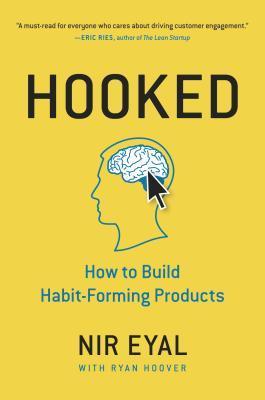
Hooked Book Summary
How to Build Habit-Forming Products
Book by Nir Eyal
Summary
Hooked provides a practical framework for designing habit-forming products that solve users' problems and improve their lives, while cautioning against the ethical risks of misapplying persuasive technology.
The Habit Zone
For a product to be habit-forming, it needs to have two key elements: high frequency of use and high perceived utility. When both of these elements are strong enough, the product enters what Eyal calls "The Habit Zone" - it becomes a default behavior that users do with little or no conscious thought.
Some examples are checking email multiple times per day or searching on Google whenever a question comes to mind. These products are deeply embedded behavioral habits for many users.
Forming user habits gives businesses major advantages, including higher customer lifetime value (users stay longer), pricing flexibility (habits make users less price sensitive), supercharged growth through frequent usage, and a sharp competitive edge (users are less likely to switch).
However, habits are generally hard to form, as old habits die hard. The enemy of forming new habits is past behaviors and routines that are etched into users' minds. Even when users want to change, old neural pathways remain, ready to be reactivated with any lapse in the new routine.
Section: 1, Chapter: 1
Forming Habits
"The more frequently the behavior occurs, the stronger the habit. This is one reason why many habit-forming products are used daily. Using a product every day deepens the habit associated with it."
Section: 1, Chapter: 1
Vitamins vs Painkillers
Eyal uses a vitamin vs painkiller analogy to describe one key difference between nice-to-have products versus must-have products.
- Vitamins are "nice-to-have" products - they don't solve an obvious pain point and aren't absolutely critical. The benefits are often more abstract and less immediately perceptible.
- Painkillers, on the other hand, solve an acute need or pain point. The relieving effect is more noticeable and immediate. Users can more clearly link using the product to alleviating their problem.
Interestingly, many habit-forming products start as vitamins but evolve into painkillers as the habit takes hold. For example, Instagram may have initially been a nice-to-have photo sharing app. But for many users, as a strong habit formed, it turned into a must-have that alleviates boredom, loneliness, and FOMO (fear of missing out). The perceived utility increased as the habit rooted itself.
Section: 1, Chapter: 1
Triggers
Two Types of Triggers
The "Trigger" is the actuator of a behavior - the spark plug that sets the engine in motion. Without a trigger to cue the user, no behavior happens.
There are two types of triggers:
- External triggers are cues in the user's environment that provide information for what to do next. App icons, email notifications, ads and promotions are all examples of external triggers. They tell the user what action to take next and provide a clear call-to-action.
- Internal triggers arise from within the user's own mind as associations with certain emotions, routines, or situations. When a user feels lonely, an internal trigger may cue them to open Facebook. When bored, an internal trigger prompts launching a game or browsing YouTube.
Here's the key: Habit-forming products often start by using external triggers to get users to take the intended actions. But through repeated usage, they aim to form strong associations with internal triggers, so users are cued automatically without needing an external prompt.
The goal is to get users responding automatically to internal triggers by opening your app or using your product as the solution to their emotional need or situation. Once this happens, the habit is firmly rooted in users' everyday routines and emotional realities.
Section: 1, Chapter: 2
The 5 Whys Method
To uncover what internal triggers are prompting users to action, Eyal recommends a technique called the 5 Whys Method:
- Start by clearly defining the behavior you want to turn into a habit. Then ask: "Why does the user want to use this product or feature?"
- Come up with your clearest answer to the first why.
- Then ask why again, but this time in response to your answer from step 2. "Why is that?"
- Repeat this process of asking "Why?" to your previous answer at least 5 times. Each time you're getting deeper into the underlying human motivation.
- By the time you get to the 4th or 5th why, you'll likely have reached the deepest underlying emotional reason - the root cause - that drives the behavior. This gives you the internal trigger your product must ultimately address.
Section: 1, Chapter: 2
Action
The Fogg Behavior Model
Eyal describes the Fogg Behavior Model created by famous Stanford professor BJ Fogg, which states that for any behavior to occur, three things must be present:
- Sufficient motivation - The user must have some level of desire to take the action. There are three core motivators: seeking pleasure/avoiding pain, seeking hope/avoiding fear, seeking social acceptance/avoiding rejection.
- Sufficient ability - The user must have the capacity to complete the desired action. This means it must be easy enough to do. Six factors influence this: time, money, physical effort required, mental effort required, degree of social deviance, and how routine it is.
- A trigger to activate the behavior - This is the cue (external or internal as described earlier) that prompts the action and sets the behavior in motion.
Fogg presents this in a simple formula: B=MAT. A given Behavior will only occur if Motivation, Ability, and a Trigger are all present in sufficient quantities.
Eyal notes that of the three, increasing ability (making the action easier to do) is the most reliable way to increase the desired behavior. Increasing the simplicity of the action makes users more likely to do it.
Section: 1, Chapter: 3
The Six Elements of Simplicity
Fogg outlines six "elements of simplicity" that influence a task's difficulty:
- Time - How much time will this action take? The quicker the better.
- Money - What is the fiscal cost of taking the action? Cheaper is simpler.
- Physical Effort - How much labor is involved in taking the action? Less effort equals more simplicity.
- Brain Cycles - What level of mental effort and focus is required? The less thinking the simpler it is.
- Social Deviance - How socially acceptable is this behavior? Socially normal behaviors are simpler.
- Non-Routine - How much does this action disrupt current routines? More familiar and routine actions are simpler.
Section: 1, Chapter: 3
Rewards
Investment
Related Content
Crossing the Chasm Book Summary
Geoffrey Moore
"Crossing the Chasm" unveils the hidden challenges of launching disruptive technologies and provides a proven roadmap for navigating the treacherous gap between early adopters and mainstream markets, enabling companies to achieve market leadership and sustainable growth.
"Crossing the Chasm" unveils the hidden challenges of launching disruptive technologies and provides a proven roadmap for navigating the treacherous gap between early adopters and mainstream markets, enabling companies to achieve market leadership and sustainable growth.
Business
Management
Technology
Four Thousand Weeks Book Summary
Oliver Burkeman
"Four Thousand Weeks" offers a radical perspective on time management, urging us to abandon the futile quest for control and embrace our finite existence. By accepting our limitations and making conscious choices, we can discover a more meaningful and fulfilling way to spend our brief time on this planet.
"Four Thousand Weeks" offers a radical perspective on time management, urging us to abandon the futile quest for control and embrace our finite existence. By accepting our limitations and making conscious choices, we can discover a more meaningful and fulfilling way to spend our brief time on this planet.
Philosophy
Personal Development
Atomic Habits Book Summary
James Clear
Atomic Habits reveals the surprising power of small habits, demonstrating how tiny changes can compound into remarkable results over time. By focusing on systems over goals and building identity-based habits, you can create lasting change and unlock your full potential.
Atomic Habits reveals the surprising power of small habits, demonstrating how tiny changes can compound into remarkable results over time. By focusing on systems over goals and building identity-based habits, you can create lasting change and unlock your full potential.
Productivity
Personal Development
Psychology