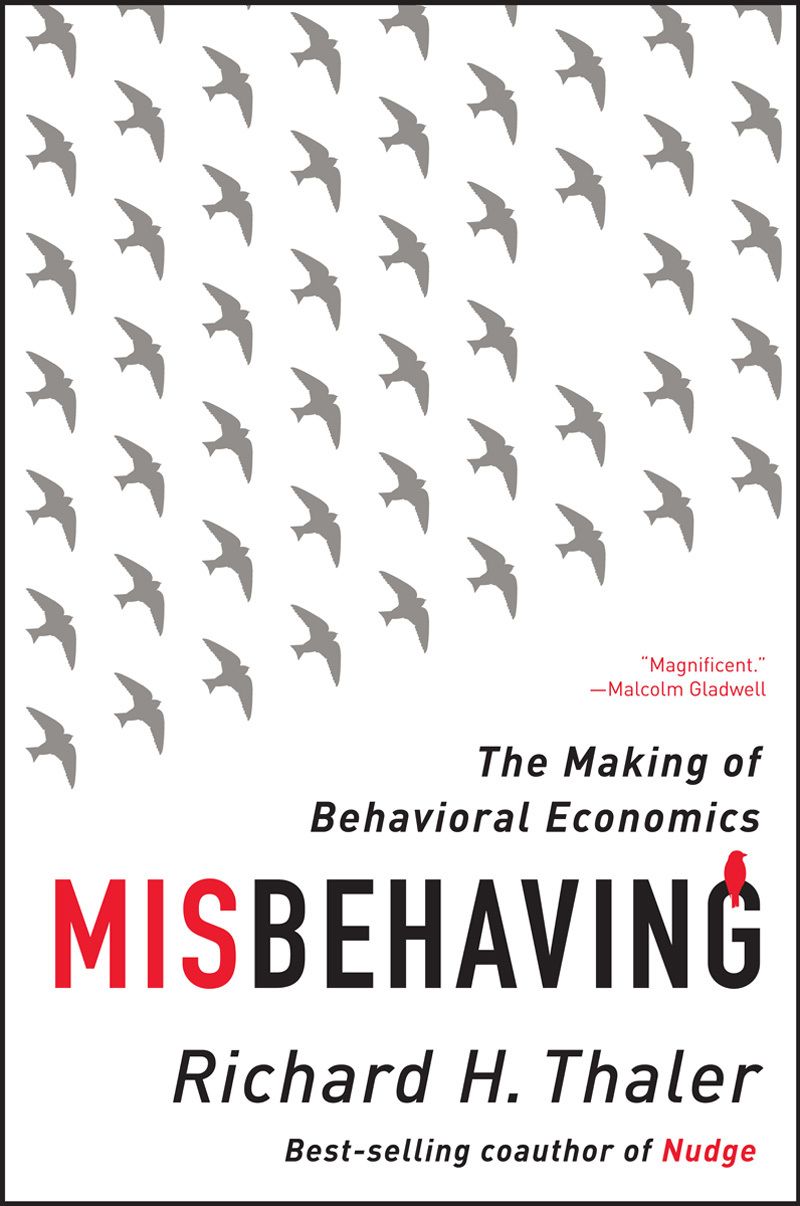
Misbehaving Book Summary
The Making of Behavioral Economics
Book by Richard Thaler
Summary
Richard Thaler chronicles the emergence of behavioral economics, challenging traditional economic assumptions about economics, and revolutionizing our understanding of decision-making. Thaler demonstrates the power of behavioral insights to improve people's lives while shedding light on the profoundly human factors that shape our choices.
1. Beginnings: 1970-1978
Economists Assume Irrelevant Factors Don't Matter, But They Do
Standard economic theory assumes that people make rational decisions based only on relevant factors. However, behavioral economics recognizes that in the real world, many supposedly irrelevant factors (SIFs) heavily influence behavior. Examples include:
- Framing effects (e.g. 70/100 feels much worse than 96/137 even if the percentage is the same)
- Anchoring (being influenced by arbitrary reference points)
- Availability bias (judging frequency by how easily examples come to mind) SIFs make behavior deviate from what rational models predict. Identifying SIFs and how they impact decisions is a key aim of behavioral economics.
Section: 1, Chapter: 1
The Endowment Effect
The endowment effect refers to the finding that people tend to value items they own more highly than identical items they do not own, even if they acquired the item recently or by chance. Examples include:
- Participants given a mug demanded significantly more money to part with it than others were willing to pay to acquire the same mug
- People refuse to sell bottles of wine for prices they would never pay to acquire those bottles
- List prices create an "anchor" that sellers then demand more than, but buyers are unwilling to pay
The endowment effect shows that ownership itself (even very recent ownership) makes people value items more. This violates standard economic assumptions of fungibility and stable preferences. Loss aversion likely underpins the effect - giving something up feels like a loss.
Section: 1, Chapter: 2
Mere Ownership Makes Us Overvalue Items
Be aware that your tendency to overvalue what you already own can lead to poor decisions, such as:
- Holding on to losing investments rather than cutting your losses
- Refusing to part with items you no longer need
- Overpricing items you're trying to sell
- Turning down good deals because you're anchored to a higher price you previously paid
Section: 1, Chapter: 2
Anomalies In Behavior
Early in his career, Richard Thaler started collecting examples of anomalies - human behaviors that deviated from the predictions of standard economic models. Some examples from his list:
- Paying more attention to sunk costs than rational models say we should
- Refusing to buy or sell items based on apparently irrelevant factors like recent ownership
- Failing to ignore past costs when making decisions
- Avoiding options to constrain our future behavior
At the time, these anomalies were seen as quirks or mistakes, not fundamentally important. But Thaler saw them as clues that the rational models were flawed and needed to be revised to incorporate human psychology.
Section: 1, Chapter: 3
Prospect Theory
Prospect theory, developed by Kahneman and Tversky, provided a formal alternative to the standard economic theory of expected utility. A key element is the value function, which has several important features:
These features explained many of the anomalies Thaler had identified, like the endowment effect. Loss aversion makes people reluctant to part with items they already own. The value function's shape also implies risk aversion for gains but risk seeking for losses.
Section: 1, Chapter: 4
Focus On Changes Rather Than Absolute Levels
We experience life as changes, not absolute levels. As such, we should:
- Evaluate outcomes as gains or losses relative to a reference point. E.g., a 5% raise feels better if others got 3% than if they got 7%.
- Losses hurt about twice as much as equivalent gains feel good. Be more cautious about risks that could lead to loss.
- Because of diminishing sensitivity, look for opportunities to break up gains (to make each one feel bigger) and combine losses (to make them feel less bad overall).
- Since losses are so painful, think carefully before giving something up, even if you'll get something else of equal value in return. Is it worth the pain of the loss?
Section: 1, Chapter: 4
Behavioral Economics Had A Slow Start
In the late 1970s, Richard Thaler was a young professor trying to apply psychology to economics, but with a hard time getting others to take his ideas seriously. A few key moments:
- On a drive to Stanford, he pondered how to convince skeptical economists that psychological factors really do affect economic decisions
- He discovered the work of Kahneman and Tversky on heuristics, biases and prospect theory, which provided an academic foundation for his ideas
- At Stanford, he met Baruch Fischhoff, Paul Slovic and others studying human judgment, further expanding his knowledge of relevant psychology
However, the economic establishment still viewed behavioral approaches as quirky at best and misguided at worst.
Section: 1, Chapter: 5
The Endowment Effect Proved Challenging To Demonstrate
One of the key early findings in behavioral economics was the endowment effect - our tendency to value things we own more highly than identical things we don't own. However, Thaler and colleagues ran into several challenges in trying to demonstrate the effect:
- Experimental subjects had to be making real choices with real money at stake, not just hypothetical survey responses, or else economists would dismiss the results
- The experiments had to rule out alternative explanations like transaction costs or implied information value
- Results had to be replicated across different item types and with high levels of statistical significance
In the end, carefully designed experiments involving things like trading mugs and pens provided convincing evidence. But the process illustrates the high burden of proof required to shift established economic wisdom, even in the face of compelling anomalies.
Section: 1, Chapter: 6
Economists' Objections Presented A "Gauntlet"
As Thaler and colleagues tried to publish early behavioral economics research, they encountered a predictable set of objections from economists, which Thaler dubbed the "Gauntlet":
1
The stakes weren't high enough - people will behave rationally when big money is on the line2
People will learn their way out of biases over time3
In markets, individual biases will cancel out4
Arbitrage by rational actors will eliminate any impact of bias on pricesOvercoming these objections required careful experimental designs and an accumulation of empirical evidence across many studies. But the gauntlet also revealed the reluctance of many economists to incorporate psychological realism into their models, even in the face of contrary evidence.
Section: 1, Chapter: 6
2. Mental Accounting: 1979-85
Perceived Fairness Affects Willingness To Pay
The "beer on the beach" study illustrates how perceived fairness affects willingness to pay, even for identical products. Thaler asked people to imagine buying a beer from either a fancy resort hotel or a run-down grocery store. The catch: the beer is to be consumed on the beach, so the drinking experience will be identical.
Results showed people were willing to pay much more for the beer from the resort ($7.25 on average) than for the one from the store ($4.10). The location's perceived fairness as a reference point shaped their valuations, even though the consumption experience was the same. This effect, which Thaler calls "transaction utility," has important implications for pricing decisions.
Section: 2, Chapter: 7
Maximize Perceived Transaction Utility In Your Pricing
To make your prices feel fair and maximize consumers' willingness to pay:
- Position your offering as being "on sale" or "a bargain" compared to reference prices (e.g., "lista price," competitors)
- Articulate reasons why your price is fair given your costs, product quality, target market, etc.
- Avoid blatant cash grabs or price hikes that will feel like "rip-offs" (e.g., surge pricing during emergencies)
- Consider obscuring or shrouding certain costs to minimize "pain of paying" (e.g., shipping & handling)
- Make price increases feel fair by offering some additional value at the same time
Remember: perceived fairness is often more important than actual price level in driving purchase behavior. A bargain-hunting mentality keeps retailers like Costco in business. Focus first on perception, not just on the nominal price.
Section: 2, Chapter: 7
Sunk Costs Leads Us To Throw Good Money After Bad
The sunk cost fallacy is our tendency to continue an endeavor once we've invested time, effort or money into it, even when continuing is no longer rational. An example from Thaler's personal life illustrates how mental accounting can exacerbate the effect.
Actively spending money makes the sunk cost highly vivid and painful if the purchase isn't then utilized. We feel the need to "get our money's worth." But this means we often throw good money (or time or effort) after bad, continuing down an unprofitable path.
Section: 1, Chapter: 8
Mental Accounting
People often use mental budgets or "buckets" to constrain their spending - e.g., $200/month on dining out. But this heuristic can lead to irrational behavior.
In one study, subjects were told they were going to a play. Half were told they had recently spent $50 going to a basketball game (same bucket), while half were told they got a $50 parking ticket (different bucket). Subjects were then asked if they would still buy a ticket to the play.
Those who had gone to the game were less likely to buy play tickets, presumably because they felt they had already spent their entertainment budget for the month. But this makes no sense - the historical spending is a sunk cost and should be irrelevant to the play decision. Yet because it was categorized in the same mental bucket, it still affected their choice.
Section: 2, Chapter: 9
3. Self-Control: 1975-88
4. Working With Danny: 1984-85
5. Engaging With The Economics Profession: 1986-94
6. Finance: 1983-2003
7. Welcome To Chicago: 1995-Present
8. Helping Out: 2004-Present
Related Content
Thinking Fast and Slow Book Summary
Daniel Kahneman
Kahneman explores the two systems that drive the way we think: the intuitive, automatic System 1 and the deliberate, analytical System 2. It explores how these systems shape our judgments, decisions, and biases, revealing the surprising power of intuition and the pitfalls of overconfidence.
Kahneman explores the two systems that drive the way we think: the intuitive, automatic System 1 and the deliberate, analytical System 2. It explores how these systems shape our judgments, decisions, and biases, revealing the surprising power of intuition and the pitfalls of overconfidence.
Psychology
Personal Development
Business
The Psychology of Money Book Summary
Morgan Housel
The Psychology of Money is a fascinating look at the strange ways people think about money and teaches you how to make better sense of one of life's most important topics. Doing well with money isn't necessarily about what you know; it's about how you behave, and behavior is hard to teach, even to really smart people.
The Psychology of Money is a fascinating look at the strange ways people think about money and teaches you how to make better sense of one of life's most important topics. Doing well with money isn't necessarily about what you know; it's about how you behave, and behavior is hard to teach, even to really smart people.
Psychology
Money
Self-Help