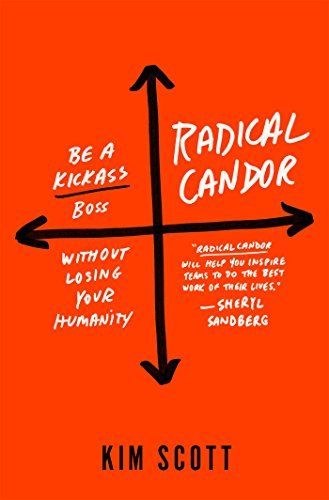
Radical Candor Book Summary
Be a Kick-Ass Boss Without Losing Your Humanity
Book by Kim Malone Scott
Summary
Radical Candor is a management philosophy that emphasizes caring personally about your team while also challenging them directly, creating a culture of feedback, trust and high performance.
Radical Candor - Saying What You Think While Also Giving A Damn
Radical Candor involves both "caring personally" and "challenging directly." Caring personally means giving a damn about people, not just professionally but personally. Challenging directly means being willing to say what you really think, even if it's uncomfortable. By combining these two dimensions, you create Radical Candor - the ability to give guidance and feedback in a way that challenges people directly while also showing you care.
Section: 1, Chapter: 1
The "Um" Story - How Direct Feedback Can Be An Act Of Caring
Early in her career at Google, the author's boss Sheryl Sandberg pulled her aside after a presentation. She complimented the author's intellect and ability to see both sides of an argument. But then Sheryl told her very directly "you said 'um' a lot in there. Were you aware of it?" The direct feedback made the author aware of how much she was saying "um" and motivated her to work with a speech coach to improve. This demonstrated how giving direct, even uncomfortable, feedback can be an act of caring when done with good intent.
Section: 1, Chapter: 1
Manipulative Insincerity - What Happens When You Neither Care Nor Challenge
The opposite of Radical Candor is Manipulative Insincerity - this is what happens when you neither care about a person nor challenge them directly. It's praise that is insincere and not specific, or criticism that is neither clear nor kind. People give praise or criticism from a place of Manipulative Insincerity when they are too focused on being liked, or when they are too tired to care or argue anymore. But guidance that comes from this place tends to be confusing and unhelpful for the recipient.
Section: 1, Chapter: 1
Radical Candor Is Relative To The Recipient
An important insight about Radical Candor is that it is measured at the listener's ear, not the speaker's mouth. What feels like Radical Candor to one person may feel aggressive or insensitive to another. You have to tailor your approach to the individual and also to their cultural context.
- For an Israeli team she worked with, the author found that very blunt, almost confrontational feedback was accepted as Radical Candor. But that same style was offensive to a team in Tokyo, so she had to adjust to a style of "polite persistence" to challenge them while still showing respect.
- The takeaway is you can't just memorize some
Radically Candid phrases to use. You have to build a relationship and understand what works for each individual to challenge them while also showing you care.
Section: 1, Chapter: 1
At Apple, A Culture Of Criticism Coupled With Deep Respect
The author observed the culture at Apple involved intense, direct debate and criticism, but always done with a foundation of deep respect. Steve Jobs invited people to tell him when he was wrong, insisting they challenge his ideas. He wanted people's genuine opinions, even if they disagreed with his.
But while the criticism was very direct, it was coupled with real personal caring and respect. Jobs would explain why someone's work was not good enough and articulate why, but would also emphasize that any criticism was not fundamentally calling their abilities into question. This demonstrated a culture of Radical Candor - direct challenge coupled with real personal caring. The respect and personal caring made the direct criticism and debate possible.
Section: 1, Chapter: 1
Guidance - The Atomic Building Block Of Management
Radically Candid relationships enable good guidance - praise and criticism that is kind, clear, specific and sincere. Guidance is the "atomic building block" of being a good boss. To be successful:
- Bosses have to want to give guidance
- Bosses have to be able to give it effectively
- Employees have to be eager to receive guidance
If any of these three are missing, an organization will collapse.
The chapter explores how to get guidance as a boss, give it to your employees, and encourage it across the whole team.
Section: 1, Chapter: 2
Provide Guidance Immediately, Directly, And In Person
When providing guidance or feedback to employees, follow these key tips:
- Do it immediately: The longer you wait between noticing a behavior and commenting on it, the less effective the feedback will be. Don't save up criticism.
- Do it in person: Feedback is most effective when done in person, where you can see the person's facial expressions and body language and respond accordingly. If you can't do it in person, do it live over video chat, or worst case, phone. Never give important feedback over email/text if you can avoid it.
- Criticize in private and praise in public: A good rule of thumb is to provide criticism in a 1:1 setting, while providing praise in a group/public setting. This shows respect for the individual and also helps the positive example spread.
- Don't personalize: Make the feedback about the work/behavior, not the individual. Point to specific actions and impacts vs. making it about the person's immutable traits.
Section: 1, Chapter: 2
Rethinking Ambition - Not Everyone Wants To "Climb The Ladder"
Too often as managers, we assume that everyone on our team wants to be on a steep growth trajectory and be promoted as quickly as possible. But the reality is that not everyone wants the next bigger job right now. At different phases of life and career, people may be very content and fulfilled in their current role. Pushing them toward promotions they don't want leads to unhappiness.
The author calls this the difference between "rock stars" and "superstars." Superstars are always gunning for the next big role. Rock stars are excellent at their current job and find fulfillment there. Organizations need both. If you promote a rock star into a role they don't want, you lose them. If you fail to keep giving a superstar new challenges, you lose them.
As a manager, you have to get to know each individual, understand what their current ambitions and motivations are, and manage them accordingly. Don't impose a one-size-fits-all idea of ambition.
Section: 1, Chapter: 3
Manage The Person, Not Just The "Talent"
"For many bosses, 'recognition' means 'promotion.' But this is a big mistake in most cases. Promotion often puts these people in roles they are not as well-suited for or don't want. The key is to recognize their contribution in other ways. It may be a bonus or a raise. Or, if they like public speaking, get them to present at your all-hands meetings... If they like teaching, get them to help new people learn their roles faster. Or if they are shy, make sure you and others on the team thank them privately for the work they do. Consider, carefully, tenure awards."
Section: 1, Chapter: 3
Related Content

Lean In Book Summary
Sheryl Sandberg
In Lean In, Sheryl Sandberg examines the barriers women face in achieving leadership roles and offers compelling, research-based advice on what women can do to overcome these obstacles and achieve their full potential in both their professional and personal lives.
In Lean In, Sheryl Sandberg examines the barriers women face in achieving leadership roles and offers compelling, research-based advice on what women can do to overcome these obstacles and achieve their full potential in both their professional and personal lives.
Leadership
Feminism
Business
Biography
Start With Why Book Summary
Simon Sinek
Start with Why offers a powerful framework for how leaders and organizations can inspire others, build trust and loyalty, and achieve long-term success by clearly articulating and staying true to their purpose, cause or belief.
Start with Why offers a powerful framework for how leaders and organizations can inspire others, build trust and loyalty, and achieve long-term success by clearly articulating and staying true to their purpose, cause or belief.
Management
Leadership
Business
Entrepreneurship