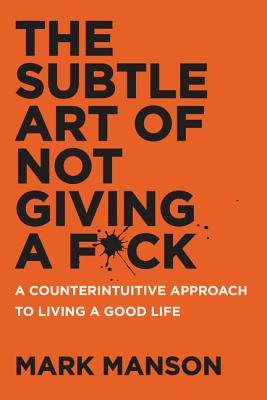
The Subtle Art of Not Giving a F*ck Book Summary
A Counterintuitive Approach to Living a Good Life
Book by Mark Manson
Feeling Lazy?Read 1 Minute Summary
Summary
In "The Subtle Art of Not Giving a F*ck," Mark Manson argues that the key to a good life is not the pursuit of happiness, but rather the embrace of uncertainty, failure, and our own limitations - learning to care deeply about a few important things, and letting go of the rest.
The Counterintuitive Approach To Living A Good Life
In the introduction, Mark Manson argues that the key to living a good life is not trying to be positive all the time. Instead, we need to become better at handling adversity, accepting our limitations and flaws, and learning how to not give a f*ck about things that don't really matter. Manson acknowledges this approach is counterintuitive in an age obsessed with positive thinking and self-help mantras.
Section: 1, Chapter: 1
The Feedback Loop From Hell
The "Feedback Loop from Hell" refers to the cycle where we feel bad about feeling bad, which makes us feel even worse. For example:
- We feel anxious about feeling anxious
- We get angry that we're feeling angry
- We feel guilty about feeling guilty
This leads us into a downward spiral. The more we try to avoid negative emotions, the more powerful they become. Manson argues the solution is to accept negative emotions as a normal, inevitable part of life rather than desperately trying to escape them.
Section: 1, Chapter: 1
Wanting Positive Experience is a Negative Experience
"Wanting positive experience is a negative experience; accepting negative experience is a positive experience. It's what the philosopher Alan Watts used to refer to as 'the backwards law' - the idea that the more you pursue feeling better all the time, the less satisfied you become, as pursuing something only reinforces the fact that you lack it in the first place."
Section: 1, Chapter: 1
Embrace And Deal With Your Problems - Don't Avoid Them
Manson argues that many people are caught up in an endless cycle of avoidance, always pursuing quick-fix highs and escaping painful emotions. Instead, we need to confront our issues head on:
- Choose to view struggles and pain as opportunities for growth
- Ask yourself "What am I willing to struggle for? What do I give a f*ck about?"
- Practice meditation and other techniques to sit with and accept discomfort
By facing problems directly instead of avoiding them, we build resilience and derive more meaning from life. Avoidance only makes us weaker and less prepared to handle the inevitable challenges we'll face.
Section: 1, Chapter: 1
You Are Not Special (And That's Okay)
In today's world, there is immense pressure to be exceptional, to "stand out from the crowd." Social media makes it seem like everyone else is living extraordinary lives. This leads to entitlement and unrealistic expectations. But Manson argues that constantly comparing ourselves to extreme outliers makes us feel inadequate and insecure. The truth is, by definition not everyone can be extraordinary. And that's totally fine. There is nothing wrong with being average in most areas of life. Embracing this leads to more peace and self-acceptance.
Section: 1, Chapter: 2
The Value Of Suffering
Drawing on academic research, Manson discusses how many trauma survivors, such as victims of sexual assault or military veterans, report becoming stronger, more self-aware and more grateful in the aftermath of terrible experiences.
This phenomenon is called post-traumatic growth. It shows how humans are incredibly adaptive, and that we often emerge from suffering and adversity with a newfound appreciation for life and inner resilience. Suffering reveals what really matters to us.
Of course, Manson is not arguing that traumatic events are good. Only that humans have a remarkable capacity to create meaning and grow from even the worst experiences imaginable. Suffering is inevitable - it's how we relate to it that matters.
Section: 1, Chapter: 3
Emotions Are Overrated. Learn To Question Them
Instead of always believing and acting on our emotions, Manson argues we should learn to question them:
- Emotions can feel real and powerful in the moment but are often irrational and out of proportion upon later reflection.
- Our emotions evolved to help our ancestors survive, not to make us happy in the modern world.
- Use self-awareness to analyze your emotions before blindly obeying them. Ask "Is this a useful emotion? Does it serve me in this situation? Or am I being overly negative/anxious/angry for no good reason?"
By getting into the habit of analyzing and questioning our emotions instead of always identifying with them, we can make better decisions and become less reactive. How we interpret and act on feelings is a choice.
Section: 1, Chapter: 3
The Self-Awareness Onion
Manson introduces the concept of the "Self-Awareness Onion," which has three layers:
- A simple understanding of one's emotions
- An ability to ask why we feel certain emotions
- Our personal values: How we measure ourselves (and how we measure others)
Manson argues that we must peel back these layers to understand our values and what truly matters to us. It's hard work, but it's essential for making wise choices and building a meaningful life. Most people get stuck on the first or second layer.
Section: 1, Chapter: 4
Shitty Values That Create Misery
Manson identifies several common values that seem appealing on the surface but actually lead to unhappiness and dysfunction:
- Pleasure: Feels good in the short-term but is fleeting and unfulfilling
- Material Success: Research shows that once basic needs are met, more money does little to boost happiness
- Always Being Right: Makes you delusional and antagonizes others
- Staying Positive: Involves denying reality and repressing valid emotions
Manson advises readers to diligently examine their value system, and replace toxic values with healthier ones. Examples of better values: honesty, creativity, humility, curiosity.
Section: 1, Chapter: 4
How To Adopt Good Values
Manson offers some tips for choosing and incorporating better values:
- Good values are based in reality, socially constructive, and immediate and controllable (e.g. honesty, innovation, vulnerability, standing up for oneself)
- Bad values are reliant on external events, socially destructive, and not immediate or controllable (e.g. dominance through manipulation, always being center of attention, staying positive all the time)
- Your values are what you choose to find important, not necessarily what feels good
- Prioritize as few values as possible - the more things you give a f*ck about, the more you'll be stretched thin and your efforts diluted
- Actively reject things that don't align with your values. You can't stand for something if you stand for everything.
Consciously adopting values is hard work. You must choose what to give a f*ck about, and take responsibility for those choices. That's part of being an adult.
Section: 1, Chapter: 4
Related Content
Everything is F*cked Book Summary
Mark Manson
In a world where everything seems fcked, Manson provides a provocative exploration of the human condition, offering a counterintuitive perspective on the nature of hope, the illusion of self-control, and the quest for meaning amongst uncertainty
In a world where everything seems fcked, Manson provides a provocative exploration of the human condition, offering a counterintuitive perspective on the nature of hope, the illusion of self-control, and the quest for meaning amongst uncertainty
Personal Development
Philosophy