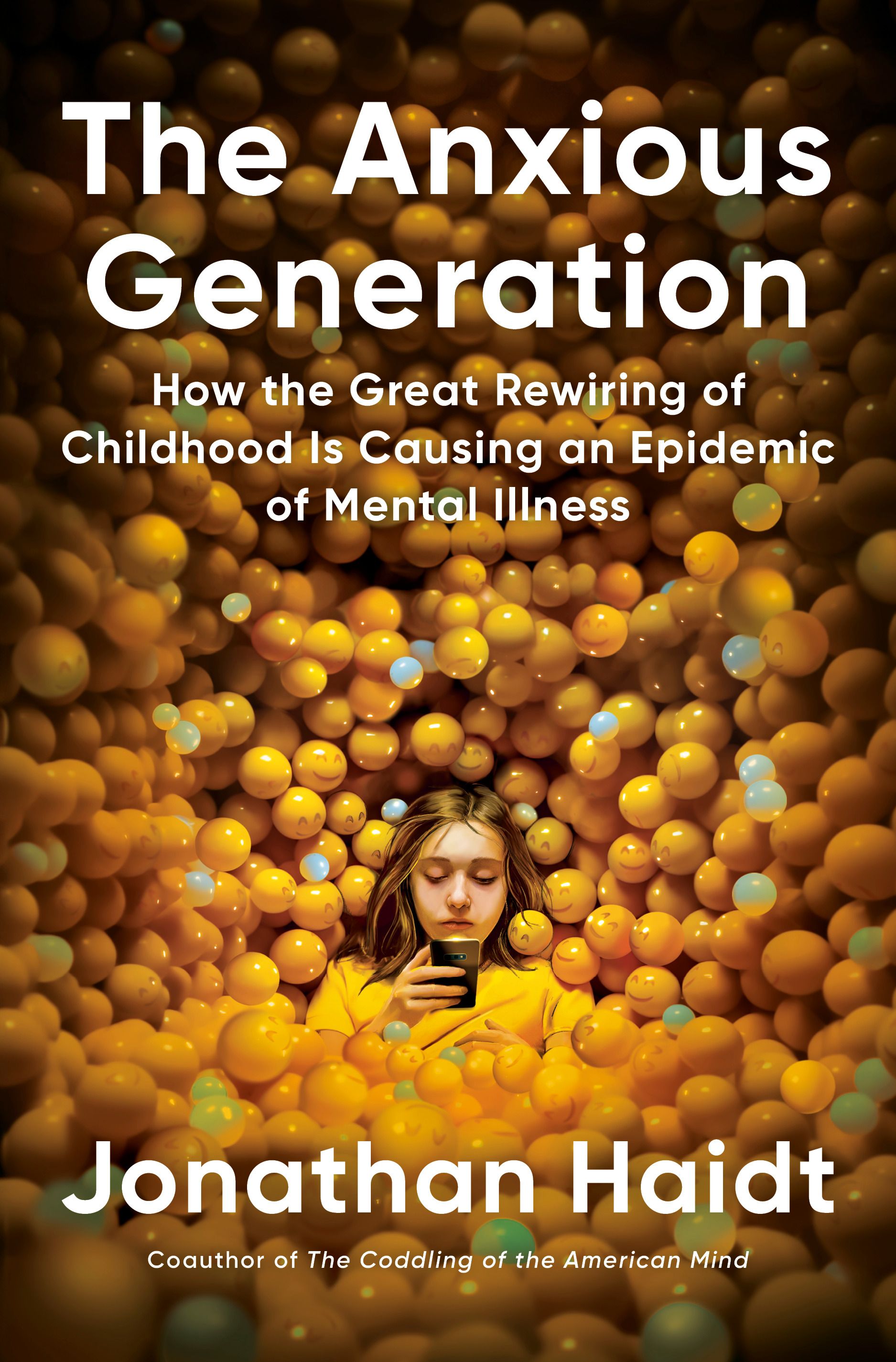
The Anxious Generation Book Summary
How the Great Rewiring of Childhood is Causing an Epidemic of Mental Illness
Book by Jonathan Haidt
Summary
In The Anxious Generation, Jonathan Haidt traces the sudden rise of teen anxiety, depression, and self-harm to the simultaneous decline of free play and rise of smartphones. Haidt shows how restoring the pillars of a play-based childhood may be the key to reversing the mental health crisis engulfing Gen Z.
1. A Tidal Wave
In the early 2010s, rates of anxiety, depression, self-harm and suicide suddenly skyrocketed among American teenagers, especially girls. Similar tidal waves of teen mental illness soon emerged in Canada, the UK, and other countries across the English-speaking world.
The available evidence points to one primary cause: the rapid shift from basic flip phones to smartphones occurring at the exact same time. Almost overnight, teens went from spending their leisure hours hanging out with friends to spending them hunched over phones, scrolling social media feeds, playing mobile games, watching porn, and texting in group chats nearly every waking minute.
This abrupt severing of in-person social bonds and 24/7 exposure to curated/addictive content pushed many teens' brains into a state of perpetual fight-or-flight. The opening chapters lay out the full scope of the teen mental health crisis and trace its close connection to the technological trends that define Gen Z.
An Epidemic of Mental Illness Among the Young
In the early 2010s, rates of anxiety, depression, self-harm and suicide began rising sharply among adolescents, especially girls, across the U.S., UK, Canada and other Western nations. Key trends:
- Depression rates roughly tripled among teen girls and doubled among teen boys in the U.S. between 2010-2020
- Rates of self-harm nearly tripled for younger adolescent girls
- Suicide rates rose dramatically, especially for younger teen girls
- Similar patterns emerged in the UK, Canada, Australia, and across Western Europe at the same time No other theory, such as the 2008 financial crisis or concerns about school shootings and climate change, can explain this sudden, synchronized international increase in teen mental illness. The main factor that changed in the early 2010s was adolescents rapidly transitioning from basic cell phones to smartphones with social media.
Section: 1, Chapter: 1
"The Transition to Phone-Based Childhood"
"Between 2010 and 2015, the social lives of American teens moved largely onto smartphones with continuous access to social media, online video games, and other internet-based activities. This Great Rewiring of Childhood, I argue, is the single largest reason for the tidal wave of adolescent mental illness that began in the early 2010s."
Section: 1, Chapter: 1
Looking for Clues in the Data
Digging into the mental health data provides important clues about what changed for teens in the 2010s:
- The increases are mainly in internalizing disorders like anxiety and depression, not externalizing disorders. Girls are affected more than boys.
- The increases are concentrated in Gen Z. Millennials and older generations show much smaller changes.
- ER visits and hospitalizations for self-harm and suicide attempts skyrocketed for younger adolescent girls after 2010, confirming this is a real crisis, not just increased willingness to report symptoms.
Section: 1, Chapter: 1
2. The Backstory: Decline of Play-Based Childhood
The sudden deterioration of teen mental health in the 2010s was the joint product of two separate trends long in the making. The first was the steady erosion of children's freedom to engage in unsupervised play, take risks, and develop independence throughout the 1980s-2000s, thanks to helicopter parenting and an expanding culture of overprotection, often called "safetyism."
This style of restrictive childrearing was well-intentioned, motivated by love and fear, but often counterproductive - it blocked kids from the very experiences needed to develop healthy coping skills and resilience.
The decline of free-range childhood set the stage for smartphones to fill the void with addictive distraction rather than maturity-building milestones.
What Do Children Need to Do in Childhood?
Human childhood is unique - children's brains grow rapidly until age 5 but then development slows until puberty. This extended period allows time for cultural learning and development of key motivations:
1. Free play - the "work" of childhood. Through play, children wire up their brains, overcome fears, and gain social and physical competencies.
2. Attunement - connecting and synchronizing with others through games and rituals. Builds trust and belonging.
3. Social learning - acquiring culture through imitation, especially of prestigious individuals. Conformity and prestige biases guide learning. A play-based childhood provides age-appropriate experiences matched to sensitive developmental periods. The phone-based childhood disrupts this natural process.
Section: 1, Chapter: 2
The Cuckoo Bird of Childhood
"Smartphones are like the cuckoo bird, which lays its eggs in other birds' nests. The cuckoo egg hatches before the others, and the cuckoo hatchling promptly pushes the other eggs out of the nest in order to commandeer all of the food brought by the unsuspecting mother. Similarly, when a smartphone, tablet, or video game console lands in a child's life, it will push out most other activities, at least partially."
Section: 2, Chapter: 2
Your Child's Personal Trainers - Mark Zuckerberg and Charli D'Amelio
Be aware of who your children's role models are and what they are learning from them. In a phone-based childhood, social learning mechanisms lock onto the most viral content creators, not necessarily the most virtuous exemplars. Some key lessons:
- Craft your online image carefully and do whatever it takes to gain likes/followers
- Share only your most glamorous, enviable moments
- Constantly monitor your social status and do what's trending to stay relevant This replaces learning from family, teachers, coaches, and community elders. Consider setting limits on social media to make space for real-world mentorship and skill development.
Section: 2, Chapter: 2
The Sensitive Period for Cultural Learning
Ages 9-15, especially the first years of puberty, may be a sensitive period when cultural learning has an outsized, long-term impact on identity and worldview. Studies show:
- Immigrating during this window leads kids to "feel" like the new culture. Moving before or after doesn't.
- Social media use during this period predicts lower wellbeing, while use at other ages has less effect.
- The transition to social media in the early 2010s directly impacted this sensitive period for Gen Z, which may explain their worse mental health outcomes compared to Millennials.
Section: 2, Chapter: 2
Discover vs Defend - The Two Basic Modes of the Human Brain
The human brain contains two subsystems that put it into two common modes:
- Discover mode: Activates when opportunities are detected. Characterized by positive emotions, excitement, and eagerness for new experiences. The default mode for confident, happy people.
- Defend mode: Activates when threats are detected. Characterized by stress, anxiety, negativity, and risk aversion. The default mode for anxious, depressed people.
Young people born after 1995 are more likely to be chronically stuck in defend mode compared to prior generations. Their brains are on high alert for threats rather than being hungry for growth experiences.
Section: 2, Chapter: 3
The Importance of Risky Play
"As one enlightened summer camp administrator told me, 'We want to see bruises, not scars.'"
This quote captures the crucial role that risk-taking and minor injuries play in healthy child development. When children engage in mildly risky physical play, like on adventure playgrounds, they learn to manage their bodies, assess risks, and keep themselves safe. The occasional bruise or scrape teaches valuable lessons. But serious injuries that leave scars are to be avoided. Getting this balance right - bruises, not scars - is key to raising antifragile kids.
Section: 2, Chapter: 3
Safetyism Is Making Kids Fragile
The obsession with keeping kids physically and emotionally "safe" above all else - an ideology called safetyism - is actually making them more fragile and anxious. To counteract this:
- Don't try to protect them from all negative emotions or conflict. Facing setbacks is how they develop coping skills.
- Resist the urge to intervene and solve all their problems. Struggling builds strength and confidence.
- Realize that well-intentioned overprotection sends the message that the world is a dangerous place and they can't handle it. Raising antifragile kids means exposing them to challenges, not coddling them from reality. A childhood that is too safe and sanitized leads to fragile, anxious adults.
Section: 2, Chapter: 3
"We Blocked the Path to Adulthood, Then Gave Them Smartphones"
In recent decades, adults have done two contradictory things that have made it harder for adolescents to successfully transition to adulthood:
- Overprotected kids in the real world by restricting their unsupervised play, risk-taking, and independence due to unfounded safety fears. This prevents them from gaining skills and confidence.
- Underprotected kids in the online world by giving them smartphones and unrestricted internet access. This exposes them to adult content and experiences in an unhealthy order.
The combination of real-world overprotection and virtual-world underprotection means kids aren't getting the right experiences at the right ages to wire their brains for healthy adulthood. We've blocked the traditional path to maturity, then handed them devices to distract them.
Section: 2, Chapter: 4
Why Rites of Passage Matter
Anthropologists have found that nearly all societies have coming-of-age rituals and rites of passage that help adolescents transition to adulthood. For example:
- The Apache Sunrise Dance where girls are secluded after their first period then welcomed into womanhood
- The Jewish bar/bat mitzvah where 12/13 year olds publicly read from the Torah and take on adult responsibilities
- Initiation rites for fraternal orders or military units that bond members together While details vary, rites of passage serve universal purposes - separating youth from childhood, putting them through trials/challenges overseen by elders, then welcoming them into the adult community with new status. Modern society has largely abandoned rites of passage, making the transition to adulthood ambiguous and unguided. Bringing back culturally-appropriate initiation rites could help.
Section: 2, Chapter: 4
3. The Great Rewiring
If the waning of free play steadily weakened the psychic defenses of Gen Z, the waxing of 24/7 connectivity swiftly broke them down. Chapters 5-8 look closely at the myriad ways smartphones eroded teen wellbeing from 2010-2015 and beyond.
4. Collective Action For Healthier Childhood
Steering Gen Z from a phone-based childhood back to a play-based one will require a multi-layered effort. We cannot rely on isolated individual families putting away the devices when peer pressure, school expectations, and Big Tech's persuasive design are all pulling in the other direction. Rather, we need coordinated action from all levels of society - parents and kids setting limits together, teachers and principals creating phone-free learning spaces, policymakers raising the age-appropriate design standards, and health professionals/cultural leaders shifting norms.
From restoring recess and free play, to safeguarding spaces/times from tech intrusion, to updating laws around privacy and safety-by-design, there is much we can do to reclaim childhood. But we must band together quickly, before the next generation gets sucked even deeper into virtual reality. Our kids' wellbeing - and humanity's future - hang in the balance.
Related Content
Four Thousand Weeks Book Summary
Oliver Burkeman
"Four Thousand Weeks" offers a radical perspective on time management, urging us to abandon the futile quest for control and embrace our finite existence. By accepting our limitations and making conscious choices, we can discover a more meaningful and fulfilling way to spend our brief time on this planet.
"Four Thousand Weeks" offers a radical perspective on time management, urging us to abandon the futile quest for control and embrace our finite existence. By accepting our limitations and making conscious choices, we can discover a more meaningful and fulfilling way to spend our brief time on this planet.
Philosophy
Personal Development