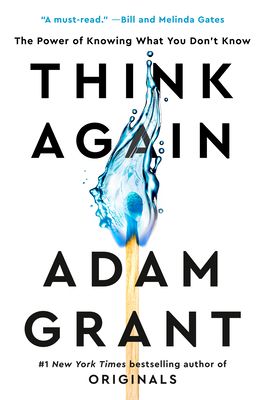
Think Again Book Summary
The Power of Knowing What You Don't Know
Book by Adam Grant
Summary
Think Again is a compelling exploration of the power of knowing what you don't know, and how embracing the joy of being wrong and actively questioning your opinions can help you make better decisions
1. Individual Rethinking
The Power Of Knowing What You Don't Know
Chapter 1 introduces the concept of "rethinking" - the ability to question your existing beliefs and opinions, and update them based on new information. The author argues that in a rapidly changing world, the ability to rethink and unlearn is more important than raw intelligence or knowledge. The chapter gives examples of people and organizations that failed to rethink their assumptions, often with disastrous consequences. These include the demise of BlackBerry, the Challenger and Columbia space shuttle disasters, and the 2008 financial crisis in Iceland.
Section: 1, Chapter: 1
What The Wildfire Tragedy Teaches Us About Rethinking
The chapter opens with the tragic story of the 1949 Mann Gulch wildfire in Montana that killed 13 firefighters. The firefighters were unable to outrun the fire and drop their heavy equipment in time, which sealed their fate. Psychologist Karl Weick later analyzed that the real problem was the firefighters' inability to drop their tools - both physical tools and mental models. They were so attached to their existing way of doing things that they couldn't adapt in time. This highlights how important it is to "drop your tools" - i.e. let go of existing beliefs and habits - in order to rethink and survive in a fast-changing environment.
Section: 1, Chapter: 1
The 4 Modes of Thinking
The chapter outlines 4 modes that our thinking can fall into:
- Preacher mode - when we preach our beliefs and try to defend them from any counterarguments. We focus on convincing others to agree with us.
- Prosecutor mode - we try to prove others wrong and win the argument at all costs. We focus on attacking the other side's weaknesses.
- Politician mode - we try to tell people what they want to hear to gain their approval and support. We focus on campaigning for people's support.
- Scientist mode - we try to seek the truth by questioning assumptions, running experiments, and updating beliefs based on evidence. We focus on discovering reality.
Section: 1, Chapter: 1
Confidence Vs Competence
It's easy to conflate confidence and competence, assuming that those who speak with conviction must know what they're talking about. But there is often a divergence between the two. Overconfidence is especially common among those with the least ability. The trouble is when we mistake confidence for competence, we stop questioning ourselves and fail to rethink faulty assumptions. To counter this, whenever you feel very confident about something, remind yourself "I might be wrong" and look for ways to prove yourself wrong. Don't assume that just because you believe something strongly, it must be true.
Section: 1, Chapter: 1
Beware The Dunning-Kruger Effect
Chapter 2 explores the confidence-competence gap, focusing on the Dunning-Kruger effect. This is a cognitive bias where people with low ability in a domain tend to vastly overestimate their skills, while those with high ability tend to be more accurate or even underestimate themselves. The less intelligent we are in an area, the more we seem to overestimate our actual intelligence in that domain. The trouble is this "confident ignorance" prevents us from recognizing holes in our knowledge and rethinking misguided opinions. Grant shares examples of the Dunning-Kruger effect in action, from people claiming knowledge of non-existent concepts to unskilled entrepreneurs remaining blind to their shortcomings.
Section: 1, Chapter: 2
How To Find The "Sweet Spot" Of Confidence
While overconfidence can make us blind to our weaknesses, underconfidence can be equally detrimental by making us doubt our strengths. The key is to find the "sweet spot" between the two extremes - what Adam Grant calls confident humility. This means having faith in our capability while being open to doubting our current solutions or approaches. We can be confident in our ability to learn and figure things out, even if we're not confident that we have all the right answers yet. Regularly reminding ourselves that we have the capacity to improve, while staying humble enough to question our existing knowledge, can help us avoid the traps of both overconfidence and underconfidence.
Section: 1, Chapter: 2
Attach To Your Values, Not Your Opinions
To cultivate a mindset of rethinking, it helps to detach your sense of self from your current opinions. Instead, anchor your identity in your values - the principles you stand for. Seeing yourself as someone committed to the pursuit of truth, for example, makes it easier to let go of stale opinions when faced with contrary evidence. In contrast, if you see your beliefs as a core part of who you are, you'll feel threatened when they're challenged and dig in your heels. As Adam Grant puts it: "I don't let my beliefs become part of my identity. I know I have the right to change my mind."
Section: 1, Chapter: 3
Great Scientists Are Passionate About Proving Themselves Wrong
What separates great scientists from average ones is not just their intelligence, but their approach to their own knowledge. The best scientists relish discovering that they were wrong, because it means they've learned something new. They actively try to poke holes in their own theories, and they get excited when an experiment fails to validate their hypothesis. Nobel Prize winner Daniel Kahneman sums it up: "Being wrong is the only way I feel sure I've learned anything."
In contrast, most of us instinctively defend our opinions when they're attacked. We prosecute the other side's weaknesses while preaching the strengths of our stance. But the goal of science is to establish what is true, not to prove that we're right. Falling in love with our ideas prevents us from accepting when we might be wrong about them.
Section: 1, Chapter: 3
Our Totalitarian Ego
"We laugh at people who still use Windows 95, yet we still cling to opinions that we formed in 1995. We listen to views that make us feel good, instead of ideas that make us think hard."
Section: 1, Chapter: 3
Harness The Power Of Counterfactuals
One way to make ourselves more open to rethinking our opinions is to engage in counterfactual thinking - imagining how things could have turned out differently. For example, if you're very attached to your political ideology, consider how your beliefs might differ if you grew up in a different country or era. Or reflect on the role of chance in shaping your circumstances - how your life trajectory might have changed if random events played out another way.
Pondering these alternative realities can highlight the element of arbitrariness in many of our beliefs. It's a reminder that we could easily be a different person in a parallel universe - which makes it easier to let go of tightly held opinions in this one.
Section: 1, Chapter: 3
Why The Wright Brothers Succeeded
The Wright brothers, Orville and Wilbur, are famous for inventing the airplane - but few know that their success was fueled by their ability to argue productively. Growing up, the brothers constantly debated and disagreed with each other, honing their skills in constructive conflict. This proved vital when they worked together to solve the challenge of human flight.
Over the months of testing different designs, the Wrights had intense arguments, sometimes shouting at each other for hours on end. But they followed a few key principles that kept their conflicts healthy:
- They attacked ideas, not each other. Their disputes were about technical details, not personal feuds.
- They argued about "how", not just "why." Instead of just asserting their positions, they dug into the mechanics of how to make their ideas work in practice.
- They accepted that they could both be wrong. After an argument, they often returned the next day having both changed their minds.
Section: 1, Chapter: 4
Task Conflict Vs Relationship Conflict
Psychologist Karen "Etty" Jehn distinguishes between two types of conflict: relationship conflict (personal, emotional clashes) and task conflict (disagreements about ideas and opinions). Her research shows that while relationship conflict is usually destructive, moderate task conflict can actually improve team performance by enhancing creativity and preventing groupthink.
The key is to keep task conflicts focused on the substance of the debate, not the egos of the people involved. Some tips:
- Frame a disagreement as a debate, not an argument. An argument feels like a battle, but a debate feels like a cooperative search for truth.
- Separate the idea from the person. Critique the work, not the author. "I disagree with that suggestion" is better than "I disagree with you."
- Agree that you might be wrong. Admitting the possibility of error keeps defensiveness in check and minds open on both sides.
- Focus on "how" questions, not just "why." Explaining how your view might work in practice invites more constructive discussion than just asserting why you're right.
Section: 1, Chapter: 4
2. Interpersonal Rethinking
3. Collective Rethinking
Related Content
Thinking Fast and Slow Book Summary
Daniel Kahneman
Kahneman explores the two systems that drive the way we think: the intuitive, automatic System 1 and the deliberate, analytical System 2. It explores how these systems shape our judgments, decisions, and biases, revealing the surprising power of intuition and the pitfalls of overconfidence.
Kahneman explores the two systems that drive the way we think: the intuitive, automatic System 1 and the deliberate, analytical System 2. It explores how these systems shape our judgments, decisions, and biases, revealing the surprising power of intuition and the pitfalls of overconfidence.
Psychology
Personal Development
Business
Rebel Ideas Book Summary
Matthew Syed
Matthew Syed reveals the vital ingredient missing from our understanding of success: cognitive diversity. Rebel Ideas shows how bringing together different insights, perspectives and thinking styles turbocharges creativity, problem-solving and decision-making, to improve performance in today's complex world.
Matthew Syed reveals the vital ingredient missing from our understanding of success: cognitive diversity. Rebel Ideas shows how bringing together different insights, perspectives and thinking styles turbocharges creativity, problem-solving and decision-making, to improve performance in today's complex world.
Psychology
Innovation
Business
Leadership