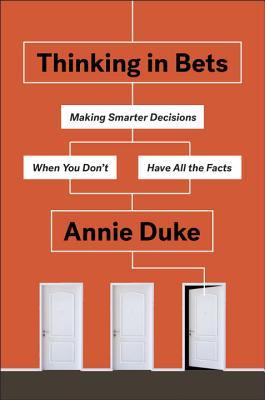
Thinking in Bets Book Summary
Making Smarter Decisions When You Don't Have All the Facts
Book by Annie Duke
Summary
In "Thinking in Bets," Annie Duke draws on her experience as a professional poker player to share strategies for making sound decisions under uncertainty, such as thinking probabilistically, learning from outcomes, surrounding yourself with truthseeking groups, and using mental time travel to pressure-test beliefs and plans.
Life Is Poker, Not Chess
In Chapter 1, Annie Duke argues that life is more like poker than chess. Chess contains no hidden information and little luck, so the better player almost always wins. But in poker and in life, there are unknown variables and luck involved. Even the best decision doesn't always lead to a good outcome, and a bad decision can sometimes work out due to luck. Duke uses examples like Pete Carroll's famous goal-line call in the Super Bowl and how the same play call would have been deemed brilliant rather than idiotic if it had worked.
Section: 1, Chapter: 1
"I'm Not Sure": Using Uncertainty To Our Advantage
One of the key insights is that we should get more comfortable saying "I'm not sure" and acknowledging uncertainty. Poker players know that they can never be fully certain if their decision is right, due to incomplete information. They focus on making the best decision possible given what they know. We should do the same in life - make the best choices we can while accepting that we don't know everything. Don't be afraid to express uncertainty, as it makes you more credible. Redefine "wrong" to mean the decision-making process was flawed, not that the outcome was bad due to factors beyond your control.
Section: 1, Chapter: 1
"Wanna Bet?" On Your Beliefs
Annie Duke introduces the powerful question "Wanna bet?" as a way to test the strength of your beliefs. When someone challenges you with a bet, it forces you to consider:
- Why do I believe this?
- How much information do I have to support it?
- Under what circumstances might my belief not be true?
"Wanna bet?" triggers you to vet your beliefs and express your level of confidence in them accurately, rather than just assuming they are 100% true. This is what poker players and good decision makers do constantly. Duke argues we should all adopt this betting framework for our beliefs and predictions.
Section: 1, Chapter: 2
We Form Abstract Beliefs In A Flawed Way
Duke cites research showing that we form abstract beliefs in a backwards way - we hear something, assume it's true, and only sometimes get around to vetting it later, if at all.
Experiments found that even when questionable information was clearly labeled as false, people still tended to process it as true, especially when under time pressure. Our brains evolved to assume things we hear are true because doubting everything would be cognitively inefficient. But this means many of our beliefs about the world are not properly vetted. Even when presented with contradictory evidence, we often still cling to existing beliefs.
Section: 1, Chapter: 2
The Stubbornness Of Beliefs
To illustrate how stubbornly we hold onto beliefs even in the face of contrary evidence, Duke cites a famous study called "They Saw a Game." Researchers showed a film of a heated football game between Dartmouth and Princeton to students from those two schools.
Despite watching the same clip, the two groups had wildly different interpretations of what happened based on their tribal loyalties. The Princeton students saw Dartmouth players commit twice as many infractions as their own team, while Dartmouth students thought the teams committed fouls equally. This showed how powerfully our beliefs shape how we interpret objective events to confirm our existing views.
Section: 1, Chapter: 2
"Beliefs Are Like A Large Pile Of Matches, Not Cards"
"Beliefs, in most cases, aren't like cards that can be flipped easily when the facts change. Beliefs are like a large pile of matches that can ignite at the slightest provocation. Unlike cards, matches are hard to extinguish once they get going. We can keep throwing more and more facts on the fire and yet, in the face of the evidence, the beliefs remain ablaze."
Section: 1, Chapter: 2
Being Smart Can Make Bias Worse
Surprisingly, being more intelligent and knowledgeable can actually make bias worse in some cases. The smarter you are, the better you are at finding reasons to support your existing beliefs and explaining away or discounting contradictory evidence. Very intelligent people with more information at their disposal can more easily rationalize away facts that don't fit their opinions. This means even very smart, educated people are still highly prone to biased and motivated reasoning in defense of their beliefs. Raw intelligence alone doesn't lead to objectivity.
Section: 1, Chapter: 2
Fielding Outcomes - Separating Luck And Skill
Chapter 3 focuses on how to learn productively from outcomes. Duke argues we must get better at "fielding" outcomes - determining whether they were due to the quality of our decisions (skill) or factors beyond our control (luck).
Poker players know that even good decisions can lead to bad outcomes and vice versa due to luck. The challenge is that it's hard to tease apart the contributions of luck vs. skill. But if we attribute bad outcomes solely to luck, we miss opportunities to improve our choices. If we chalk up good outcomes solely to skill, we may wrongly reinforce bad habits.
Section: 1, Chapter: 3
"Outcomes Don't Tell Us What's Our Fault And What Isn't"
"Outcomes don't tell us what's our fault and what isn't, what we should take credit for and what we shouldn't. Outcomes are rarely the result of our decision quality alone or chance alone, and outcome quality is not a perfect indicator of the influence of luck or skill. When it comes to fielding outcomes, we tend to focus on the quality of the outcome as the deciding factor between luck and skill."
Section: 1, Chapter: 3
The Danger Of Resulting - Judging Decisions Solely By Results
A classic example of the danger of judging decisions solely by their results is the rise in obesity that accompanied the low-fat diet craze. Public health officials encouraged people to shun fatty foods and embrace carbs and sugars instead in the 1980s-90s. But obesity skyrocketed as a result.
However, in the moment, people eating "low-fat" but high-sugar snacks like SnackWells cookies likely attributed any weight gain to bad luck or other factors. It took a long time for the realization that judging food quality by fat content alone was flawed. This shows the peril of "resulting" - assuming the quality of a decision can be judged solely by its outcome.
Section: 1, Chapter: 3
Related Content
Thinking Fast and Slow Book Summary
Daniel Kahneman
Kahneman explores the two systems that drive the way we think: the intuitive, automatic System 1 and the deliberate, analytical System 2. It explores how these systems shape our judgments, decisions, and biases, revealing the surprising power of intuition and the pitfalls of overconfidence.
Kahneman explores the two systems that drive the way we think: the intuitive, automatic System 1 and the deliberate, analytical System 2. It explores how these systems shape our judgments, decisions, and biases, revealing the surprising power of intuition and the pitfalls of overconfidence.
Psychology
Personal Development
Business
The Signal and the Noise Book Summary
Nate Silver
In The Signal and the Noise, Nate Silver explores the art and science of prediction, explaining what separates good forecasters from bad ones and how we can all improve our understanding of an uncertain world.
In The Signal and the Noise, Nate Silver explores the art and science of prediction, explaining what separates good forecasters from bad ones and how we can all improve our understanding of an uncertain world.
Prediction
Decision Making
Economics