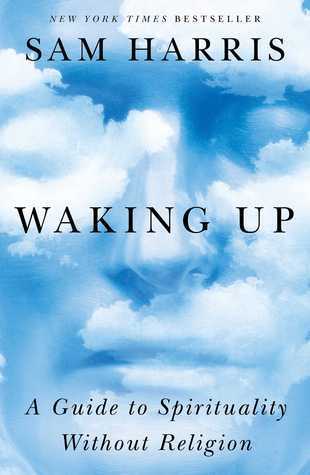
Waking Up Book Summary
A Guide to Spirituality Without Religion
Book by Sam Harris
Summary
In "Waking Up," Sam Harris explores the nature of consciousness and the self through the lens of neuroscience, philosophy, and contemplative practice, arguing that true spirituality lies not in religion or dogma but in a direct, experiential understanding of the mind that is available to anyone willing to look closely.
The Search For Happiness Is Universal
All human beings seek happiness and try to avoid suffering. We are constantly trying to optimize our experience of the world - seeking pleasant sights, sounds, tastes, sensations, and moods. Even when we achieve our goals, the resulting happiness is fleeting.
True well-being seems elusive as we lurch between wanting and not wanting. Some people begin to suspect that a deeper form of well-being exists beyond just gratifying one's desires. Certain individuals even go on retreats, spending months or years in silent meditation to find an inner peace not dependent on external circumstances.
Section: 1, Chapter: 1
A Human Mind Is A Wandering Mind
"We spend our lives lost in thought. The question is, what should we make of this fact? In the West, the answer has been "Not much." In the East, especially in contemplative traditions like those of Buddhism, being distracted by thought is understood to be the very wellspring of human suffering."
Section: 1, Chapter: 1
Eastern Spirituality Focuses On The Primacy Of Mind
The great insight of the Eastern contemplative traditions is that while the conventional self is an illusion, it is possible to realize our identity with a deeper level of consciousness. This realization is available in the present moment but is usually obscured by identification with thought. Eastern spirituality focuses on the primacy of mind and changing one's perception as the key to lasting well-being, whereas the West focuses more on changing external circumstances.
Section: 1, Chapter: 1
The Buddha Taught Specific Practices For Insight
The Buddha didn't teach Buddhism as a faith-based religion, but rather as empirical instructions: If you do X, you will experience Y. Buddhism contains practices anyone can do, without accepting any unjustified beliefs, to experience insights into the nature of one's own mind. The purpose is to cut through the illusion of the self.
Section: 1, Chapter: 1
Vipassana Meditation Cultivates Mindfulness
One of the most well-known Buddhist meditation practices is vipassana or "insight" meditation. It can be taught in an entirely secular way. The purpose is to cultivate a quality of mind called mindfulness, which is a state of clear, non-judgmental, and undistracted attention to the contents of consciousness, whether pleasant or unpleasant.
Vipassana is the practice of noticing the components of one's experience with equanimity, without grasping at the pleasant or pushing away the unpleasant. This eventually leads to the insight that there is no self that is the enduring experiencer of one's experience.
Section: 1, Chapter: 1
The Goal Of Meditation Is To Recognize The Intrinsic Selflessness Of Consciousness
The purpose of meditation is not to achieve a magical state of sustained bliss, but rather to recognize that consciousness itself is free of the feeling of self in every moment, whether one is concentrated or distracted. Glimpsing the intrinsic selflessness of awareness, even for a moment, can radically transform one's life. While this insight won't permanently remove all psychological suffering, it allows one to be free in the present moment, in the midst of both fortune and misfortune.
Section: 1, Chapter: 2
Consciousness Is Subjective Experience
At the heart of the mind-body problem lies the mystery of consciousness itself. Philosopher Thomas Nagel defined consciousness as essentially subjective experience - there is "something that it is like" to be a conscious creature.
Consciousness cannot be an illusion, because the very fact that things seem a certain way is what consciousness is in the first place. Even a brain in a vat having delusions is conscious simply by virtue of having experience at all. Consciousness, in this sense, is the one thing in this universe that cannot be an illusion.
Section: 1, Chapter: 2
No One Knows How Consciousness Emerges From The Brain
Despite all that neuroscience has learned about the brain, no one really knows how networks of neurons produce the inner światło of consciousness. It seems impossible to explain subjective experience in terms of physical processes.
There appears to be an unbridgeable "explanatory gap" between objective descriptions of the brain and first-person experience. Some philosophers argue this gap can never be closed by science. Others believe consciousness may remain a mystery forever.
Section: 1, Chapter: 2
Split-Brain Patients Reveal The Divisibility Of Consciousness
Research on split-brain patients, whose cerebral hemispheres have been surgically disconnected, reveals some startling things about consciousness:
- The two hemispheres display a remarkable degree of functional specialization and independence when separated
- The hemispheres can have separate senses of self, different desires, and even fight against each other for control
- Consciousness itself is divisible by splitting the brain
Subjectively, there is only consciousness and its contents, but the unity of the mind depends on the normal functioning of the corpus callosum connecting the two hemispheres.
Section: 1, Chapter: 2
Related Content
Why Buddhism Is True Book Summary
Robert Wright
Robert Wright explores how Buddhist teachings and meditation practices, particularly from the Vipassana tradition, align with findings from modern psychology and evolutionary theory to diagnose the human condition and provide a path to greater clarity, happiness, and moral progress.
Robert Wright explores how Buddhist teachings and meditation practices, particularly from the Vipassana tradition, align with findings from modern psychology and evolutionary theory to diagnose the human condition and provide a path to greater clarity, happiness, and moral progress.
Mindfulness
Religion
Psychology
Science
Philosophy
Happiness