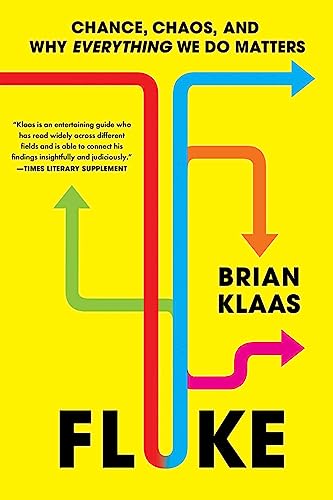
Fluke Book Summary
Chance, Chaos, and Why Everything We Do Matters
Book by Brian Klaas
Summary
In "Fluke," Brian Klaas argues that chance, chaos, and the interconnectedness of all things play a far greater role in shaping our lives and the world than we often acknowledge, and that embracing this insight can lead to a more meaningful and empowered existence.
The Pivotal Vacation That Shaped History
In 1926, Mr. and Mrs. H. L. Stimson vacationed in Kyoto, Japan. Nineteen years later, Stimson, as U.S. Secretary of War, used his fond memories of Kyoto to ensure it was removed from the list of potential atomic bomb targets.
Instead, Hiroshima and Nagasaki were bombed, with the latter only being targeted due to unexpected cloud cover over the original target of Kokura. The Stimsons' seemingly innocuous vacation ended up sparing one hundred thousand lives in Kyoto while sealing the fate of a similar number elsewhere, demonstrating the immense impact small, chance events can have.
Section: 1, Chapter: 1
Laplace's Demon And The Limits Of Prediction
Laplace proposed a thought experiment involving an omniscient being (Laplace's demon) that could know the precise details of every atom in the universe. With such perfect information, Laplace argued, this being could predict the future with absolute certainty.
However, chaos theory, as discovered by Edward Norton Lorenz, shows that even in deterministic systems, microscopic differences in initial conditions can lead to vastly different outcomes over time. This means that even if Laplace's demon existed, the tiniest measurement error would cause its predictions to become wildly inaccurate. Perfect prediction is therefore impossible, highlighting the fundamental uncertainty and unpredictability of our world.
Section: 1, Chapter: 1
The Delusion Of Individualism In An Intertwined World
We tend to view our lives through an individualist prism, imagining that we are in control of our destinies and that our major decisions define our path. However, the reality is that we live in a deeply intertwined world where the decisions and actions of others, even those we will never meet, can profoundly shape our lives in ways we often fail to perceive.
The delusion of individualism blinds us to the complex web of causality that connects us all across time and space. Recognizing the relational, intertwined nature of existence is crucial for understanding how change truly happens in our lives and societies.
Section: 1, Chapter: 2
Ivan's Lifesaving Soccer Ball
In the summer of 2022, a tourist named Ivan was swept out to sea off the coast of Greece. Just before slipping under the waves, he spotted a soccer ball floating in the distance and swam to it, clinging to it until he was rescued 18 hours later. It turned out the ball had drifted 80 miles after two boys accidentally kicked it into the sea 10 days earlier. Without their inadvertent action, Ivan would have perished. This story powerfully illustrates how even the seemingly insignificant choices of people we will never meet can become inextricably linked with our own fates in an intertwined world.
Section: 1, Chapter: 2
The Illusion of Individualism
"The real story of our lives is often written in the margins. Small details matter, and even the apparently insignificant choices of people we will never meet can seal our own fates—though most of us will never see that quite so clearly as Ivan did."
Section: 1, Chapter: 2
The Greatest Fluke Of All Time
Around 2 billion years ago, a single bacterium bumped into a prokaryotic cell and ended up inside it. That bacterium eventually evolved into a mitochondrion, the powerhouse of our cells. This chance event, which occurred just once and never again, enabled the rise of all complex life on Earth, from plants to animals to humans.
Our very existence can be traced back to this microscopic accident, underscoring the immense role of contingency and chance in shaping the history of life.
Section: 1, Chapter: 3
Survival Of The Luckiest
The popular conception of evolution emphasizes "survival of the fittest," suggesting a relentless optimization process. However, Stephen Jay Gould and other scientists have shown that chance and contingency play a much larger role. Humanity's evolutionary history is marked by flukes:
- The rise of mammals was enabled by the chance asteroid impact that wiped out the dinosaurs.
- Genetic bottlenecks and founder effects meant that the composition of small, arbitrarily selected populations ended up shaping the future of our species.
- Recent research suggests our intellect may have developed to cope with chaotic climate fluctuations in the Rift Valley.
Recognizing the role of randomness and chance in our origins is crucial for understanding the contingent nature of our existence.
Section: 1, Chapter: 3
Bacteria Evolve In Real-Time, Demonstrating Contingency
Richard Lenski's Long-Term Evolution Experiment (LTEE) has tracked the evolution of E. coli bacteria through over 70,000 generations. Twelve initially identical populations are grown in separate flasks, allowing researchers to observe evolutionary changes and test for the role of contingency.
A key finding emerged when one population suddenly gained the ability to metabolize citrate due to a series of specific, unlikely mutations. Despite "replaying the tape" many times, this ability never re-evolved, powerfully demonstrating the role of contingency in shaping evolutionary outcomes. The LTEE shows that while evolution may seem convergent and predictable over short timescales, history can pivot on chance events.
Section: 1, Chapter: 3
The Fitness Beats Truth Theorem
Our perceptions of reality have been shaped by evolution to be useful for our survival, not to accurately reflect the truth. The Fitness Beats Truth theorem, developed by evolutionary biologists and cognitive scientists, shows that natural selection will always favor perceptual strategies that enhance reproductive fitness over those that provide a more truthful representation of the world.
Just as a computer's desktop interface is a useful but inaccurate depiction of the machine's actual workings, our brains present us with a simplified, sometimes illusory model of reality that nonetheless enables us to effectively navigate our environment. Recognizing that our perceptions are inherently biased and limited is crucial for understanding how we make sense of the world.
Section: 1, Chapter: 4
Sea Turtles And Jewel Beetles - When Shortcuts Fail
Evolutionary "shortcuts" in cognition can lead organisms astray when their environment changes in unexpected ways:
- Sea turtle hatchlings instinctively move towards the brightest part of the horizon, which under natural conditions leads them to the ocean. However, with the advent of beachfront development, artificial lighting has caused many hatchlings to move away from the water, perishing in droves.
- Male jewel beetles are wired to attempt to mate with females that have a distinct size, color, and dimpled texture. When a beer company unknowingly mimicked these traits on their bottles, male beetles began fruitlessly trying to copulate with discarded bottles, neglecting actual females.
Section: 1, Chapter: 4
The Paradox Of The Locust Swarm
Locust swarms demonstrate a perplexing dynamic that mirrors aspects of modern human society. At low densities, locusts behave as individuals, their actions uncoupled from those around them. At medium densities, they form semi-coordinated clusters, but these clusters are prone to sudden directional changes and function independently of one another.
However, at high densities, locusts undergo a behavioral phase shift, coalescing into a unified swarm that moves together. Surprisingly, despite the swarm's coordinated movement, the overall direction of the swarm is highly unpredictable and can shift abruptly based on slight perturbations. This "paradox of the swarm" - the coexistence of individual order and collective unpredictability - characterizes many modern human systems and helps explain our vulnerability to sudden crises.
Section: 1, Chapter: 5
Related Content
The Tipping Point Book Summary
Malcolm Gladwell
The Tipping Point reveals the hidden forces that cause social epidemics - from fashion trends to crime waves - to spread like viruses, and shows how to start and control positive epidemics of our own.
The Tipping Point reveals the hidden forces that cause social epidemics - from fashion trends to crime waves - to spread like viruses, and shows how to start and control positive epidemics of our own.
Psychology
Personal Development
Sociology
Economics
The Black Swan Book Summary
Nassim Nicholas Taleb
The Black Swan is about the extreme impact of rare and unpredictable outlier events, and how we tend to find simplistic explanations for them after the fact, making us blind to randomness and vulnerable to future Black Swans.
The Black Swan is about the extreme impact of rare and unpredictable outlier events, and how we tend to find simplistic explanations for them after the fact, making us blind to randomness and vulnerable to future Black Swans.
The Drunkard's Walk Book Summary
Leonard Mlodinow
"The Drunkard's Walk" reveals how randomness and chance play a far greater role in our lives than we typically realize, challenging our perceptions of success, decision-making, and the patterns we think we see in the world around us.
"The Drunkard's Walk" reveals how randomness and chance play a far greater role in our lives than we typically realize, challenging our perceptions of success, decision-making, and the patterns we think we see in the world around us.
Psychology
Economics
Statistics
Heuristics