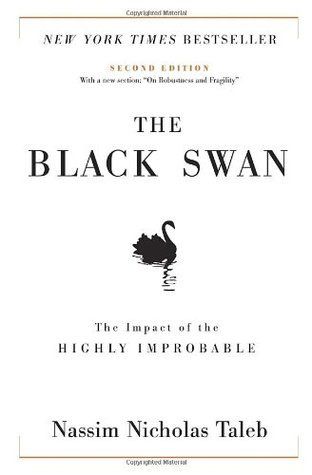
The Black Swan Book Summary
The Impact of the Highly Improbable
Book by Nassim Nicholas Taleb
Summary
The Black Swan is about the extreme impact of rare and unpredictable outlier events, and how we tend to find simplistic explanations for them after the fact, making us blind to randomness and vulnerable to future Black Swans.
1. Umberto Eco's Antilibrary
The Black Swan
A Black Swan is an outlier event that carries an extreme impact and is explainable only after the fact. Black Swans are rare, have extreme impact, and are retrospectively predictable.
Examples: the rise of the Internet, World War I, 9/11 attacks
Our minds are not equipped to truly estimate the probabilities of rare events due to biases like narrative fallacy and hindsight bias
Section: 1, Chapter: 1
"It was so unexpected"
"It was so unexpected," we will say. We will spend considerable energy convincing ourselves that it was so unexpected, not foreseeable, and unpredictable. Unpredicted? Yes. Unpredictable? Not necessarily... Our track record in predicting those events is dismal; yet by some mechanism called the hindsight bias we think that we understand them."
Section: 1, Chapter: 1
The Triplet of Opacity
The triplet of opacity describes the three facets that prevent us from grasping the true nature of the world:
1. The illusion of understanding - thinking the world is more understandable than it actually is
2. The retrospective distortion - assessing matters only after the fact
3. The overvaluation of factual information and the handicap of authoritative experts
Section: 1, Chapter: 1
Yevgenia's Black Swan
Yevgenia, an unknown author, gets rejected by publishers initially. She puts her manuscript online where it garners a small following. A small publisher picks it up, and it becomes a runaway bestseller. Her "overnight success" was highly improbable and unpredictable. In hindsight, critics proclaim the inevitability of her new writing style catching on.
Section: 1, Chapter: 2
Beware the Scalable Profession
Avoid professions where success is driven by a single lucky break, as opposed to the slow accumulation of small gains. In scalable professions like acting, singing, writing, a small number of winners takes the lion's share of rewards. Non-scalable professions like dentistry, massage therapy have a more equitable distribution of income. Resist the lure and ego gratification of scalable professions unless you have an extraordinary risk appetite
Section: 1, Chapter: 3
Extremistan vs Mediocristan
The world can be divided into two domains:
Extremistan - Characterized by extreme events, winner-take-all dynamics, and unpredictability. E.g. book sales, sizes of cities, stock markets, deaths in war, terrorist attacks.
Mediocristan - Characterized by predictable averages, physical constraints, and the irrelevance of outliers. E.g. height, weight, calorie consumption.
Section: 1, Chapter: 3
Avoid Tunneling to Predict the Future
When thinking about the future, don't assume that it will be an extension of the present. Unexpected "tunnels" (low-probability, high-impact events) can completely disrupt any forecast.
Example: Trying to predict an entire war from its first few days is likely to fail due to tunneling. The longer the projected timeline, the higher the chances of a tunnel event occurring
Section: 1, Chapter: 4
Disconfirming Evidence > Confirming Evidence
Our natural tendency is to look for instances that confirm our story or beliefs. Disconfirming evidence is often far more relevant for getting closer to the truth.
Example: No amount of white swans can prove the statement "all swans are white", but a single black swan can refute it. Actively seek disconfirming evidence to escape the confirmation bias.
Section: 1, Chapter: 5
The Narrative Fallacy
The narrative fallacy describes our innate tendency to weave past events into coherent, cause-and-effect stories that explain what happened. We have an insatiable appetite for easy-to-digest, packaged, causal explanations, even when reality is far more complex and random. "Splitting brains" experiments show that the left hemisphere of the brain specializes in this kind of pattern-seeking, meaning-making storytelling. The problem is that these stories often give us a distorted, overly deterministic view of the world, blinding us to randomness and the possibility of Black Swans.
Section: 1, Chapter: 6
2. We Just Can't Predict
3. Those Gray Swans of Extremistan
Related Content
Talking to Strangers Book Summary
Malcolm Gladwell
In "Talking to Strangers," Malcolm Gladwell argues that our natural instincts are ill-suited for a world of frequent stranger interactions. Through case studies and research, he reveals how misguided assumptions lead to disastrous misunderstandings and offers insights on more thoughtful engagement.
In "Talking to Strangers," Malcolm Gladwell argues that our natural instincts are ill-suited for a world of frequent stranger interactions. Through case studies and research, he reveals how misguided assumptions lead to disastrous misunderstandings and offers insights on more thoughtful engagement.
Psychology
Communication
Sociology
Range Book Summary
David Epstein
"Range" challenges the conventional wisdom that early specialization is the key to success. Instead, Epstein argues that in our increasingly complex and unpredictable world, it is those with broad experience and diverse skills who are best equipped to thrive.
"Range" challenges the conventional wisdom that early specialization is the key to success. Instead, Epstein argues that in our increasingly complex and unpredictable world, it is those with broad experience and diverse skills who are best equipped to thrive.
Personal Development
Learning
Psychology
Think Again Book Summary
Adam Grant
Think Again is a compelling exploration of the power of knowing what you don't know, and how embracing the joy of being wrong and actively questioning your opinions can help you make better decisions
Think Again is a compelling exploration of the power of knowing what you don't know, and how embracing the joy of being wrong and actively questioning your opinions can help you make better decisions
Psychology
Business
Personal Development